Of all the fears patients bring to a fistula consultation, one comes up again and again, often asked quietly at the very end: “Doctor, will I be able to control my motions after the operation?”
It is a fair question. The anal fistula tract runs through or near the muscles that keep you continent, and the most reliable way to cure a fistula has traditionally been to lay it open — which means cutting some of that muscle. This article explains, honestly, how real the risk is, which techniques protect your control, how we decide, and what can be done if leakage has already started after an earlier operation.
If you are looking for treatment rather than information, see our complex fistula treatment and fistula treatment pages.
Why can fistula surgery affect bowel control?
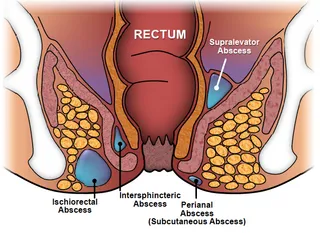
Bowel control depends on two ring-shaped muscles around the anal canal — the internal and external anal sphincters. A fistula tract often passes through them. Operations that cut across the tract (fistulotomy, cutting seton) also cut part of this muscle. The more muscle divided, the higher the chance of leakage of gas, mucus or stool afterwards.
Think of the sphincter as a tap washer. You can trim a thin edge and it still seals. Cut too deeply and it drips.
- Internal sphincter — an involuntary muscle that keeps the canal closed at rest. Damage here often causes passive soiling or staining you don’t feel.
- External sphincter — the voluntary “squeeze” muscle. Damage here causes urge leakage — you feel the need but cannot hold on.
- Scarring and wound shape — even without much muscle loss, a groove-shaped scar (the so-called keyhole deformity) can let mucus seep out.
Continence is also influenced by stool consistency, rectal sensation and the pelvic floor, which is why two patients with the same operation can have different results.
How common is incontinence after fistula surgery, really?
Serious loss of stool control is uncommon when surgery is matched to the fistula. Minor problems — difficulty holding gas, occasional staining — are more common, especially after fistulotomy for deeper tracts, and published rates vary widely between studies. Many minor symptoms improve within three to six months as healing completes.
Numbers you read online range from almost zero to surprisingly high. The difference comes down to:
- What was counted — gas leakage and staining versus true stool incontinence.
- Which fistulas were operated — a low, simple tract behaves very differently from a high trans-sphincteric one.
- Who was operated — women, older patients and people with previous anal surgery are at higher baseline risk.
The honest summary: for a low, simple fistula, a well-performed fistulotomy rarely causes a meaningful problem. For high or complex fistulas, cutting the muscle is where most of the risk lives — which is exactly why sphincter-saving techniques exist.
Which fistula operations protect the sphincter best?
Sphincter-preserving procedures — loose draining seton, LIFT, VAAFT, FiLaC (laser) and endorectal advancement flap — do not divide the anal sphincter, so their risk to continence is low. Their trade-off is a higher chance of recurrence than fistulotomy. The right choice depends on how much muscle the tract crosses.
| Procedure | Cuts sphincter? | Risk to continence | Typical recurrence risk | Best suited for |
|---|---|---|---|---|
| Fistulotomy (lay-open) | Yes — the muscle below the tract | Low for low tracts; rises with deeper tracts | Lowest | Low, simple fistulas with healthy muscle |
| Cutting seton | Yes — slowly, over weeks | Moderate; now used selectively | Low | Rarely preferred today |
| Loose (draining) seton | No | Very low | Controls sepsis, not usually a cure alone | First stage for complex/infected tracts |
| LIFT (ligation of intersphincteric tract) | No | Low | Moderate | Trans-sphincteric fistulas with a mature tract |
| VAAFT (video-assisted) | No | Low | Moderate | Complex, branching or recurrent tracts |
| FiLaC (laser closure) | No | Very low | Moderate; some need a repeat | Selected complex or high tracts |
| Advancement flap | No (mucosal flap) | Low–moderate | Moderate | High fistulas, anterior fistulas in women |
For technique details, see our pages on LIFT, VAAFT, FiLaC laser, seton and fistulotomy, or read LIFT vs VAAFT vs FiLaC compared.
An honest note on laser: FiLaC is excellent at protecting the sphincter, but it is not a magic bullet. Its cure rate is less predictable than fistulotomy, and it does not suit every tract. We would rather tell you that before surgery than after.
Who is at higher risk of losing control after fistula surgery?
Risk is higher in women with front (anterior) fistulas, those with childbirth-related sphincter injury, older patients, people with diabetes, IBS or loose stools, anyone who has had several earlier anal operations, and patients with high or complex tracts. These patients especially need MRI mapping and a sphincter-first plan.
| Risk factor | Why it matters |
|---|---|
| Female, anterior fistula | The front sphincter is naturally thinner in women |
| Previous vaginal delivery, especially difficult/instrumental | May have a hidden sphincter tear already |
| Age above ~60 | Muscle strength and rectal sensation decline |
| Previous fistula, piles or fissure surgery | Less “muscle reserve” left to spend |
| Loose stools, IBS, Crohn’s disease | Liquid stool is much harder to hold |
| Diabetes | Can affect nerves and healing |
| High, horseshoe or branching tract | More muscle involved |
| Existing mild leakage before surgery | Any further loss is felt sooner |
If two or three of these apply to you, a quick fistulotomy “to finish it in one go” is often the wrong answer — even if it has the best cure rate on paper. This is also why we look for underlying causes such as TB or Crohn’s disease when a fistula behaves unusually.
How do surgeons decide between cure and continence?
The decision rests on three things: how much sphincter the tract crosses (seen best on MRI), how good your control is today, and how many operations you have already had. When muscle involvement is small, fistulotomy gives the best cure. When it is significant, a staged, sphincter-saving approach is safer.
At Sharvari Hospital, the planning conversation usually follows this sequence:
- Map the tract. MRI fistula mapping shows whether the tract is inter-, trans-, supra- or extra-sphincteric, how high it runs, and whether there are hidden branches or abscesses. (Here is how to read your MRI fistulogram report.)
- Measure your baseline. We ask specific questions about gas, liquid and solid stool control, pads and urgency — often recorded as a Wexner (Cleveland Clinic) continence score. If you already have symptoms, we may advise anorectal manometry or endoanal ultrasound before deciding.
- Control infection first. A loose seton drains pus and lets inflammation settle — it often makes the definitive operation smaller and safer.
- Choose the least muscle-costly option likely to work. Sometimes that means accepting a slightly higher chance of needing a second procedure in exchange for protecting control for life.
- Agree on the trade-off with you. A 30-year-old man with a low tract and a 55-year-old woman with an anterior tract after two deliveries should not get the same operation.
A second operation for recurrence is inconvenient. Permanent incontinence changes your life. Our bias, when in doubt, is always toward preserving the muscle.
Is leakage after fistula surgery normal in the first few weeks?
Some discharge, mucus or staining from the healing wound is common for several weeks and is not true incontinence. Difficulty holding gas can also be temporary while swelling settles. If you cannot hold formed stool, or leakage worsens rather than improves after six to eight weeks, get reviewed.
A rough guide to what we usually see during recovery:
| Time after surgery | What is common | What needs a call |
|---|---|---|
| Week 1–2 | Wound discharge, staining, mild difficulty holding gas | Fever, severe pain, inability to pass urine |
| Week 3–6 | Discharge reducing; gas control improving | Leakage of formed stool |
| Month 2–3 | Most wounds healed; occasional mucus | Symptoms getting worse, not better |
| Month 3–6 | Continence usually settled or still improving | Persistent stool leakage, need for pads |
Keeping stools soft but formed (fibre, fluids, avoiding very spicy or oily food in the early weeks) and starting pelvic floor exercises once the wound is comfortable both help. We explain these at your follow-up visits. For many of our patients from Wakad, Hinjawadi and Tathawade, the clinic is close enough to drop in for a quick wound check before or after work — frequent early checks catch problems while they are still small.
What can be done if I already have incontinence after fistula surgery?
First, get properly assessed rather than living with it. Most patients improve with simple steps — stool-bulking diet, medicines like loperamide where suitable, pelvic floor exercises and biofeedback. Tests such as manometry and endoanal ultrasound show whether the muscle is weak or divided. A sphincter repair is considered only for selected patients.
Many people come to us a year or two after an operation elsewhere, embarrassed and assuming nothing can be done. That is rarely true. The usual step-up approach:
- Clinical assessment — examination, continence score, review of old operation notes and MRI.
- Tests — anorectal manometry (measures squeeze and resting pressure) and endoanal ultrasound (shows whether and where the muscle ring is broken).
- Conservative care, which helps most patients:
- Soluble fibre (e.g. psyllium) to make stool bulkier and easier to hold
- Medicines such as loperamide, where appropriate and supervised
- Structured pelvic floor (Kegel) exercises
- Biofeedback therapy with a trained physiotherapist
- Treating any loose-stool cause — IBS, lactose intolerance, infection
- Procedures for persistent problems:
- Correcting a keyhole deformity or scar if soiling is the main issue
- Overlapping sphincteroplasty (repair of the divided muscle) when ultrasound shows a clear defect
- Newer options such as sacral nerve stimulation are available at only a few specialised centres in India; we will tell you honestly if you need to be referred
We also check for a persistent or recurrent fistula at the same time — occasionally the “leakage” is actually pus or mucus from a tract that never fully healed. If that sounds like your situation, read recurrent or complex fistula — when to get a second opinion.
What questions should I ask my surgeon about continence before fistula surgery?
Ask what type of fistula you have, how much sphincter muscle it crosses, whether an MRI has been done, which operation is planned and why, what the risk to gas and stool control is for your specific case, and what the backup plan is if the first procedure does not work.
A short checklist to take into the consultation:
- Is my fistula low or high? Simple or complex?
- Has MRI mapping been done — and can you show me the tract?
- Will any sphincter muscle be cut? How much?
- Are sphincter-saving options (LIFT, VAAFT, FiLaC, flap, seton) suitable for me?
- If you choose fistulotomy, why is that safe in my case?
- What happens if the fistula comes back?
- How will you check my control before and after surgery?
A good surgeon welcomes these questions. For more, see questions to ask before fistula surgery.
When should I see a doctor urgently?
See a doctor the same day if you have fever with a painful swelling near the anus, pus with rising pain, inability to pass urine, or bleeding that soaks pads. Book an early review if you cannot hold formed stool, need pads daily, or leakage is worsening two months or more after surgery.
Red flags:
- Fever with increasing pain or swelling around the anus (possible abscess)
- Sudden loss of control over stool, especially with back pain or leg numbness — this needs emergency assessment for a nerve problem
- Heavy bleeding from the wound
- Leakage that is getting worse, not better, after the first six to eight weeks
- New leakage years after surgery with weight loss or change in bowel habit — needs further evaluation
Why Choose Sharvari Hospital for Fistula Surgery?
- Sphincter-first planning. Dr. Kundan Kharde (MBBS, MS – General Surgery, FMAS, 19+ years of surgical experience) chooses the operation for your anatomy and your control — not the other way round.
- MRI fistula mapping for every complex, high or recurrent fistula before surgery.
- Every technique available, used honestly — fistulotomy, seton, LIFT, VAAFT, FiLaC and flap repair. We tell you the trade-offs, including when laser is not the best choice.
- Help for existing leakage — assessment, conservative care and repair options for patients who already have symptoms after surgery elsewhere.
- Follow-up close to home — about 5 minutes from Wakad and 10 minutes from Hinjawadi Phase 1, with easy access from Baner, Aundh and the PCMC belt.
- Transparent estimates and cashless insurance support.
Worried about bowel control — before or after fistula surgery? Bring your reports and let us plan the safest route.
- 📞 Phone / WhatsApp: +91 951 951 1928
- 📧 Email: [email protected]
- 📍 Sharvari Hospital, Pimple Nilakh, Pune — 411027
- 🔗 Complex fistula treatment · Fistula treatment at Sharvari · Fistula treatment in Wakad · Fistula treatment in Hinjewadi
Related Reading
- LIFT vs VAAFT vs FiLaC: Minimally Invasive Fistula Surgery Compared
- Fistula Surgery Success Rate: What the Data Says
- Types of Anal Fistula: Simple vs Complex
- Recurrent or Complex Fistula? When to Get a Second Opinion
- Fistula With Crohn’s or Tuberculosis: Why Some Fistulas Won’t Heal
Written and reviewed by Dr. Kundan Kharde, MBBS, MS – General Surgery, FMAS, Sharvari Hospital, Pune. Last reviewed: September 2026.
This article is for patient education only and does not replace an in-person consultation. Continence risk differs for every patient; your surgeon should explain the risk for your specific fistula before any operation.