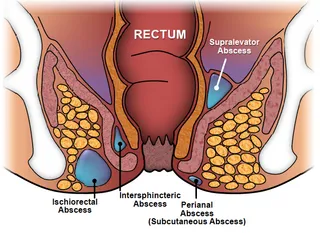
When a doctor says your fistula is “high,” “complex,” or “intersphincteric,” it can sound intimidating. This guide translates those terms into plain language so you understand why classification matters for safety and cure. It does not replace examination or imaging.
For treatment options once you know your type, use the fistula treatment hub. For how doctors map tracts, see fistula diagnosis tests. Book online at Sharvari Hospital, Pune. Related: Proctology.
Medically reviewed by Dr. Kundan Kharde, MS, FMAS — Senior Proctologist at Sharvari Hospital, Pune. View profile.
Why fistula “type” matters
Fistula surgery is not one-size-fits-all because the tract’s relationship to the anal sphincter muscles (the rings that help control stool) changes risk. Techniques that are excellent for a low, simple fistula may be unsafe for a high tract without a different plan.
Patient education chapters such as StatPearls — anal fistula summarise classification systems used in clinical practice. Independent reading can help you recognise terms on a report, even though only your surgeon applies them to your body.
Muscle involvement and continence
The more muscle the tract crosses or runs near, the more your team must protect continence while still trying to eliminate infection. That tension drives the choice between open techniques, sphincter-sparing options, staged setons, or combined approaches.
Why the same word “fistula” hides different problems
Two people can both say “I have a fistula,” yet one has a short low tract and another has a branching high tract with prior failed surgery. Classification is how specialists communicate that difference quickly.
The main anatomic patterns (Park types) explained simply
Park’s classification groups fistulas by where the tract runs relative to the sphincters. Teaching summaries (including open-access medical references) often quote approximate proportions in mixed patient groups:
- Intersphincteric — commonly described as the most frequent group in many teaching series (often roughly around four in ten cases in textbook diagrams). The tract stays largely between internal and external sphincter components.
- Transsphincteric — often described as the next largest group (often roughly around three in ten). The tract crosses sphincter muscle to a variable height.
- Suprasphincteric — less common (often taught as roughly one in five in mixed populations). The pathway runs in a more complex plane above portions of muscle.
- Extrasphincteric — rare (often taught as roughly one in twenty or fewer). May relate to unusual anatomy, prior trauma, or conditions like Crohn’s disease.
Important: these percentages are population teaching aids, not a prediction about your exam. Your surgeon cares about your mapping, not an average diagram.
Intersphincteric
Often discussed as relatively more straightforward when low and simple—but “intersphincteric” is not automatically “easy.” Length, secondary openings, and infection still matter.
Transsphincteric
Because muscle is crossed, fistulotomy (cutting open along the tract) may carry higher continence risk than in a very low simple case. This is where LIFT, laser, flap, or staged strategies are discussed more often.
Suprasphincteric and extrasphincteric (rarer)
These patterns more often trigger imaging, staged drainage, and multidisciplinary input—especially if Crohn’s is present.
Simple vs complex: what patients should know
“Simple” and “complex” are clinical judgements, not moral labels.
Simple (general meaning)
Often implies a single tract, low position, minimal muscle involvement, and no active abscess—favouring a more direct repair when your surgeon agrees.
Complex (general meaning)
Often implies high tract, multiple branches, recurrence after prior surgery, active inflammation, radiation history, or IBD. Expect more imaging and possibly staged operations.
For how specialists manage difficult cases conceptually, see complex fistula treatment—this page stays at the classification level. For how complex fistulas are treated at Sharvari Hospital — including staged, sphincter-preserving plans — see the dedicated treatment page.
How specialists map your fistula
Examination under anaesthesia (conceptual)
An EUA lets the surgeon examine safely, probe gently, and sometimes treat in the same setting if appropriate. Patients often fear “another surgery,” but EUA is frequently the clearest way to see anatomy.
MRI or ultrasound before surgery
Almost every fistula patient at Sharvari Hospital is imaged before surgery — an MRI fistulogram or a trans-rectal ultrasound. MRI shows extensions and sphincter involvement; trans-rectal (endoanal) ultrasound is the alternative for some tracts. Details live in the diagnosis article to avoid duplication. How the clock-face map and sphincter involvement are read is explained in our guide to MRI fistula mapping, which includes a real mapped case.
Recurrent surgery and changing “type”
If you have already had a procedure, scarring can make a previously “simple” story harder to interpret. New openings may appear away from the old site. That does not mean you are out of options—it means the next plan should be deliberate, often with MRI, and sometimes with a seton phase to calm inflammation before definitive repair.
Words on imaging reports (what patients peek at)
Reports may mention horsehoe, secondary extensions, collections, or internal opening at X o’clock. The clock-face description refers to position around the anus as viewed in a standard surgical orientation. Do not panic over jargon—ask your clinician to point to a diagram so you can picture it.
How type changes treatment options (overview only)
Your surgeon matches technique to anatomy. Low simple tracts may be suitable for fistulotomy when muscle division is acceptably small. Transsphincteric tracts may lead to LIFT or energy-based options in selected patients. Complex disease may require seton first.
Do not self-select a technique from blogs. The main Pune fistula guide lists options in context; your candidacy is decided in person.
Two anonymised patterns (composites, not promises)
Pattern A: A young professional notices a small painful lump that drains after a few days, then a tiny pit remains with occasional dampness. Exam shows a low tract. Imaging may not be needed. Discussion may include a direct technique if muscle risk is low. Recovery may be quicker—see desk-job recovery notes only after your plan is fixed.
Pattern B: A patient with two prior surgeries has multiple external openings and nightly pain. MRI shows branching tracts. A seton may be placed first; definitive repair waits for calmer tissue. Timeline stretches in weeks to months. Success is still possible, but expectations must match staging.
Real patients are not A/B labels—these vignettes simply show why type and history change the conversation. Your job is not to decide which pattern you are; your job is to show up with a timeline so your surgeon can classify accurately.
Mini glossary (terms you will hear)
- Internal opening: the bowel-side hole where contamination enters the tract.
- External opening: the skin-side hole where drainage exits.
- Goodsall’s rule (historical guidance): an exam clue linking external opening position to likely internal opening location—not a perfect rule in every patient, but a teaching tool.
- Seton: a drain or thread placed through the tract to control infection during staging.
- Sphincter-sparing: techniques designed to limit muscle division.
Ask your surgeon to sketch your tract if that helps you remember the plan.
Questions to ask after your diagnosis
- Which Park category do my findings best fit—and what uncertainty remains?
- Will I need MRI before a definitive repair?
- What is the continence risk of the recommended approach—and what is plan B?
- Is staging expected (seton first), or single stage?
Crohn’s disease: when “type” is only part of the story
In Crohn’s, perianal fistulas may need medical therapy alongside surgery. Classification still matters, but inflammation control can change timing. If you have IBD, bring your gastroenterologist’s contact and a list of biologics or steroids—coordination reduces surprises. For how Crohn’s and tubercular fistulas are tested and treated, read fistula with Crohn’s or tuberculosis.
Why we avoid over-precision online
You may see blogs quoting exact cure percentages for each type. Outcomes depend on surgeon experience, case mix, follow-up length, and how success is defined. This article intentionally avoids a fake-precision table of percentages per Park type; if you want numbers, ask what published series your team trusts for your pattern.
Local care in Pune (Wakad / Hinjewadi corridor)
If you commute from the western IT corridor, plan visits without rushing post-op—our location in Pimple Nilakh is positioned for many patients from Wakad and Hinjewadi. Call +91 951 951 1928 or book online.
Common questions (FAQ)
What are the four types of fistula?
Doctors often describe intersphincteric, transsphincteric, suprasphincteric, and extrasphincteric patterns—names that describe where the tract runs relative to muscle.
What is a simple anal fistula?
Generally a straightforward tract with favourable anatomy for treatment—your surgeon defines this after mapping.
What is a complex fistula?
Often higher tracts, branches, scarring, recurrence, or active disease that needs staged or sphincter-sparing planning.
Which type is most common?
Teaching literature commonly describes intersphincteric patterns as the largest group in mixed series—your case may differ.
Can MRI show fistula type?
MRI helps show tract route and branches; it supports classification but clinical examination remains central.
Reference: StatPearls — anal fistula (NCBI Bookshelf).