★★★★★
"The treatment plan was clear, and recovery was much smoother than I expected."
Ameya
Google Review
Chronic anal fissure treatment at Sharvari Hospital, Pimple Nilakh — 5 minutes from Wakad Chowk — is led by Dr. Kundan Kharde (MS, FMAS), a surgeon with 19+ years' experience and 6,000+ surgeries. Options range from medicines to laser surgery and LIS (lateral internal sphincterotomy) as a day-care procedure: most patients go home the same day and are back to desk work in 2–3 days — results vary.
Fissure treatment at a glance
| Procedure | Laser sphincterolysis / LIS (day-care) |
|---|---|
| Anaesthesia | Short spinal or general anaesthesia |
| Duration | 15–20 minutes |
| Hospital stay | Day-care — same-day discharge for most |
| Back to desk work | 2–3 days; results vary |
| Full healing | Typically 2–4 weeks |
📍 Sharvari Hospital, Pimple Nilakh, near Wakad Chowk · 6,000+ Surgeries

Dr. Kundan Kharde · Fissure Specialist Pune View profile →
MS (Gen. Surgery) · FMAS · 19+ Years · 6,000+ Surgeries
High Success Rate · ISO 9001:2015 Certified Hospital
Chronic anal fissure pain responds best to early, structured care. At Sharvari Hospital in Pimple Nilakh, fissure treatment combines conservative plans, precise laser options, and sphincter-preserving surgery when needed — with same-day discharge for many patients. मराठी वाचकांसाठी — फिशर संपूर्ण मार्गदर्शक (मराठी).
Transparent pricing
Laser fissure surgery starts at ₹35,000*
Insurance accepted · Cashless with 50+ TPAs · No-Cost EMI available*
Book Consultation
Get a callback within 30 minutes
An anal fissure is a small tear in the thin, moist lining of the anal canal, usually caused by passing a hard stool. It causes sharp pain during and after bowel movements and often bright red bleeding. A fissure under six weeks old is called acute and frequently heals with soft stools and ointments. Beyond about six weeks it is considered chronic — the edges thicken, a sentinel skin tag may form, and the tight internal sphincter keeps re-tearing the wound, which is why chronic fissures usually need a procedure rather than more ointment courses.
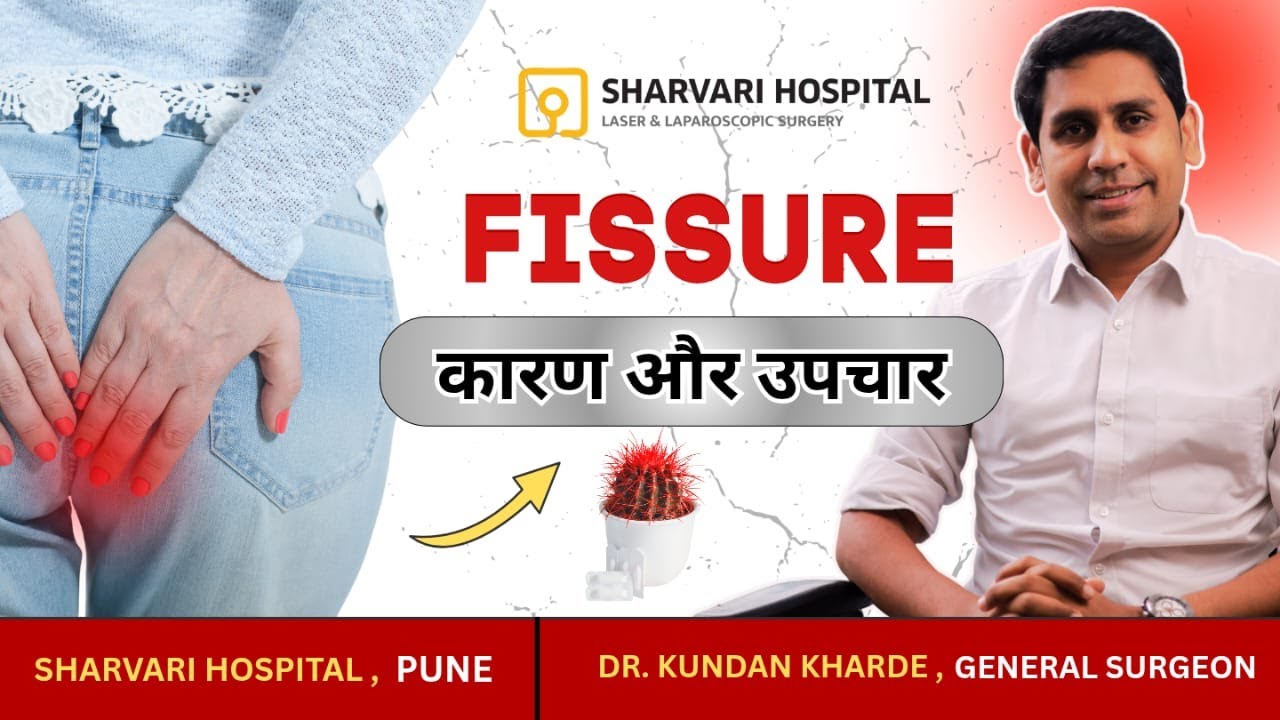
Dr. Kundan Kharde explains in Hindi what an anal fissure is, why it causes sharp pain and bleeding during bowel movements, the common causes, and how treatment progresses from diet and ointments to a short day-care procedure for chronic cases. Every patient's healing timeline differs — results vary.
Most fissures are caused by trauma to the anal canal: hard or large stools, chronic constipation and straining, repeated diarrhoea, or childbirth. Less commonly, inflammatory bowel disease or infection is responsible — one reason self-treatment beyond a few weeks is unwise.
Left untreated, a fissure feeds a chronic pain cycle: pain causes the sphincter to spasm, spasm reduces blood flow to the tear, poor blood flow prevents healing, and the next bowel movement re-opens the wound. Fear of pain leads to postponing stools, which makes them harder still. Over months the fissure edges scar, a sentinel pile (skin tag) forms, and in some patients the raw area becomes infected — which can progress to an abscess or an anal fistula, a more complex problem to treat. Early treatment is simpler, cheaper and far less painful.
These three are confused constantly, and they need different treatment. The quick rule: fissure = sharp pain + bright bleeding, piles = bleeding without pain, or a lump, fistula = discharge from an opening near the anus. Examination settles it in one visit.
| Feature | Fissure | Piles (haemorrhoids) | Fistula |
|---|---|---|---|
| Main symptom | Sharp, cutting pain during/after stool | Bleeding without pain, itching, or a lump | Recurring discharge of pus near the anus |
| Bleeding | Bright red, small amount on paper | Bright red, may drip into the pan | Usually pus or blood-stained discharge |
| Pain pattern | Severe with stool, lasts minutes to hours | Mild unless thrombosed or prolapsed | Dull throbbing; worsens if it blocks and swells |
| Visible sign | Small tear ± sentinel skin tag | Soft swelling at the anal verge | Small external opening with discharge |
| First-line treatment | Softeners, ointments, sitz baths | Diet, medicines; laser for higher grades | Almost always needs surgery (e.g. FiLaC) |
Read the full comparison in our guide: anal fistula vs anal fissure — key differences. Related services: piles treatment · fistula treatment.
Every fissure plan at Sharvari starts conservatively unless the fissure is clearly chronic: a fibre-rich diet with plenty of fluids, warm sitz baths for 10–15 minutes two to three times daily, prescribed stool softeners, and topical ointments that relax the sphincter and improve blood flow to the tear. For fissures that fail ointments but are not yet scarred, a Botox injection (chemical sphincterotomy) relaxes the spasm for two to three months, giving the tear a window to heal — without cutting any muscle. See the written criteria we use before recommending any operation: when surgery is not needed.
What to eat and avoid with a fissure:
| ✅ Eat freely | ❌ Limit or avoid |
|---|---|
| Vegetables, fruit (papaya, pear, guava), salads | Red and green chilli, very spicy food |
| Whole grains, oats, dalia, brown rice | Deep-fried snacks and bakery items |
| Dal, curd, buttermilk | Alcohol and excess tea/coffee |
| 2.5–3 litres of water daily | Low-fibre fast food and processed meat |
हिंदी में पूरा डाइट गाइड पढ़ें — फिशर में क्या खाना चाहिए, और मराठीत — फिशर संपूर्ण मार्गदर्शक.
While you arrange a consultation, these measures genuinely reduce pain — none of them replaces treatment for a chronic fissure:
All three relieve the sphincter spasm that stops a fissure from healing — they differ in how long the effect lasts and how definitive the result is. Your examination (fissure age, scarring, sphincter tone, continence history) decides which is right for you.
| Feature | Laser sphincterolysis | LIS (surgical) | Botox injection |
|---|---|---|---|
| Best suited for | Chronic fissure ± sentinel tag | Chronic/recurrent fissure with persistent spasm | Non-healing acute fissure; surgery-averse patients |
| Anaesthesia | Short spinal or general | Short spinal or general | Local / short sedation |
| Duration | 15–20 minutes | 15–20 minutes | 5–10 minutes |
| Healing rate | High in selected patients | Over 90% (ASCRS-reported series) | Around 60–80%; effect wears off in 2–3 months |
| Recurrence | Low with diet compliance | Under 10% | Higher — spasm can return as the toxin wears off |
| Incontinence risk | Low — sphincter-preserving intent | Minor, usually temporary changes in a small minority; significant permanent incontinence is rare | Temporary flatus leakage in some patients; resolves |
| Return to desk work | 2–3 days | 2–3 days | Same or next day |
Figures reflect ranges reported in ASCRS clinical practice guidance and published series; individual outcomes vary with fissure chronicity, technique and overall health.
The procedure is day-care and takes about 15–20 minutes:

Dr. Kundan Kharde explains lateral internal sphincterotomy (LIS) for chronic fissure: a small, measured portion of the tight internal sphincter is divided so blood flow returns and the tear can finally heal. It is a day-care procedure — most patients feel the sharp pain ease within days, and recurrence is low. Results vary.
Fissure procedures at Sharvari Hospital are performed by Dr. Kundan Kharde (MS, FMAS) — 19+ years of surgical experience and 6,000+ surgeries, with chronic and recurrent fissures a core part of his proctology practice. You are never treated by a single-doctor setup: a dedicated anaesthetist, OT team and 24×7 nursing cover every case.
Fissure care is part of the Sharvari Proctology Centre, the hospital's dedicated department for piles, fissure and fistula.

Dr. Kundan Kharde, Specialist in Fissure Treatment at Sharvari Hospital
MBBS, MS (General Surgery), FMAS
MBBS · MS (General Surgery) Maharashtra Medical Council Reg. No. 2013113384 Verify on the MMC register →
Dr. Kundan Kharde has extensive expertise in laser and minimally invasive proctology procedures. He focuses on clear diagnosis, personalized treatment planning, and structured follow-up care for safe recovery.
Most patients are back at a desk in 2–3 days and fully healed in 2–4 weeks. Every patient follows the structured 30-day Sharvari Assure™ follow-up pathway with a written diet and sitz-bath plan. Results vary.
| Milestone | What to expect |
|---|---|
| Day 1 | Walk within hours; same-day discharge for most. Mild burning with the first stool is expected — the sharp pre-surgery pain is typically already gone. |
| Day 2–3 | Back to desk work / work-from-home for most patients. Continue sitz baths after each stool, softeners and the prescribed diet. |
| Day 7 | Review visit. Discomfort largely settled; normal walking, stairs and light activity are fine. Stools should be consistently soft by now. |
| Week 2–4 | The tear epithelialises fully. Gym and travel usually cleared at review; keep fibre and fluids permanently — that is what prevents recurrence. |
| Day 30 | Final Sharvari Assure™ review: healing confirmed, continence checked, long-term diet plan reinforced. |
Call us at +91 951 951 1928 (24×7) without waiting for your next appointment if you notice:
Preventing recurrence is mostly diet discipline: fibre at every meal, 2.5–3 litres of water daily, curd or buttermilk, responding to the urge promptly, and not straining. If constipation returns, restart softeners early instead of pushing through — one week of hard stools can re-open a healed fissure.
Fissure treatment cost depends on whether your fissure is acute or chronic and which procedure fits your anatomy. Many acute fissures settle with medicines alone; chronic fissures usually need a short day-care procedure. You receive a single written estimate after examination — no hidden charges.
| Treatment | Estimated Cost* | Typical Use |
|---|---|---|
| Medicines + diet plan | ₹1,000 – ₹3,500 | Acute fissure (under 6 weeks) |
| Botox injection (chemical sphincterotomy) | ₹12,000 – ₹25,000 | Sphincter spasm, non-healing acute fissure |
| Laser fissure surgery | ₹35,000 – ₹65,000 | Chronic fissure ± sentinel tag |
| Lateral Internal Sphincterotomy (LIS) | ₹25,000 – ₹50,000 | Chronic fissure with persistent spasm |
| Combined procedure (fissure + piles) | ₹80,000 – ₹1,20,000 | Fissure with co-existing piles |
*All figures are indicative and insurance-dependent — final cost varies with fissure chronicity, anaesthesia, and admission needs. Cashless facility with 50+ insurers and TPAs; EMI options available. See the full guide: anal fissure treatment cost in Pune →
The reasons are verifiable, not promotional: a 50-bed hospital of our own with laser-equipped operation theatres, ISO 9001:2015 certified quality systems, PCMC Nursing Home Registration No. 884, 24×7 emergency and nursing cover, and 240+ Google reviews. The Pimple Nilakh campus is 5 minutes from Wakad, 8 from Baner and 12 from Hinjewadi Phase 1 — see fissure treatment in Wakad, Hinjewadi and Baner.
ISO 9001:2015 · PCMC Reg. 884 Featured in Lokmat — verify our credentials and read Dr. Kharde's columns.
"The treatment plan was clear, and recovery was much smoother than I expected."
"Excellent guidance, transparent pricing, and very supportive staff."
"Dr. Kharde explained everything patiently. I felt safe throughout treatment."
Related proctology services at the same campus: piles treatment, anal fistula treatment and perianal abscess treatment.
Anal Fissures Uncovered: Causes, Symptoms, and How in Pune: symptoms, treatment options, and recovery guidance at Sha…
Doctor-reviewed diet guide for piles, anal fissure and fistula — foods that soften stool, foods that trigger pain, an…
Anal fissure treatment cost in Pune — medicines, Botox injection price, laser and LIS surgery rates, daycare charges…
Confused between piles, fissure, and fistula? Learn the key differences in symptoms, causes, and treatment options fr…
Fistula vs fissure: compare pain patterns, bleeding, discharge, and typical treatments. Expert proctology context at…
Managing Fistulas and Fissures: Effective in Pune: symptoms, treatment options, and recovery guidance at Sharvari Hos…
Speak with Sharvari Hospital about laser or conservative fissure treatment, insurance paperwork, and recovery planning.