A perianal abscess is a pocket of pus beside the anus. It does not resolve with antibiotics alone — it needs surgical drainage, usually within 24–72 hours of diagnosis. At Sharvari Hospital, Pimple Nilakh (near Wakad, Pune), drainage is a day-care procedure by Dr. Kundan Kharde, MS, FMAS, a proctologist with 19+ years’ experience. Most patients go home the same day. Around one in three abscesses later forms an anal fistula.
What is a perianal abscess?
A perianal abscess is an infected, pus-filled cavity in the tissue around the anal canal. It almost always starts in one of the small anal glands that sit just inside the anus. When a gland’s duct blocks, bacteria multiply inside it and the infection pushes outward, collecting under the skin beside the anus as a hot, tense lump. In Hindi patients often describe it as गुदा के पास फोड़ा or मवाद वाली गांठ; in Marathi, गुदद्वाराजवळ गळू.
Where abscesses form
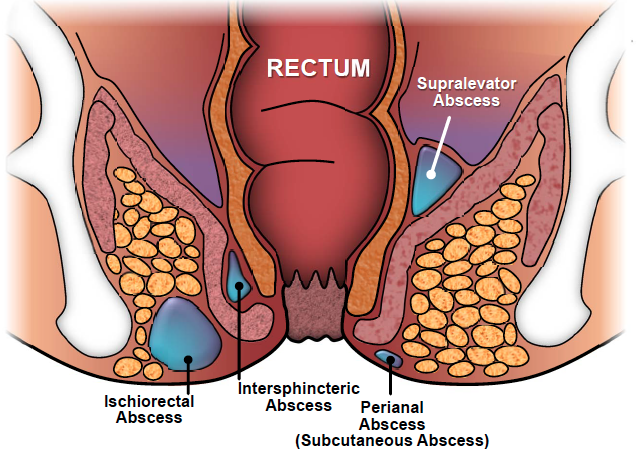
Surgeons classify the abscess by which space the pus has tracked into, because this decides how it is drained and how likely a fistula is later:
| Type | Where it sits | How it feels |
|---|---|---|
| Perianal (most common, ~60%) | Just under the skin beside the anus | Visible red, tender lump |
| Ischiorectal | Deeper, in the fat on either side of the rectum | Buttock pain and fever; the lump may not be visible |
| Intersphincteric | Between the two anal muscles | Deep, constant pain; nothing to see outside |
| Supralevator | Above the pelvic floor | Rare; deep pelvic pain, usually needs imaging |
Symptoms — when is it an emergency?
The typical story is two or three days of increasing, throbbing pain beside the anus that becomes constant, does not ease with bowel movements, and makes sitting difficult. A swelling appears and the skin over it turns red and shiny. Fever and a general feeling of being unwell are common.
Red-flag signs needing same-day care
- Fever above 38 °C or chills
- Redness spreading across the buttock or towards the groin
- Inability to sit or pass urine because of pain
- Diabetes, chemotherapy, steroid use or any condition that weakens immunity
- A previous abscess in the same place (suggests an underlying fistula)
Symptoms often mistaken for piles
Because the lump is beside the anus, many people assume it is piles and apply an over-the-counter cream for a week. The differences matter: piles bleed and prolapse but are seldom hot or feverish; an abscess is hot, exquisitely tender and often comes with fever. If you are unsure, our guide on piles, fissure and fistula — how to tell them apart walks through the distinctions.
Why antibiotics alone do not work
An abscess is a walled-off collection of pus. Antibiotics travel in the bloodstream, but the centre of an abscess has no blood supply, so the drug never reaches the bacteria at a useful concentration. The wall also keeps the pressure — and the pain — building. This is why the American Society of Colon and Rectal Surgeons’ clinical practice guideline for anorectal abscess and fistula-in-ano recommends prompt incision and drainage as the primary treatment, with antibiotics reserved for people who also have spreading cellulitis, diabetes, immunosuppression or a prosthetic heart valve. A course of antibiotics may quieten the surface redness for a few days, which is exactly how patients arrive at the OPD two weeks later with a larger abscess.
How a perianal abscess is drained
Drainage is a short procedure — usually 15–30 minutes — but doing it correctly matters, because an incision in the wrong place or an incompletely emptied cavity is the commonest reason an abscess “comes back”.
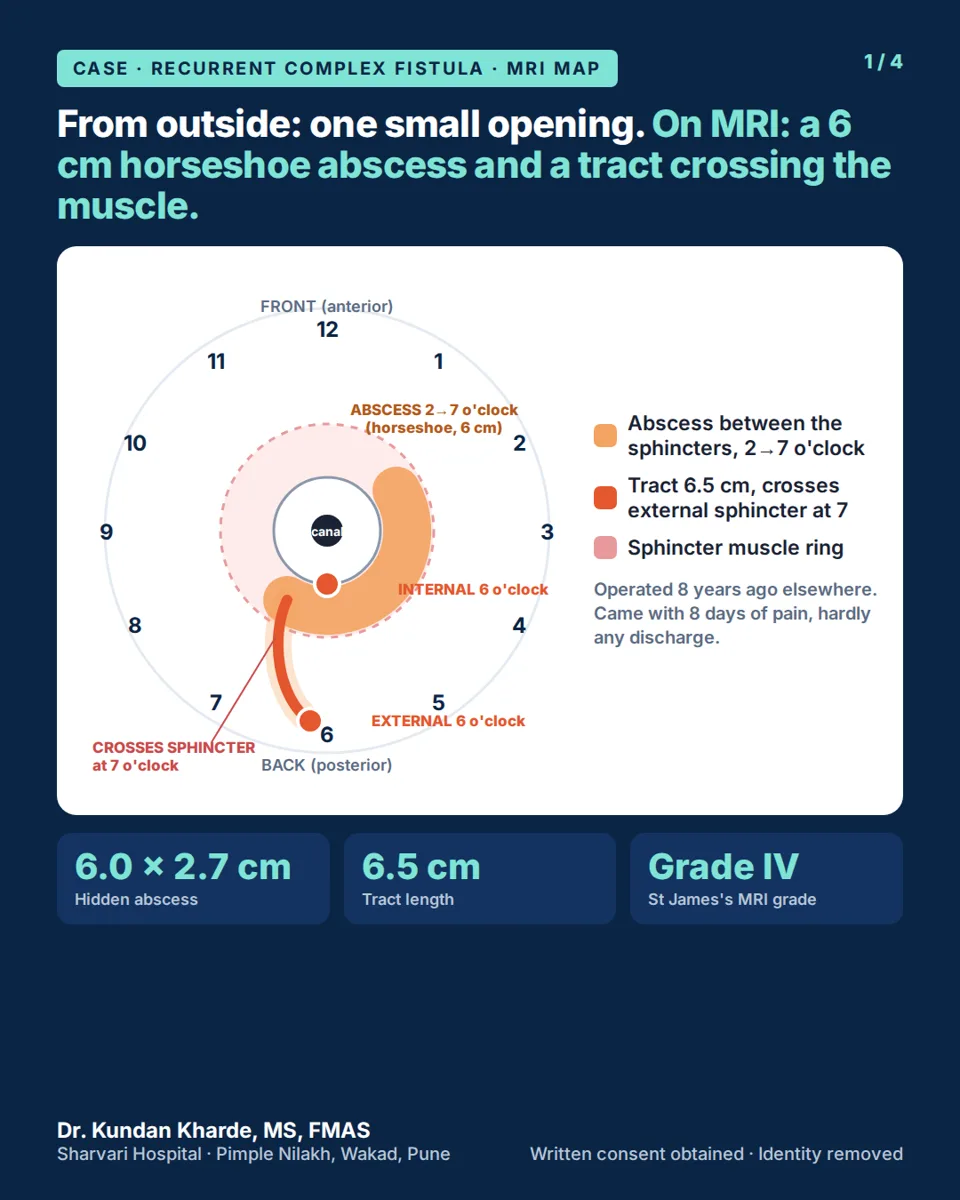
- Examination. The surgeon confirms the abscess, checks for a second collection and looks for an internal opening that would indicate an existing fistula. In deep or recurrent cases an MRI fistulogram mapping is arranged first.
- Anaesthesia. Local anaesthetic for a small superficial abscess; spinal or short general anaesthesia for anything deeper or in a patient who cannot tolerate local infiltration.
- Incision. A small cut is made over the most fluctuant point, kept as close to the anal margin as possible so that any later fistula tract is short.
- Drainage and cavity wash. Pus is evacuated, loculations (internal partitions) are gently broken down, and the cavity is irrigated.
- Packing or no packing. Current practice is to avoid tight packing where possible; a loose wick or none at all heals just as well with less pain.
- Discharge. Same-day discharge for most patients, with a sitz-bath routine, oral painkillers and a review appointment.
Day-care vs admission — who needs which
| Situation | Usual plan |
|---|---|
| Simple perianal abscess, otherwise healthy | Day-care under local or spinal anaesthesia |
| Ischiorectal or large abscess | Day-care under spinal/general; occasionally overnight |
| Diabetes with fever, or spreading cellulitis | Admission for IV antibiotics and glucose control |
| Suspected supralevator abscess | Admission, imaging, drainage under general anaesthesia |
What anaesthesia is used
Most simple abscesses at Sharvari Hospital are drained under local anaesthesia with light sedation. Spinal anaesthesia is preferred for deep ischiorectal collections because it allows a thorough examination of the anal canal at the same time. General anaesthesia is used when the patient prefers it or when the abscess is high. The anaesthetist decides at assessment, which is also why the final cost is fixed only after examination.
Perianal abscess surgery cost in Pune
The figures below are Sharvari Hospital’s typical charges for incision and drainage. They include surgeon and anaesthetist fees, operation-theatre charges and same-day discharge; medicines, imaging and any overnight stay are additional.
| Procedure | Anaesthesia | Typical cost |
|---|---|---|
| Simple perianal incision & drainage | Local | from ₹25,000 |
| Ischiorectal incision & drainage | Spinal / general | from ₹35,000 |
| Complex or deep abscess | General | ₹45,000 and above |
| Laser fistula surgery later, if a fistula forms | Spinal / general | from ₹60,000 |
What moves the figure within these ranges:
| Factor | What changes the cost |
|---|---|
| Abscess depth | Deeper cavities need theatre time and sometimes an MRI beforehand |
| Anaesthesia | Set at assessment, not at booking |
| Day-care vs overnight | Diabetes, fever or a large cavity may need admission |
| Insurance | Cashless with 50+ insurers; pre-authorisation handled by our desk |
A written estimate is given after examination. For the service overview, insurance list and OPD timings see the perianal abscess treatment page, or call +91 951 951 1928.
Recovery timeline after drainage
| Period | What to expect | What to do |
|---|---|---|
| Day 0–2 | Immediate relief of pressure; soreness at the wound; some blood-stained discharge on the dressing | Sitz bath (warm water, 10 minutes) 2–3 times daily and after every bowel movement; oral painkillers as prescribed; walk, don’t lie flat all day |
| Day 3–7 | Discharge lessens; sitting comfortable with a cushion; most people back to desk work | Continue sitz baths; keep stool soft with 25–30 g fibre and 2–3 litres of water; first review visit |
| Week 2 | Wound visibly smaller; little or no discharge | Resume light exercise; avoid cycling and heavy lifting until reviewed |
| Week 4 | Simple abscess wounds usually closed; deep wounds still healing | If the wound is still open or leaking at 6–8 weeks, ask for a fistula assessment |
Healing is from the inside out, so the wound must be kept open and clean rather than sealed. Timelines vary with abscess size, diabetes control and smoking.
Why one in three abscesses becomes a fistula
The abscess started in an anal gland whose duct opens inside the anal canal. Drainage empties the pus, but if that internal opening stays open, stool bacteria keep trickling down the same path and a permanent tunnel — an anal fistula — forms between the anal canal and the skin. Published series report fistula formation after roughly 30–40% of drained abscesses, which is why we counsel every patient about the possibility at discharge rather than treating it as a surprise later.
Signs your abscess has turned into a fistula
- Pus, blood or fluid still leaking from the old wound after 6–8 weeks
- A small pimple-like opening near the scar that discharges intermittently
- A lump that refills every few weeks and then bursts
- Recurrent abscess in the same spot
What to do if pus keeps coming back
Do not simply have the abscess re-drained each time. A recurring abscess almost always means a fistula, and the tract needs to be mapped and treated as a whole. At Sharvari Hospital that means an MRI fistulogram followed by definitive anal fistula treatment in Pune — laser (FiLaC), LIFT or fistulotomy depending on how much muscle the tract crosses. The earlier a fistula is treated, the simpler the tract and the less muscle is involved.
Risks and what can go wrong
Incision and drainage is a low-risk procedure, but no operation is risk-free:
- Recurrence — if the cavity is not fully emptied or an underlying fistula is present.
- Fistula formation — the 30–40% figure discussed above.
- Bleeding — usually minor and settles with pressure.
- Delayed healing — more likely with diabetes, smoking or steroid use.
- Continence changes — rare after simple drainage, but a risk if a fistula is later laid open across sphincter muscle; this is why tract mapping precedes fistula surgery.
Results vary from person to person. Your surgeon will explain the trade-offs that apply to your abscess at assessment.
Getting treated in Wakad, Hinjewadi, Baner and PCMC
Sharvari Hospital is at Sr. No. 19(P), behind Gulmohor Park, Vishal Nagar, Pimple Nilakh — about 10 minutes from Wakad Chowk via the Wakad–Pimple Nilakh road, and within 20–25 minutes of Hinjewadi Phase 1, Baner, Aundh, Pimple Saudagar and Ravet. Perianal abscess is one of the few proctology problems that should be seen the same day, so the OPD keeps emergency slots and the phone line is answered 24×7.
Call +91 951 951 1928 or message on WhatsApp with a photo of the swelling and how many days it has been present; the team will tell you whether to come in today.
Frequently asked questions
How much does perianal abscess surgery cost in Pune?
At Sharvari Hospital, incision and drainage of a simple perianal abscess starts around ₹25,000 under local anaesthesia. Deeper ischiorectal abscesses needing spinal or general anaesthesia are around ₹35,000, and complex or deep abscesses ₹45,000 and above. Admission, imaging and diabetes care change the figure, so a written estimate is given after examination. Cashless insurance is accepted through 50+ insurers.
Can a perianal abscess heal without surgery?
Very rarely. A small abscess may burst on its own, but the cavity usually refills because the infected anal gland that started it is still open. Antibiotics alone do not drain pus. Surgical guidelines (ASCRS) recommend prompt incision and drainage as the primary treatment; antibiotics are added only for specific situations such as spreading cellulitis, diabetes or a weak immune system.
How long does recovery take after abscess drainage?
Most patients walk out the same day, return to desk work in 2–4 days and feel largely normal within a week. The wound is left open to heal from inside out, which takes 2–4 weeks for a simple abscess and up to 6 weeks for a deep one. Daily sitz baths and a fibre-rich diet make the biggest difference. Results vary with abscess size and general health.
Will my perianal abscess turn into a fistula?
Roughly one in three drained abscesses later forms an anal fistula — a tunnel between the anal canal and the skin. Warning signs are pus or blood that keeps leaking from the old wound, a lump that refills, or a wound that has not closed by 6–8 weeks. If that happens, an MRI fistulogram maps the tract before definitive fistula surgery.
Is perianal abscess drainage painful?
The drainage itself is done under local, spinal or general anaesthesia, so you do not feel the incision. The relief of pressure usually reduces pain immediately afterwards. Soreness for the first 2–3 days is expected and is managed with oral painkillers and sitz baths. Pain experience differs from person to person.
Is perianal abscess treatment covered by insurance?
Yes — incision and drainage is a recognised surgical procedure and is covered by most health-insurance policies, often as an emergency admission. Sharvari Hospital offers cashless treatment with 50+ insurers and TPAs, and our desk handles the pre-authorisation paperwork. Some policies apply a waiting period for day-care procedures; we check this before admission.
What happens if I delay drainage?
The abscess enlarges, pain worsens, and infection can spread into the deeper spaces around the rectum or, in people with diabetes, into the bloodstream (sepsis). Delay also makes a fistula more likely and more complex. If you have fever, spreading redness or cannot sit, you should be examined the same day.
Is a perianal abscess the same as piles?
No. Piles are swollen blood vessels that bleed and prolapse but are rarely hot or feverish. A perianal abscess is an infection — a hot, tense, throbbing swelling beside the anus, often with fever. The treatments are completely different, so a doctor’s examination matters before you self-treat with piles creams.
Medically reviewed by Dr. Kundan Kharde, MS, FMAS — proctologist and laparoscopic surgeon, Sharvari Hospital, Pune. Clinical statements follow the ASCRS Clinical Practice Guideline for the Management of Anorectal Abscess, Fistula-in-Ano, and Rectovaginal Fistula. This article is general information, not a substitute for examination.