“Something comes out when I pass stool” is the opening sentence for piles far more often than for anything else — but it is also the opening sentence for rectal prolapse, and the two are treated completely differently. In the de-identified case below, a 24-year-old had been treated for piles by several doctors for about a year before one examination showed that the swelling was the whole wall of the rectum. This article explains what rectal prolapse is, why it gets labelled as piles, the examination that settles it, who gets it, how the three main operations differ, and what to bring to a consultation.
Medically reviewed by Dr. Kundan Kharde, MS, FMAS — Founder & Director, Lead Proctology Surgeon, Sharvari Hospital, Pune. 19+ years, 6,000+ surgeries. View profile.
What rectal prolapse is
Rectal prolapse means the rectum — the last part of the large bowel, just above the anal canal — slides downward and comes out through the anus. There are two kinds, and the distinction matters for treatment.
Mucosal prolapse is when only the inner lining of the rectum slips down. It is short, usually a centimetre or two, and it often overlaps with large internal piles; the surface shows folds that run lengthwise, like the piles they sit alongside.
Full-thickness (complete) rectal prolapse is when the entire rectal wall — lining, muscle and all — telescopes out. It comes out as a single ring-shaped mass with a central opening, and the folds on its surface run in concentric circles, the same all the way round. It is not made of haemorrhoidal tissue at all, which is why nothing done to the piles cushions has any effect on it.
Why it is confused with piles
Three things push the diagnosis towards piles.
The complaint is identical. Both conditions produce “something comes out when I go to the toilet”. Piles are common; prolapse is not; so piles is the first thought, and nothing in the patient’s own words separates the two.
The examination is often done at rest. At rest, both a prolapse and a set of piles sit inside. A look at the anus, or a finger examination, in a patient lying relaxed can be entirely normal in both. The ring only appears when the patient bears down, and if that step is skipped there is nothing to see and the label stays.
Young age makes prolapse unexpected. Rectal prolapse is thought of as a condition of older women, so a young man with a swelling on straining does not fit the picture. Yet long-standing constipation and straining — the commonest story in young adults with prolapse — are exactly what bring the rectum down.
The examination that settles it
The decisive step is simple: the patient is asked to strain, and the doctor looks at what appears. Sometimes this is done on the examination couch; sometimes it is done squatting or seated, because a prolapse that only comes out at stool may not come out lying down.
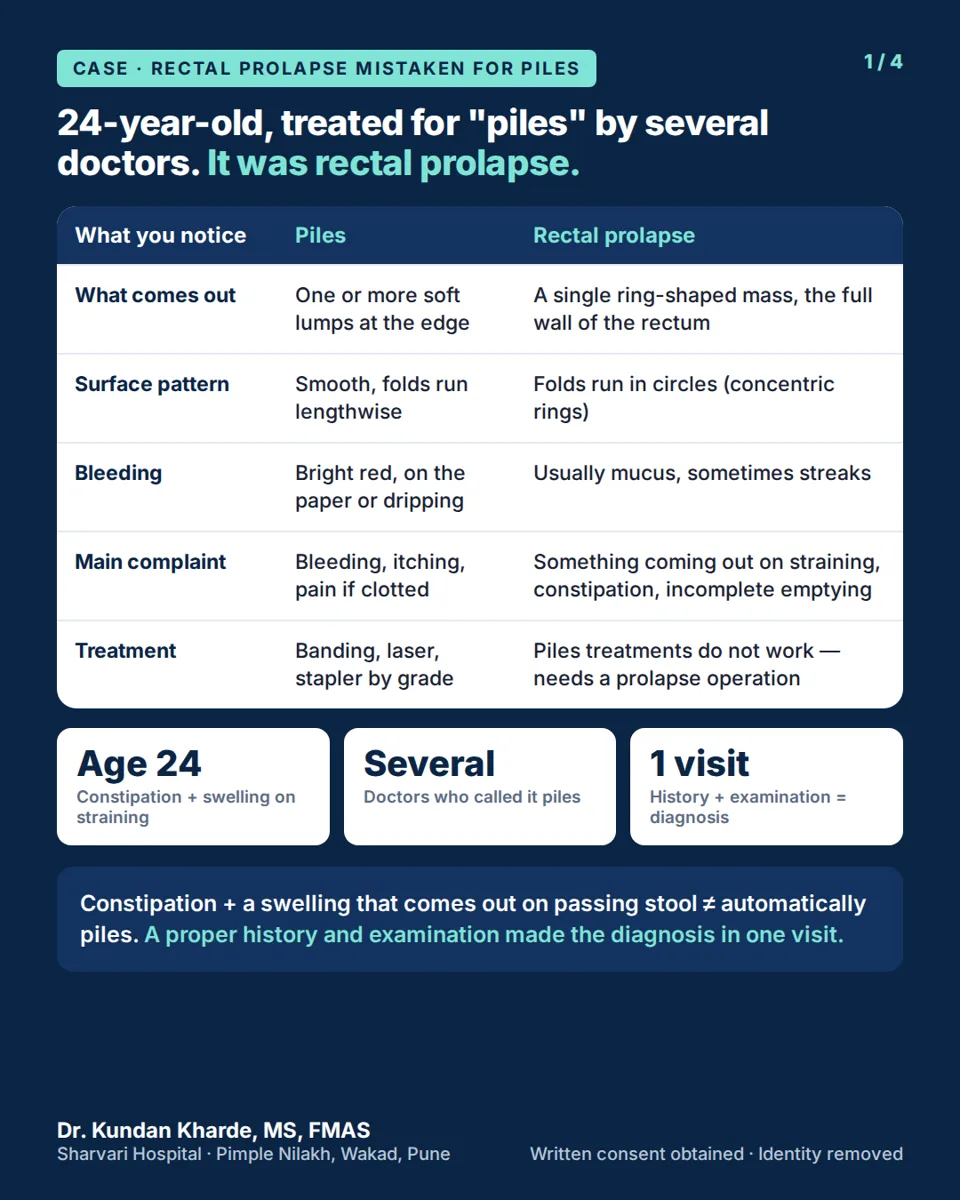
What the doctor looks for is the pattern of the folds. Piles come out as one or more separate lumps — classically at three positions — with grooves between them, and the folds on each lump run lengthwise (radially). A full-thickness prolapse is one continuous ring with folds running in circles (concentrically) around a central opening. A finger placed between the prolapsed mass and the anal skin also helps: in a full-thickness prolapse the finger passes into a sulcus all the way round, because the rectum has come out through the anal canal rather than from within it.
The other clues line up behind that. Piles bleed bright red on the paper or into the pan; prolapse more often produces mucus and staining. The main complaint with piles is bleeding, itching or pain if a pile clots; with prolapse it is the mass itself, constipation and a sense of never quite emptying. But these are pointers, not proof — the folds are.
Who gets rectal prolapse
Most textbook patients are women over sixty, often with a history of childbirth and a weakened pelvic floor. But prolapse also occurs in young adults of either sex, and in them the usual driver is years of constipation and straining. Chronic diarrhoea, conditions affecting the nerves to the pelvic floor, and previous anorectal surgery can also contribute. The practical point is that age does not decide the diagnosis. A 24-year-old can have a full-thickness prolapse, and the one in this article did.
The operations, and when each is chosen
A full-thickness rectal prolapse is treated surgically; there is no medicine or cream that puts the rectum back and keeps it there. Three operations cover most patients.
Delorme’s procedure is done entirely through the anus. The prolapse is brought out under anaesthesia, the inner lining (mucosa) of the prolapsed segment is stripped off as a sleeve, the exposed muscle wall is gathered with a series of plication stitches so the rectum shortens and firms into a collar, and the lining is re-joined with absorbable stitches. There is no abdominal incision and no mesh. It is generally chosen for shorter prolapses and for patients in whom an abdominal operation is better avoided — the elderly and frail, and also a young patient having a first repair where avoiding an abdominal procedure and any implant is preferred.
Altemeier’s procedure (perineal rectosigmoidectomy) is the other perineal option. The prolapsed segment of rectum is removed altogether through the anus and the bowel ends are joined. It is usually chosen for longer prolapses in patients who are not fit for an abdominal operation.
Abdominal rectopexy, usually laparoscopic, mobilises the rectum and fixes it to the sacrum, sometimes with a mesh and sometimes with sutures alone. It is the larger operation and is generally chosen for longer full-thickness prolapses in patients fit for it, because the prolapse is less likely to come back after an abdominal repair than after a perineal one. Which operation suits a given patient is decided from the length of the prolapse, age and fitness, bowel function and what is found on examination — and it is discussed before consent.
A real case: “piles” for a year, prolapse in one visit
A 24-year-old man came to Sharvari Hospital, Pimple Nilakh, with about a year of constipation and a swelling that came out of the anus whenever he strained to pass stool. He had consulted several doctors over that year and had been treated for piles, without relief.
On history, two things did not fit ordinary piles: the main complaint was the swelling and the constipation rather than bleeding, and he was 24. On clinical examination, with him asked to strain, what came out was not separate lumps. It was a single ring-shaped mass with folds running in circles around a central opening — the whole rectal wall. That is a full-thickness rectal prolapse, and the diagnosis was made in that one visit from the history and the examination.
He was young and otherwise well, and the prolapse was of moderate length, so Delorme’s procedure was chosen: done through the anus, no abdominal incision, no mesh. The lining of the prolapsed segment was stripped as a sleeve, the exposed muscle was gathered with plication stitches so the rectum shortened and firmed, and the lining was re-joined with absorbable stitches. He was discharged on day 2 on stool softeners and a high-fibre diet with one instruction above all others — no straining — and in his case was back to routine in about a week, with no recurrence on follow-up so far.
The full write-up, with the piles-versus-prolapse comparison table and labelled theatre photographs behind a tap-to-reveal, is the rectal prolapse mistaken for piles case study. It is one patient’s course, published with written consent and identity removed — not a statistic and not a promise.
What to bring to a consultation
- Every treatment so far, with dates — medicines, ointments, banding, injections, laser or any other procedure — and any discharge summaries or procedure notes.
- A description of what comes out: when it appears, roughly how big it is, whether it goes back on its own or has to be pushed back, and whether there is mucus or blood.
- Your bowel habit: how often, how much straining, how long constipation has been going on, and what you have tried for it.
- A phone photograph of the swelling when it is out, if you can take one; a prolapse that appears only at stool may not appear on the couch.
- Willingness to be examined while straining. That step, not the history, is what separates prolapse from piles.
Frequently asked questions
How can I tell whether it is piles or rectal prolapse?
Not from the symptoms alone — both present as something coming out when you pass stool. The examination separates them: when you strain, piles appear as one or more separate soft lumps with folds running lengthwise, while a full-thickness rectal prolapse appears as a single ring-shaped mass with folds running in concentric circles, the same all the way round. Constipation, mucus and a feeling of incomplete emptying point more towards prolapse; bright red bleeding on the paper points more towards piles.
Can a young person get rectal prolapse?
Yes. Rectal prolapse is more common in older women, but it also occurs in young adults of either sex, usually with long-standing constipation and straining. The patient in the case in this article was a 24-year-old man. Because prolapse is unexpected at that age, a young person with a swelling on passing stool is often assumed to have piles.
What is the difference between Delorme’s procedure and rectopexy?
Delorme’s procedure is done entirely through the anus: the lining of the prolapsed segment is stripped, the muscle wall is gathered with plication stitches so the rectum shortens and firms, and the lining is re-joined — no abdominal incision, no mesh. Rectopexy is an abdominal operation, usually laparoscopic, in which the rectum is mobilised and fixed to the sacrum. Delorme’s is generally chosen for shorter prolapses and where an abdominal operation is better avoided; rectopexy for longer full-thickness prolapses in patients fit for it, because the prolapse is less likely to come back after an abdominal repair.
What should I bring to a consultation if piles treatment has not helped?
A list of every treatment and procedure you have had, with dates; any discharge summaries or procedure notes; a note of what actually comes out — when, how big, whether it goes back on its own — and of your bowel habit; and a phone photograph of the swelling when it is out, if you can take one. Expect to be examined while straining; that step, not the history, is what separates prolapse from piles.
Told it is piles, but something ring-shaped comes out when you strain?
Get examined — while straining — before any further piles procedure. Call or WhatsApp +91 951 951 1928 to book with Dr. Kundan Kharde at Sharvari Hospital, Pimple Nilakh, book a consultation, or, if it is piles, start with piles treatment in Pune. Sharvari Hospital is 10–25 minutes from Wakad, Hinjewadi, Baner and PCMC.
This article is for patient education and does not replace an examination. Whether a swelling is piles, prolapse or something else is decided by looking, not by reading.