Part of the Sharvari Proctology Centre
Fistula Treatment near Wakad — Sharvari Hospital, Pimple Nilakh
Anal fistula (bhagandar) treatment for Wakad residents is done at Sharvari Hospital, Pimple Nilakh — 5 minutes from Wakad Chowk — by Dr. Kundan Kharde (MS, FMAS), a surgeon with 19+ years' experience and 6,000+ surgeries. Suitable tracts are treated with FiLaC laser or sphincter-preserving surgery as a day-care procedure: most patients go home the same day and are back to desk work in 2–3 days — results vary. Full clinical detail — techniques, cost table, FAQs — is on our fistula treatment in Pune page.

Wakad sits at the heart of Pune’s western growth corridor — minutes from Hinjewadi, Baner, Balewadi, and Pimple Nilakh. If you are searching for fistula treatment near Wakad, you do not need to wander through overcrowded general OPDs or unverified clinics. Sharvari Hospital is located in Pimple Nilakh, behind Gulmohor Park, effectively neighbours with Wakad for practical purposes: same traffic islands, same cab routes, same evening rush patterns — but a dedicated proctology-led pathway once you step inside.
Anal fistulas usually follow a perianal abscess and create a stubborn tunnel that drains intermittently. Closing that tunnel safely — while protecting the muscles that control stool — requires judgement, not a billboard promise. Dr. Kundan Kharde brings 19+ years of surgical experience and 6,000+ surgeries, guiding laser (FiLaC-type), VAAFT, LIFT, seton, or limited fistulotomy choices only after your tract is understood.
The hospital is ISO 9001:2015 certified, partners with 50+ insurance companies for cashless support where applicable, and maintains 24/7 emergency access — critical if your fistula throws an abscess flare-up on a weekend night after a long shift.
Sharvari Assure™
Our structured 30-day recovery pathway for every fistula treatment — so you never feel alone after surgery.
Week 1
Daily wound check and dressing guidance via call
Week 2-3
In-person follow-up, diet, and healing assessment
Day 30
Final clearance visit and recovery confirmation
Area guides around Wakad
“Near Wakad” searches cover dozens of apartment townships — Vishal Nagar, Wakad gaothan, Tathawade bridges, and Hinjewadi exits. Rather than duplicate the same paragraph everywhere, we built location-specific fistula pages with neighbourhood driving notes, persona-aware FAQs, and unique questions Google expects to see. Start with the suburb closest to you, then book the same hospital campus either way.
For the wider medical story — types of fistulas, MRI fistulography, recovery arcs — read the main fistula treatment page and the Pune fistula pillar URL (redirects to the same clinical programme). If bleeding is your main issue, explore piles treatment near Wakad or piles treatment in Hinjewadi — symptoms overlap, but surgery plans differ.
Fistula treatment pages by area
- Fistula treatment — Hinjewadi
- Fistula treatment — Thergaon
- Fistula treatment — Baner
- Fistula treatment — Balewadi
- Fistula treatment — Aundh
- Fistula treatment — Pimple Saudagar
- Fistula treatment — Ravet
- Fistula treatment — Tathawade
- Fistula treatment — PCMC
Piles treatment by area
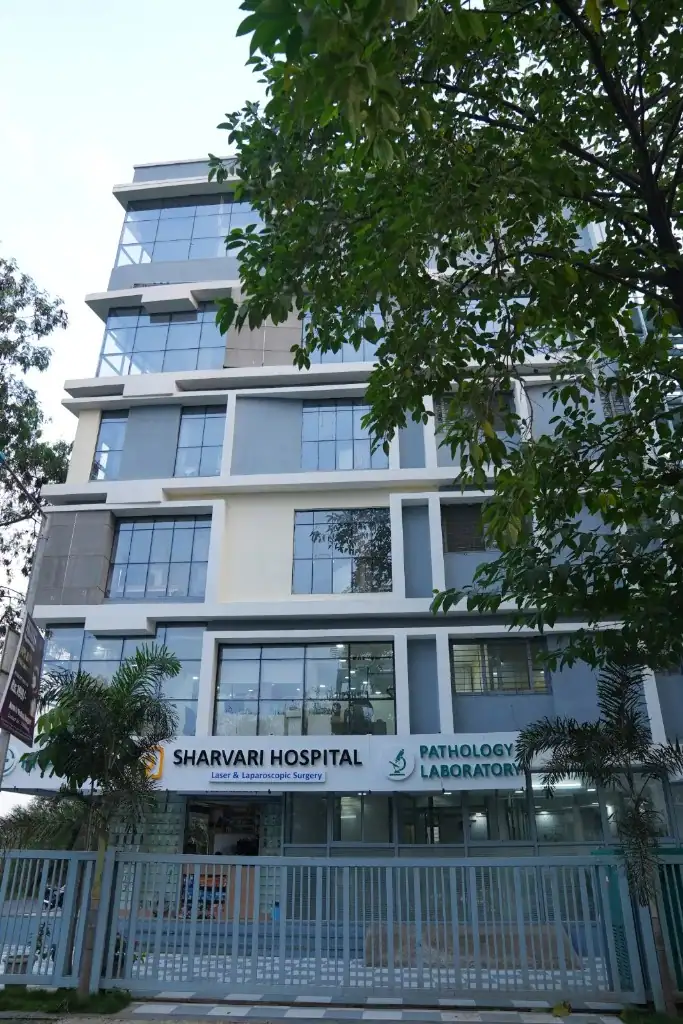
How to reach Sharvari Hospital from Wakad
Most drivers route from Wakad chowk into Vishal Nagar, then locate Gulmohor Park. Sharvari Hospital sits immediately behind the park — SR. NO. 19(P), Pimple Nilakh, Pune 411027. Average travel time is often under five minutes once you clear the chowk; peak evenings add variability. Use Google Maps voice navigation and, if signals stall, call our desk for the final left-right cues.
Symptoms — when fistula will not wait
Wakad professionals routinely tell us they ignored fistula symptoms for months because the OPD trip felt inconvenient. That is the wrong calculus — fistulas grow tracts, develop branches, and damage continence-critical sphincter muscle the longer they are left. Walk in if you notice any of these:
- A persistent small opening near the anus that drains pus, serous fluid, or stool-like discharge — even intermittently.
- Recurring perianal pain that builds up between dressings and eases when the opening drains.
- A history of perianal abscess that was drained but never quite settled — that is your fistula announcing itself.
- Underwear staining that you cannot explain by hygiene; intermittent fistulas leak silently.
- Itching, swelling, or a hard cord-like tract you can feel under the skin around the anus.
Red flags — go to emergency: fever above 38°C with perianal pain, spreading redness or swelling beyond the immediate area, severe pain with inability to sit, or any pain combined with diabetes/immunocompromise. Use our 24/7 line +91 951 951 1928. Untreated abscesses can progress to deep-space infections that are far more serious than the original problem.
Fistula treatment options compared — laser, VAAFT, LIFT, seton, fistulotomy
There is no single "best" fistula procedure — there is a best match between procedure and your specific anatomy. Here is what we offer at Sharvari Hospital, with the trade-offs spelt out plainly:
FiLaC laser: A diode laser fibre is passed along the tract; controlled radial energy ablates the epithelium and the tract closes from inside. Best for low-complexity transsphincteric fistulas with a single tract and clean drainage. Sphincter preservation is excellent. Not appropriate for complex multi-tract disease, large secondary cavities, or active sepsis.
VAAFT (Video-Assisted Anal Fistula Treatment): A miniature endoscope traces the tract under direct vision; the internal opening is closed and the tract is fulgurated. Useful for branched anatomy that needs visualisation. Slightly higher equipment cost; lower recurrence in some studies for complex tracts vs blind techniques.
LIFT (Ligation of Intersphincteric Fistula Tract): The tract is ligated and divided in the inter-sphincteric plane, sparing both sphincters. Strong sphincter preservation profile; suits transsphincteric fistulas with a clean inter-sphincteric segment.
Seton management (loose / cutting / chemical / KShar Sutra): A thread is passed through the tract to drain it and either mature the tract for later definitive repair (loose seton), or slowly cheesewire through the muscle (cutting seton / KShar Sutra). Indicated for complex high tracts where one-shot surgery would damage continence. Often staged: seton first, definitive repair months later.
Fistulotomy: The classic "lay open" — divides the tract for direct healing. Excellent cure rates for very low fistulas with no sphincter risk; not appropriate for high tracts where it would cause incontinence.
The choice is made after examination and pre-operative imaging. We do not skip the imaging step — that is where most recurrent fistulas were originally mismanaged. Almost every fistula patient at Sharvari Hospital is imaged before surgery — an MRI fistulogram or a trans-rectal ultrasound; see MRI fistula mapping before surgery.
Recovery timeline — week-by-week from Wakad
What you can plan around, by procedure type:
Days 1-2 (laser / LIFT / VAAFT):
Same-day or overnight discharge. Mild soreness, minor sticky discharge, oral pain control. Sit on a cushion; walk gently.
Days 3-5:
Most desk workers transition to work-from-home. Daily sitz baths (warm salt water, 10 minutes, 2-3 times daily). Avoid two-wheelers.
Days 6-10:
First follow-up — wound check, dressing change, return-to-office sign-off if all well. Most laser/LIFT patients are back at the Hinjewadi office around day 7-10.
Weeks 2-4:
Progressive return to gym (no heavy lifting yet); normal stool routine. Discharge usually settles fully by week 3 for low fistulas.
Weeks 4-8 (complex / seton cases):
Repeat dressing changes; outpatient seton review every 2-3 weeks; definitive repair scheduled when tract has matured.
Month 3-6:
Final review for complex cases; MRI follow-up where indicated to confirm tract closure.
We are explicit about your timeline up front. A patient who expects a "3-day fix" and gets a 6-week staged plan feels betrayed; a patient told the truth in OPD plans their work and family life realistically.
Cost transparency for fistula surgery
Fistula pricing is genuinely variable — anyone who quotes a single fixed number on the phone is hiding consumables, MRI, anaesthesia time, room category, or follow-up dressings. We itemise every line before consent.
Cost drivers: tract complexity (single vs multi-branch vs horseshoe), pre-operative imaging (almost every fistula patient at Sharvari Hospital is imaged before surgery — an MRI fistulogram or a trans-rectal ultrasound), surgical technique chosen (laser vs VAAFT vs LIFT vs staged seton), anaesthesia type (local-with-sedation vs spinal vs general), room category (general / semi-private / private / deluxe), length of stay (day-care vs overnight vs 2-night for complex cases), and follow-up dressing visits required.
Realistic ranges: Simple low fistula with day-care laser usually falls in the lower-mid five-figure range out-of-pocket. Complex transsphincteric, recurrent, or staged seton + definitive repair is materially more — often double or more, especially with MRI and longer admissions. Insurance covers most cases; copay and sub-limits depend on your specific policy.
EMI: Healthcare-specific EMI providers offer 0% short-tenure or low-cost extended-tenure options. Our finance desk runs a 5-minute eligibility check during OPD.
Insurance and cashless workflow
Sharvari Hospital is empanelled with 50+ insurers covering most major retail, corporate, and government schemes. The TPAs we deal with daily for the Wakad-Hinjewadi belt include MediAssist, Health India, FHPL, Paramount, Vidal Health, Vipul, Ericson, Raksha, Family Health Plan, and Heritage Health.
Cashless workflow: Bring your e-card, employee ID, and prior consultation notes. Our insurance desk initiates pre-authorisation in OPD itself once surgery is advised. Pre-auth is the rate-limiter, not the surgery — start it on day one. We will tell you plainly if a denial is fixable (often a missing document) or final (rare).
What to ask your HR before OPD: sub-limits on surgical packages, daycare coverage status, network hospital eligibility, copay percentage, and whether MRI is an in-policy investigation. These five questions decide your out-of-pocket exposure.
Why Wakad professionals delay fistula care — and why they should not
Three patterns we see repeatedly in OPD:
"It is just a small opening — let me try one more antibiotic course." Antibiotics calm associated infection but do not close the epithelialised tract. Repeated short courses select for resistance and let the tract develop branches. The right answer is examination, not Amoxiclav.
"I will deal with it after the next release." Fistulas do not respect sprint cycles. Every month of delay is another month of intermittent pain, soiled underwear, and worsening anatomy. Most modern techniques are day-care or short-stay — fitting them between releases is feasible if you book early.
"My family doctor said wait and watch." Wait-and-watch is sometimes correct for genuinely asymptomatic minor lesions, but most symptomatic fistulas do not heal on their own. Get a colorectal surgeon's opinion specifically — not a generalist's.
Cost, insurance, EMI
Fistula packages depend on tract complexity, the pre-operative imaging used (almost every fistula patient at Sharvari Hospital is imaged before surgery — an MRI fistulogram or a trans-rectal ultrasound), anaesthesia time, and room category. After examination you receive an itemised estimate. Our insurance coordinators work daily with corporate TPAs common along the Wakad–Hinjewadi belt. EMI options exist for eligible self-pay gaps — ask during online booking.
Fistula that has recurred after previous surgery, or involves a high or multi-tract path, is planned differently — see our dedicated page on complex and recurrent fistula care.
Recurrent or complex fistula near Wakad
Not every fistula is a simple low tract. If your fistula has come back after a previous operation, or you have been told it is high, horseshoe or multi-tract, it needs MRI mapping and a sphincter-preserving plan — not a repeat of the same surgery. Dr. Kundan Kharde takes these referrals at Sharvari Hospital, Pimple Nilakh, about 2.2 km from Wakad. Read about complex and recurrent fistula treatment in Pune.
Frequently asked questions
Where can I get fistula laser treatment near Wakad?
Sharvari Hospital in Pimple Nilakh (behind Gulmohor Park, Vishal Nagar) is roughly 2.2 km from Wakad chowk — about 5-9 minutes by car on a normal afternoon. We offer FiLaC-style laser fistula treatment when your tract anatomy is suitable, alongside VAAFT, LIFT, KShar Sutra, staged seton care, and selective fistulotomy.
Is Sharvari Hospital closer than PCMC hospitals for Wakad residents?
Wakad and Pimple Nilakh sit on the same western corridor. Most patients prefer the 5-minute Vishal Nagar route over battling central PCMC traffic for repeat dressings and follow-up — and follow-up matters more than people realise for fistula recovery.
Do you accept cashless insurance for fistula surgery from Wakad IT employees?
Yes — we are empanelled with 50+ insurers including all major TPAs serving Hinjewadi corporates: MediAssist, Health India, FHPL, Paramount, Vidal Health, Vipul, Ericson, Raksha and others. Bring your e-card, employee ID, and prior consultation notes; pre-authorisation can be initiated in OPD itself once surgery is advised.
How is fistula different from piles if I live near Wakad?
Piles mainly bleed bright red and prolapse; fistulas leak pus, serous fluid, or stool-like discharge through a stubborn external opening near the anus. Pain patterns differ too — fistulas throb between dressings, piles hurt mostly at defecation. Examination differentiates them in minutes; do not self-diagnose, especially on Reddit.
Can I walk in for a fistula emergency from Wakad at night?
Yes — emergency is 24/7. A perianal abscess (severe pain, fever, spreading redness, swelling) needs urgent incision and drainage before any definitive fistula repair is planned. Do not wait for office OPD if you have fever above 38°C with perianal pain — call +91 951 951 1928 and head to emergency.
Does Dr. Kundan Kharde see Wakad patients for complex recurrent fistulas?
Yes. Recurrent fistulas after previous surgery elsewhere are a significant share of our practice. Bring prior operative notes, discharge summaries, MRI discs, and any biopsy reports — recurrent tracts need careful mapping (often a fresh MRI fistulogram) before planning a redo. Skipping this step is the most common reason recurrent fistulas fail again.
What is FiLaC laser fistula treatment, and am I eligible?
FiLaC (Fistula-tract Laser Closure) uses a radial-emitting laser fibre passed along the tract to controllably ablate the fistula epithelium, prompting closure from inside out. It works best for low-complexity transsphincteric fistulas with a single tract and good drainage. It is not the right answer for complex multi-tract disease, large secondary cavities, or active sepsis — those need staged management first. Eligibility is decided after examination and (often) MRI.
How long does fistula surgery recovery take if I have a Hinjewadi desk job?
For low-complexity fistulas treated by laser or LIFT, most desk-job patients are at work-from-home in 3-5 days and back to office in 7-10 days. Open fistulotomy or staged seton management takes longer — often 3-6 weeks of dressing changes before tract maturation. We give a written recovery plan tailored to your specific surgery, not a generic timeline.
Will my fistula come back after surgery?
Recurrence rates depend on technique and tract complexity. For straightforward low fistulas treated by an experienced surgeon, recurrence is typically 5-15%. For complex transsphincteric or high tracts, even with optimal surgery recurrence can be 20-30%. The biggest controllable factor is matching the technique to the anatomy — which is why we MRI-map complex tracts before operating.
I have been told I have a "horseshoe fistula" — what does that mean?
A horseshoe fistula loops around the anal canal in a U-shape, often with multiple external openings. It is more complex than a single tract and almost always benefits from MRI mapping plus a staged approach (drainage seton first, definitive repair second). It is not a hopeless diagnosis — but it does need an experienced colorectal surgeon, not a quick laser appointment.
Can fistula heal without surgery if I am only mildly symptomatic?
Anal fistulas almost never heal spontaneously. Antibiotics may calm an associated abscess temporarily, but the tract itself is an epithelialised tunnel that needs surgical closure. Delaying surgery rarely improves outcomes and sometimes worsens anatomy by allowing branches to develop. We will tell you honestly if observation is reasonable in your specific case — but in most patients, definitive repair is the right answer.
What should I read before booking fistula surgery from Wakad?
Read our main fistula treatment page, the FiLaC complete guide, and at least one suburb page near you so you understand the logistics. Then book — every surgical plan is anatomy-specific, not template-driven. Bring previous reports, list current medications, and write down your top 3 questions so the consultation does not get rushed.
Are there parking facilities for Wakad visitors driving to Pimple Nilakh?
Yes — dedicated patient parking is available near the hospital entrance. Mention your vehicle type when booking if you need the closest drop-off for mobility reasons. After fistula surgery, two-wheelers are uncomfortable for the first 7-10 days due to speed breakers in Vishal Nagar — please plan a cab or family car for the discharge ride.
How much does fistula surgery cost from Wakad — give a real range, not a vague answer.
Honest answer: it varies meaningfully by complexity. A low simple fistula with laser as day-care typically falls in the lower-mid five-figure range; complex transsphincteric or recurrent tracts with longer OT time, longer admission, and often staged seton management cost more. Almost every fistula patient at Sharvari Hospital is imaged before surgery — an MRI fistulogram or a trans-rectal ultrasound — so budget for that scan in every case. Most cases with insurance run cashless after the standard sub-limits and copay. We itemise everything in writing before consent so there are no surprises after discharge — call +91 951 951 1928 for a personalised estimate.
Talk to the team
Book online, call, or WhatsApp. For fever with gluteal swelling, use the emergency entrance — do not wait for a routine slot.