Call +91 951 951 1928 | Open 24/7 | Sharvari Hospital, Pimple Nilakh, near Wakad Chowk
Sharvari Hospital
Advanced Laser & Laparoscopic Surgery

Second-opinion centre for already-operated fistula

Complex & Recurrent Anal Fistula Treatment in Pune

A complex anal fistula is one that involves a large part of the anal sphincter, has multiple or horseshoe tracts, sits high in the anal canal, or has already recurred after previous surgery. At Sharvari Hospital, Pimple Nilakh, Pune, these cases are planned on MRI fistulography and treated with sphincter-preserving techniques — draining seton, LIFT, laser (FiLaC), VAAFT or advancement flap — often in stages, to close the tract while protecting bowel control. The full programme — every technique, the cost table and the FAQs — is on our fistula treatment in Pune page.

240+ Google reviews
ISO 9001:2015 Certified
PCMC Reg. No. 884
19+ Years · 6,000+ Surgeries
Open 24×7
50+ Insurers · Cashless

Book Consultation

Get a callback within 30 minutes

🔒 100% confidential. Insurance & EMI options available.

Recurrent and high-complexity fistula after multiple previous operations

You are not an unusual case, and it is not your fault.

Anal fistula recurs more often than most patients are told before their first surgery. Published surgical series put recurrence after fistula surgery anywhere between roughly 7% and 30%, and it climbs with each additional complexity factor — a high tract, more than one tract, a horseshoe extension, an anterior fistula in a woman, or underlying disease that was never looked for.

What changes the outcome the second time is not a newer laser. It is a correct map of the tract before the operation and a plan that matches the anatomy rather than the marketing.

At Sharvari Hospital, every re-operated fistula starts from zero: fresh MRI, fresh examination under anaesthesia, and an honest answer about what is actually achievable — including how many stages it may take.
Bring your old MRI and discharge summary. We will read them with you.

What makes a fistula "complex"?

Surgeons classify fistula tracts using the Parks classification — intersphincteric, transsphincteric, suprasphincteric and extrasphincteric — based on how the tract runs relative to the anal sphincter muscles. A fistula is generally called complex when one or more of the following is present:

Feature Why it matters
High transsphincteric tract (crossing a large share of the external sphincter) Simply laying it open risks bowel-control problems
Suprasphincteric or extrasphincteric tract Runs above or outside the sphincter complex — never suitable for fistulotomy
Multiple tracts or a horseshoe extension One opening treated, others left behind → recurrence
Recurrent fistula after previous surgery Scarring distorts the anatomy and hides the original internal opening
Anterior fistula in a woman Thin sphincter in front; higher continence risk
Existing incontinence or previous sphincter injury Very little muscle reserve to spend
Underlying Crohn's disease, tuberculosis or malignancy The tract will not heal until the disease is treated
Previous pelvic radiation Impaired tissue healing

A simple, low fistula can often be laid open in one sitting. A complex fistula cannot — and attempting it anyway is one of the commonest reasons patients arrive here with both a persistent fistula and a control problem.

Read the basics first → Types of anal fistula: simple vs complex · What is anal fistula?

Why did the last surgery fail? The seven usual reasons

  1. 1

    The internal opening was never found. If the source in the anal canal is missed, the tract refills. This is the single most common cause of recurrence.

  2. 2

    A secondary tract or horseshoe extension was left behind. The main tract healed; the branch did not.

  3. 3

    The tract had epithelialised — lined itself with skin-like tissue that will not stick together and close.

  4. 4

    The wound closed at the skin before it healed in the depth, trapping infection and rebuilding the tract from inside out.

  5. 5

    Inadequate drainage of an associated abscess before the definitive procedure.

  6. 6

    Underlying disease was never excluded — Crohn's disease, and in India, tubercular fistula-in-ano, which is genuinely under-diagnosed. No surgical technique cures a tubercular tract without medical treatment alongside.

  7. 7

    The technique did not match the anatomy — a sphincter-preserving procedure chosen for the wrong tract, or a laser used where a flap was needed.

Every one of these seven is identifiable before the second operation. That is the entire point of a proper re-assessment.

What causes recurrent fistula · Fistula surgery success rate — what the data says

How we re-assess an already-operated fistula

1. MRI fistulography — the non-negotiable first step

For any complex or recurrent fistula, MRI of the pelvis with fistula protocol is the reference-standard investigation. It shows the primary tract, secondary tracts, horseshoe extensions, undrained collections and — critically — the relationship of the tract to the sphincter muscles. We do not plan redo fistula surgery without it.

How we read your MRI

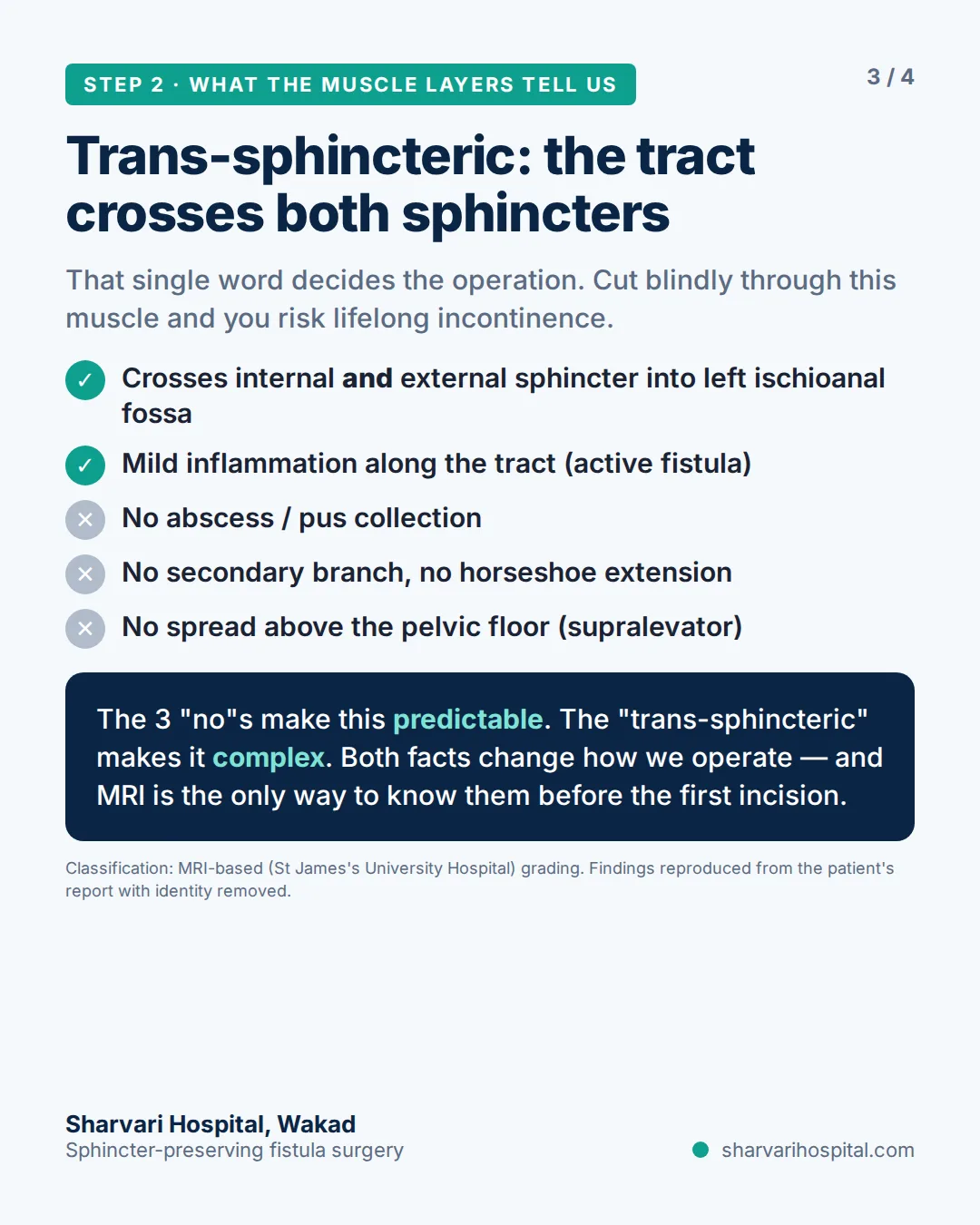
MRI fistulogram findings that change the operation: sphincter involvement, abscess, secondary tracts, supralevator extension

Four findings on the scan change the operation: how much sphincter muscle the tract crosses, whether there is an abscess that must be drained first, whether a secondary tract or horseshoe extension is present, and whether the tract climbs above the pelvic floor. The report's grade is a radiology shorthand — the plan is built from those findings and confirmed under anaesthesia. What each line of the report means is explained on our MRI fistula mapping page, and a fully mapped, probe-confirmed case is written up as a de-identified case study.

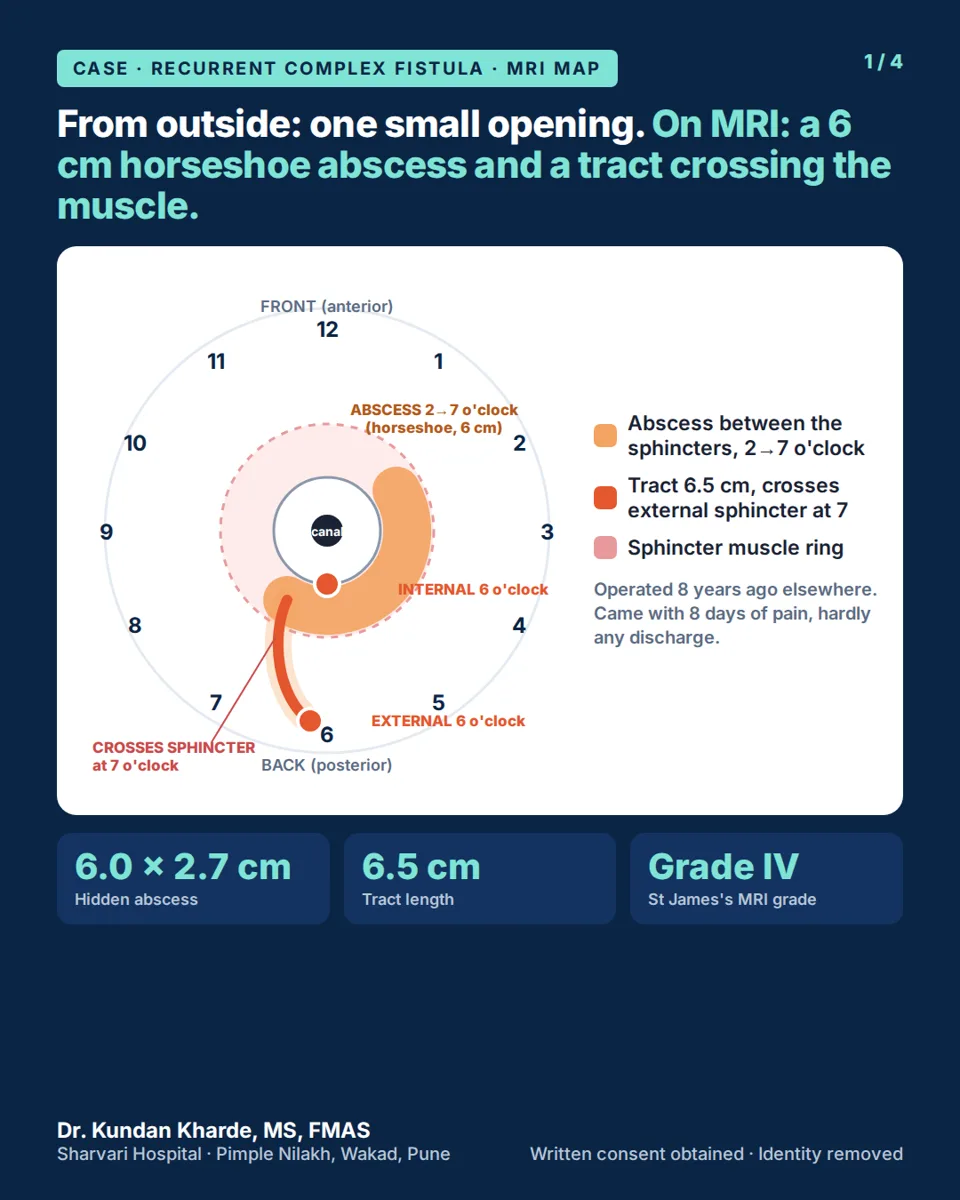
A recent recurrent case: what the MRI found

Clock-face MRI map of a recurrent anal fistula: 6 cm horseshoe abscess from 2 to 7 o’clock, internal opening at 6 o’clock, 6.5 cm tract crossing the right external sphincter at 7 o’clock — Sharvari Hospital, Pune

A man in his early thirties, operated for a fistula elsewhere about eight years earlier, came with eight days of pain, one small opening near the anus and no significant discharge. His MRI fistulogram showed a 6 cm horseshoe abscess in the posterior perirectal and intersphincteric space, a probable internal opening at 6 o’clock and a 6.5 cm tract crossing the right external sphincter — St James’s grade IV, with nothing on the surface to suggest any of it. Because the scan was done first, the abscess and internal opening were laid open and drained from inside, the part of the tract crossing the muscle was cored out rather than cut, and the tract was removed to the skin — with the external sphincter left intact. The full, de-identified write-up is the recurrent complex fistula case study.

2. Review of your previous operation notes

The old operative note tells us what was found, what was divided and what was left. Bring it. If you do not have it, we will help you request it.

3. Examination under anaesthesia (EUA)

The definitive assessment. Scarring from previous surgery can hide the internal opening on clinic examination; under anaesthesia, with probes and dye, it can usually be identified.

4. Excluding underlying disease

Where the history suggests it — multiple recurrences, unusual tract behaviour, systemic symptoms — we investigate for Crohn's disease and tuberculosis before committing to a definitive procedure. Treating the disease is part of curing the fistula. How TB and Crohn's fistulas are diagnosed and treated.

5. Assessing your continence reserve

If you already have any degree of urgency, soiling or reduced control, that changes the surgical plan entirely. We ask, we document it, and we protect what is left.

How is anal fistula diagnosed? MRI, ultrasound and tests explained

Treatment options for complex and recurrent fistula

There is no single best operation for a complex fistula. There is a best operation for your tract.

Procedure Best suited to Sphincter risk Typical recovery Notes
Draining seton Almost every complex/recurrent case, as stage one Very low Return to work in days; seton stays weeks–months Not a cure — it controls infection and lets the tract settle so the definitive procedure can work
LIFT (Ligation of Intersphincteric Fistula Tract) Transsphincteric tracts with a well-formed tract Low 2–4 weeks Published series report healing broadly in the 60–75% range
FiLaC / laser closure Suitable tracts, including some recurrent cases Low Often daycare; 2–4 weeks Sphincter-sparing; repeatable if it fails
VAAFT (video-assisted) Complex and multi-tract fistulas — the scope sees the branches Low 2–4 weeks Particularly useful where secondary tracts are suspected
Endorectal / anodermal advancement flap High tracts, recurrent cases, anterior fistula in women Low–moderate 4–6 weeks Healthy tissue is brought down to close the internal opening
Fistulotomy Only genuinely low, simple tracts High if misapplied 3–6 weeks Highest cure rate, but not appropriate for high or complex tracts
Staged / combination approach Multiple failures, horseshoe tracts, heavy scarring Low Months, in planned steps Often the honest answer for a third or fourth operation

How we choose: tract level on MRI → sphincter involvement → number of tracts → your existing continence → what has already been tried and failed. In heavily re-operated cases we will usually recommend a staged plan and say so up front, rather than promise a single-sitting cure.

We will not offer you a guarantee. Anyone who guarantees a cure for a recurrent complex fistula is telling you what you want to hear.

LIFT vs VAAFT vs FiLaC compared · Laser fistula treatment vs Kshar Sutra

Protecting bowel control — the thing nobody asks about until it's too late

The fear behind every recurrent-fistula consultation is rarely spoken aloud: will I lose control of motion?

The honest position:

  • The risk of continence disturbance rises with each operation on the same sphincter, which is why an unnecessary aggressive second surgery is worse than a conservative staged one.
  • Sphincter-preserving techniques exist precisely for this — seton, LIFT, laser closure, VAAFT and flap repairs are all designed to close the tract without dividing muscle.
  • Cutting setons and wide fistulotomy have a role, but a narrow one, and not in a patient who has already spent sphincter on previous surgery.
  • If you already have symptoms — urgency, leakage of gas, soiling — tell us at the first visit. It is not embarrassing, it is clinical information that changes the operation.
In complex and recurrent anal fistula, the surgical priority shifts from fastest cure to sphincter preservation, because continence lost cannot be surgically restored as reliably as a fistula can be re-treated.

Your treatment pathway at Sharvari Hospital

Step What happens Timeline
1. Consultation History, examination, review of previous notes and imaging Day 0
2. MRI fistulography Pelvic MRI, fistula protocol Usually within a few days
3. Plan discussion Options, stages, realistic outcomes, costs, insurance Same week
4. Insurance / cashless approval 50+ insurers, pre-authorisation handled by our desk Typically a few working days, insurer-dependent
5. Surgery (Stage 1) Usually seton placement ± drainage under anaesthesia Daycare or 1 night
6. Interval care Seton care, dressings, review visits Weeks 2–12
7. Definitive procedure LIFT / laser / VAAFT / flap, per the MRI-based plan As planned
8. Follow-up to healing Reviews to confirmed closure, not just symptom relief 3–6 months

Open 24×7 · Cashless with 50+ insurers · ISO 9001:2015 certified facility · PCMC Reg. No. 884

Cost of complex and recurrent fistula surgery in Pune

Complex and recurrent fistula surgery is priced differently from a simple, first-time fistula because it involves MRI planning, often more than one procedure, and longer follow-up.

Component Indicative range
Consultation + assessment As per current schedule
MRI fistulography As per current radiology schedule
Complex / recurrent fistula surgery ₹85,000 onwards
Staged procedures Quoted per stage before you commit

Final cost depends on the number of tracts, whether the procedure is staged, anaesthesia and stay. You get a written estimate before admission. Cashless treatment is available with 50+ insurers.

Fistula surgery cost in Pune 2026 · Fistula treatment insurance & cashless in Pune

When you should get a second opinion — today, not next month

  • ✓ Your fistula has recurred after one or more operations
  • ✓ Discharge, pain or a lump has returned within weeks of surgery
  • ✓ You have been told the only remaining option is "a big open surgery"
  • ✓ You have been offered a fourth or fifth procedure without a fresh MRI
  • ✓ You have been advised surgery but nobody has explained the sphincter risk
  • ✓ You have noticed any change in bowel control after a previous operation
  • ✓ You have been treated for months with medicines and dressings with no closure
Blurred pre-operative photograph of anal stenosis with a non-healing wound after piles surgery elsewhere — clear images on the case page Real case: a year of pain and narrowing after piles surgery elsewhere, corrected with stricture release and mucoplasty The same second-opinion principle applies to piles: a non-healing wound and scar stenosis found on examination, and the corrective plan — read the case →

Send your MRI and previous operation notes on WhatsApp — +91 951 951 1928. A surgeon will review them before you travel.

WhatsApp your reports now

Meet your surgeon

Dr. Kundan Kharde — Founder & Director — Lead Proctology Surgeon, Sharvari Hospital. 19+ years in laser and laparoscopic surgery, 6,000+ procedures performed, with a practice focus on proctology including re-operated and complex anorectal disease. Rated 4.9★ across 140+ Google reviews on his own practice profile.

→ Read Dr. Kharde's approach to redo fistula surgery

Medically reviewed by Dr. Kundan Kharde, Founder & Director — Lead Proctology Surgeon, Sharvari Hospital. Last reviewed: 16 September 2026.

Frequently asked questions

My fistula came back after surgery — can it still be cured?

▾

Yes, in most cases. Recurrence usually means the tract was incompletely mapped or an underlying cause was missed, not that the fistula is incurable. The starting point is a fresh MRI fistulography and an examination under anaesthesia, not another immediate operation.

I have been operated 2 or 3 times for fistula. Is it too late?

▾

No. Multiply-operated fistulas are treatable, but the plan changes: treatment is usually staged, with a draining seton placed first, and the priority shifts to protecting remaining sphincter function over achieving a single-sitting cure.

I have already had two or three fistula operations. Can it still be treated?

▾

Yes. Recurrence after several operations usually means a missed internal opening or secondary tract. MRI fistulogram, examination under anaesthesia and a staged sphincter-preserving repair are how these are managed at Sharvari Hospital.

Will complex fistula surgery affect my bowel control?

▾

Sphincter-preserving techniques such as seton, LIFT, FiLaC laser closure, VAAFT and advancement flap are chosen specifically to avoid dividing the sphincter muscle. The risk is not zero and rises with each previous operation, which is why the technique must match the tract anatomy shown on MRI.

Do I need an MRI before redo fistula surgery?

▾

Yes. For complex or recurrent anal fistula, MRI fistulography is the reference-standard investigation. It identifies secondary tracts, horseshoe extensions and undrained collections that clinical examination alone will miss. How we read each line of the report — and a real mapped case — is on our MRI fistula mapping page.

My fistula came back after surgery elsewhere — what should I do first?

▾

Get the tract imaged before anyone operates again. Ask for a pelvic MRI with fistula protocol (MRI fistulogram) and bring it to the consultation together with your previous operation notes, discharge summary and any earlier scans — the old notes tell us what was found and done last time, and the new MRI shows where the internal opening is, how much sphincter the tract now crosses and whether there is an undrained abscess or a second tract. A recurrence with pain but very little discharge can still hide a large collection: in one recent recurrent case the MRI found a 6 cm horseshoe abscess behind one small skin opening. The operation is then planned from that map, not from the outside opening.

How many operations will I need for a recurrent fistula?

▾

For a heavily recurrent or horseshoe fistula a staged approach is common — drainage or seton placement first, definitive closure later. The expected number of stages is explained before consent.

What is a seton and why has it been left in?

▾

A seton is a soft thread passed along the fistula tract. It drains infection and lets inflamed tissue settle so that the definitive procedure has a healthy field to work in. It is a stage in treatment, not a failure — see seton and staged fistula surgery.

Can a fistula recur because of tuberculosis or Crohn's disease?

▾

Yes. Tubercular fistula-in-ano is under-recognised in India and Crohn's disease is a well-known cause of non-healing perianal fistula. Where suspected, these are investigated before further surgery, because no surgical technique alone will close a tract driven by underlying disease.

How long does recovery take after complex fistula surgery?

▾

Complex, high and recurrent fistulas commonly need 6 to 8 weeks for full healing after the definitive procedure, and longer when treatment is staged.

Is complex fistula surgery covered by insurance in Pune?

▾

Yes. Fistula surgery is covered under most health insurance policies and Sharvari Hospital offers cashless treatment with over 50 insurers, with pre-authorisation handled by the hospital desk.

Do you treat fistula patients operated at another hospital?

▾

Yes. Sharvari Hospital routinely treats patients first operated elsewhere. Please bring your previous operative notes, discharge summary and any prior imaging.

What our fistula patients say

Verified Google reviews from Sharvari Hospital patients, Pimple Nilakh, Pune.

★★★★★
“Excellent experience for my laser surgery. Minimal pain, quick discharge and detailed follow-up instructions. The doctor answered all my questions without rushing.”

Sumeeran Kesarkar

Pune (Pimple Nilakh / Wakad / PCMC)

Minimal pain · Quick discharge
★★★★★
“Highly recommend Sharvari Hospital for laser and laparoscopic surgeries. Good follow-up and very approachable team. Recovery matched what was discussed during counselling.”

Chandan M Shahu

Pune (Pimple Nilakh / Wakad / PCMC)

Recovery matched plan
★★★★★
“Very professional and caring team. The doctor explained the procedure clearly and my recovery was smooth and comfortable. I appreciated the calm environment and the way staff coordinated admission and discharge through every step.”

Ameya

Pune (Pimple Nilakh / Wakad / PCMC)

Smooth recovery
★★★★★
“From admission to discharge, everything was well organized. Nurses and staff were very supportive throughout my stay. Instructions after surgery were clear and follow-up was easy to arrange.”

Omkar Salanki

Pune (Pimple Nilakh / Wakad / PCMC)

Well-organised stay
★★★★★
“The hospital ambience is clean and calm. The doctor listens patiently and gives confidence to the patient and family. I felt informed before consenting for the procedure.”

Suryanarayana Kotnak

Pune (Pimple Nilakh / Wakad / PCMC)

Clear counselling
★★★★★
“I came here on a friend's recommendation and was very happy with the treatment and the prompt response of staff. Billing and documentation were explained simply.”

Robin John

Pune (Pimple Nilakh / Wakad / PCMC)

Prompt response

Find Sharvari Hospital

SR. NO. 19(P), behind Gulmohor Park, Vishal Nagar, Pimple Nilakh, Pune 411027 · Open 24 hours · +91 951 951 1928

Get Directions Read Our Google Reviews

Book Your Fistula Second Opinion

Bring your MRI and previous operation notes — Dr. Kharde will tell you exactly what is achievable, and how many stages it may take.

Call WhatsApp Book