Diagnosis starts with clinical examination. Almost every fistula is then imaged — an MRI fistulogram or a trans-rectal ultrasound — to map the tract before the procedure is chosen. This helps plan the safest procedure for your anatomy.
Call +91 951 951 1928 | Open 24/7 | Sharvari Hospital, Pimple Nilakh, near Wakad Chowk
Fistula Treatment in Pune — Laser & VAAFT Surgery
Treated by Dr Kundan Kharde, MS, FMAS · Proctology & Laparoscopic Surgeon · 19+ years · 6,000+ Surgeries · Sharvari Hospital, Pimple Nilakh–Wakad, Pune
Anal fistula (bhagandar) treatment at Sharvari Hospital, Pimple Nilakh — 5 minutes from Wakad Chowk — is led by Dr. Kundan Kharde (MS, FMAS), a surgeon with 19+ years' experience and 6,000+ surgeries. Suitable tracts are treated with FiLaC laser or sphincter-preserving surgery as a day-care procedure: most patients go home the same day and are back to desk work in 2–3 days — results vary.
Same-Day Consultation Available
240+ Google reviews 📍 Sharvari Hospital, Pimple Nilakh, near Wakad Chowk · Dr. Kharde: 6,000+ Surgeries over 19+ years

Dr. Kundan Kharde · Fistula Specialist Pune View profile →
MS (Gen. Surgery) · FMAS · 19+ Years · 6,000+ Surgeries
Sphincter-preserving techniques · ISO 9001:2015 Certified Hospital
Advanced sphincter-sparing laser fistula surgery in Pune (Pimple Nilakh) with structured 30-day recovery care. ISO 9001:2015 certified.
Transparent pricing
💳 No-Cost EMI from ₹5,000/mo*
Laser fistula surgery starts at ₹60,000* (12-month EMI)
Insurance accepted · Cashless treatment.
Book Appointment
Our team will call you back today
हिंदी में पढ़ें: भगंदर का ऑपरेशन, खर्च और इलाज →
6,000+
Surgeries Done
19+
Years Experience
50-Bed
Facility
240+
Google Reviews
5+
Specialist Doctors
24/7
Emergency Care
ISO 9001:2015 Certified Hospital — Quality Management Accredited
Who treats fistula at Sharvari Hospital?
Fistula surgery here is done by Dr Kundan Kharde, MS, FMAS — 19+ years in practice and 6,000+ Surgeries. He performs all five techniques: FiLaC laser, VAAFT, LIFT, seton and fistulotomy, and chooses between them from the tract anatomy shown on MRI fistula mapping rather than from a fixed package — see how that decision is made. Tracts that are high, multi-branched or have already been operated are handled as complex and recurrent fistula, often in stages. His wider surgical profile is at fistula specialist Dr Kundan Kharde. Results vary.
Proctology — piles, fistula and fissure — is the core of Dr Kharde's practice and of this hospital, not one service among many; the same surgeon examines you, images the tract, operates, and sees you at every follow-up, including if the fistula recurs.
Fistula care is part of the Sharvari Proctology Centre, the hospital's dedicated department for piles, fissure, fistula, pilonidal sinus and perianal abscess.
Recognise The Signs
Symptoms
If these signs feel familiar, you may have an anal fistula. Early treatment can prevent deeper infection and repeat pain.
⚠️ Recurrent discharge from the anal area
⚠️ Pus or foul-smelling drainage through an opening
⚠️ Pain, swelling, and redness around the anus
⚠️ Intermittent episodes of abscess formation
⚠️ Bleeding or irritation during bowel movements
⚠️ Skin irritation due to ongoing drainage
Why Patients Choose Us
Treatment at Sharvari Hospital
Laser & Tissue-Sparing Methods
Same-Day Discharge
Reduced Recurrence Risk
Experienced fistula specialist on staff
Insurance & EMI Support
Structured Wound Care & Follow-Up
Fistula operations we perform
Five operations, one rule: the tract on your scan decides. Each page answers one "which operation" question — who it suits, the steps, recovery, risks and how it compares.
Fistulotomy & fistulectomy → Simple, superficial tract — the highest-cure operation when little sphincter is involved. LIFT → Trans-sphincteric tract with an intact sphincter — ties the tract off between the muscle layers. FiLaC laser → Trans-sphincteric tract where no muscle cut is wanted — seals the tract from inside. VAAFT → Branched or complex tract, unclear internal opening — a camera maps and treats the tunnel. Seton & staged surgery → Active sepsis, high, recurrent or horseshoe tracts — drain first, definitive operation later.
How the operation is chosen
How Dr. Kundan Kharde decides which fistula operation you need
“I image almost every fistula before I operate. The tract decides the operation, not the marketing.”
Step 1 — we map the tract before we decide
Almost every fistula patient at Sharvari Hospital is imaged before surgery — an MRI fistulogram or a trans-rectal ultrasound. The tract's path, its depth, how much sphincter muscle it crosses and whether there are hidden side branches cannot be judged from an external opening alone. Operating on an unmapped tract is how fistulas recur and how continence is lost. Once we can see the tract, the choice of operation follows from it.
| What we find | Operation Dr. Kharde chooses | Why |
|---|---|---|
| Early, simple, superficial tract | Fistulotomy (lay-open) | Highest healing rate in published series; almost no sphincter muscle is involved, so continence is not at risk |
| Mature, fibrosed superficial tract | Fistulectomy | Removes the whole hardened tract rather than only opening it — lowers the chance of recurrence |
| Deep tract involving more than 50% of the external sphincter | Combination technique — proximal fistulotomy + distal core-out, with seton or laser (FiLaC) as required | Clears the tract while protecting continence. This is where single-technique centres either under-treat (recurrence) or over-cut (continence risk) |
| Recurrent, multiple or horseshoe tracts | Staged treatment — seton first to settle sepsis, then the definitive procedure | Imaging has already shown every branch; treating it in stages clears all of them without cutting sphincter twice |
No single technique suits every fistula. Which of these applies to you is decided after clinical examination and imaging — an MRI fistulogram or trans-rectal ultrasound — and confirmed at surgery by Dr. Kundan Kharde. See the written criteria we use before recommending any operation: when surgery is not needed. Bring your reports. Call +91 951 951 1928.
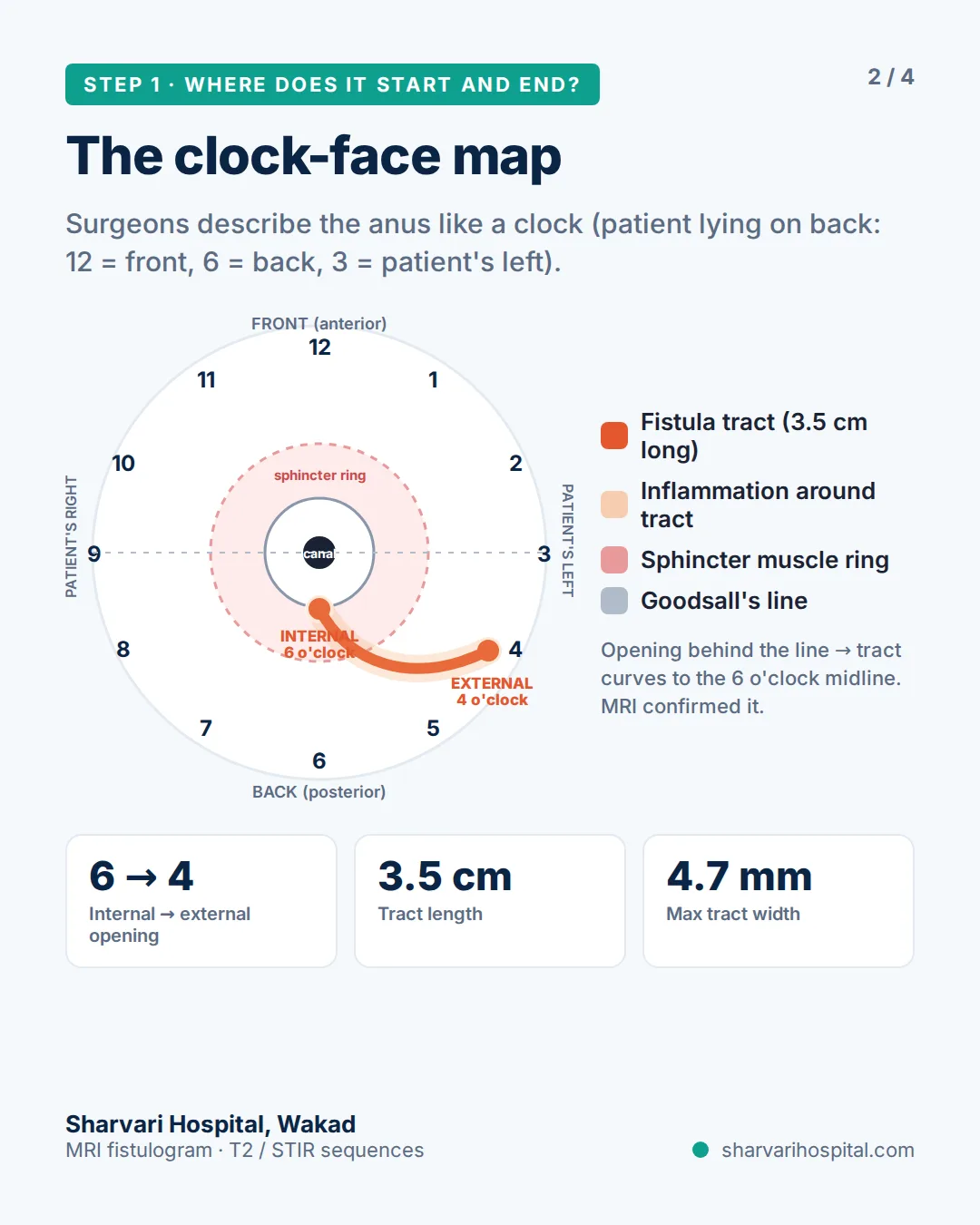
Real case: MRI mapped a trans-sphincteric tract 6→4 o’clock; the probe confirmed it; the plan changed from lay-open to hybrid fistulotomy + FiLaC. Read the case → · MRI fistula mapping
Watch: 45-Second Answer
Watch: Dr. Kharde explains it in 45 seconds
In 45 seconds, Dr. Kundan Kharde explains how the best fistula treatment is chosen — why the tract’s path and depth decide between laser (FiLaC), VAAFT, LIFT or seton placement, and why sphincter-preserving techniques matter for long-term control. The right option always follows examination and imaging. Results vary.
The Sharvari Difference
Your surgeon is your surgeon
At Sharvari Hospital you are treated by Dr. Kundan Kharde personally — the same surgeon for your consultation, your surgery, and every follow-up. No assigned or rotating panel. No call-centre coordinator deciding your care. You meet your surgeon before you decide anything.
Read his full fistula profile: Dr. Kundan Kharde — fistula doctor profile, credentials, technique choice .
One surgeon, start to finish
Dr. Kharde (MS, FMAS, 19 yrs) performs your surgery himself — not an assigned junior or a rotating panel.
One clear quote, no surprise bill
After your assessment you get a single written estimate covering surgeon fee, OT, anaesthesia, day-care stay, and follow-up. No coordinator upsell added later.
A local hospital, not an aggregator
Sharvari Hospital is a single ISO 9001:2015 hospital in Pimple Nilakh — your treatment happens here, with our own in-house operation theatre and team.
Your Treatment Journey
Recovery
From your first consultation to complete recovery, here is what your journey looks like.
1
Consultation & Diagnosis
Detailed examination by the specialist, with necessary investigations to confirm the diagnosis and stage.
2
Treatment Plan
Clear explanation of options (medical or surgical), expected outcomes, cost estimate, and insurance processing.
3
Procedure Day
Laser fistula treatment (FiLaC) or LIFT procedure. Chosen to preserve sphincter function where the tract anatomy allows. Results vary.
4
Recovery & Follow-Up
Structured follow-up protocol with diet guidance, wound care instructions, and scheduled check-ups until full recovery.
Included with every treatment
Get Sharvari Assure care →
Sharvari Assure™
Our structured 30-day recovery pathway for every fistula treatment — so you never feel alone after surgery.
Week 1
Daily wound check and dressing guidance via call
Week 2-3
In-person follow-up, diet, and healing assessment
Day 30
Final clearance visit and recovery confirmation
What is Anal Fistula?
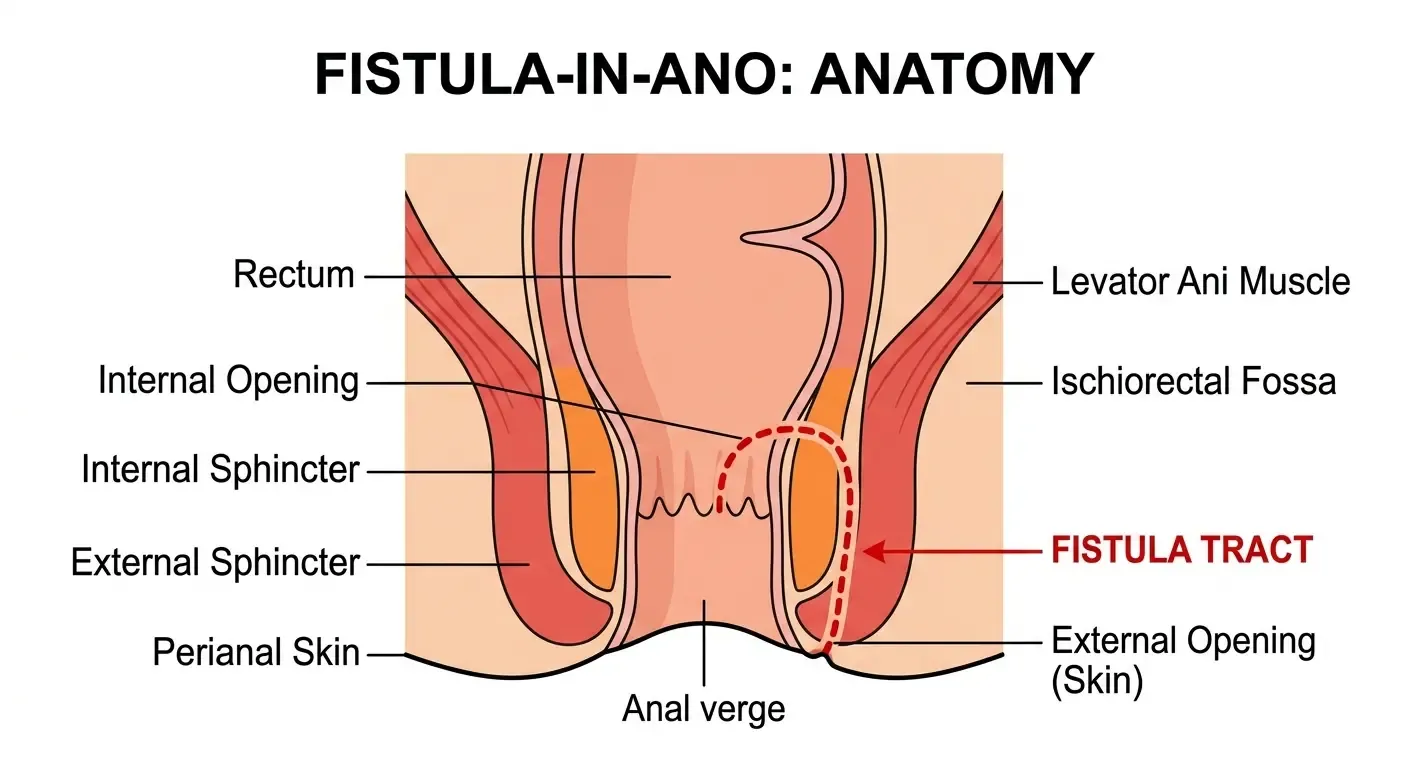
An anal fistula is a small tunnel between the inside of the anal canal and the nearby skin. It usually forms after an anal abscess (a pus-filled infection) drains or bursts. Treatment should clear infection, close the tunnel, and protect bowel control.
Causes
The most common cause is a past anal abscess. If you currently have a painful, swollen boil near the anus, see our perianal abscess treatment page — draining it early can lower the chance of a fistula forming. In some patients, long-term bowel inflammation like Crohn's disease can also cause fistula tracks. The tunnel may pass close to control muscles, so treatment must match your exact anatomy.
Diagnosis
We diagnose fistula with a focused exam and symptom history. Almost every fistula is then imaged before surgery — MRI fistulography (a detailed MRI scan that maps the tunnel path) or a trans-rectal ultrasound — so the tunnel's depth and any side branches are known before the operation is chosen. See how Dr. Kharde decides which operation you need.
Treatment options explained simply
Fistulotomy opens a shallow tunnel so it can heal from inside out. Seton is a soft thread that drains infection safely in deeper tracts. VAAFT (video-assisted anal fistula treatment) uses a tiny camera to find and close the internal opening. LIFT (ligation of intersphincteric fistula tract) closes the tunnel between muscle layers. Laser/FiLaC seals selected tunnels from inside. We choose the method that best fits your fistula type — see the comparison table. High, multi-tract or already-operated tunnels are planned differently — see our dedicated guide to complex or recurrent fistula treatment. Not sure an operation is always needed? Read our honest guide: fistula treatment without surgery — what actually works.
Risks
All fistula procedures carry some risk, including infection, delayed healing, or recurrence. Complex tunnels near bowel-control muscles can also increase treatment difficulty. Tell us early if you get fever, rising pain, heavy bleeding, or new swelling.
Why Choose Us
Fistula surgery needs sterile operation theatres, trained teams, and clear safety checks. We also arrange quick imaging when MRI fistulography is needed. Our ISO 9001:2015 process keeps each treatment step documented.
We provide 24/7 nursing support when you need admission, antibiotics, or pain control. Our insurance desk supports 50+ TPAs and helps with cashless or reimbursement documents. The hospital is in Pimple Nilakh, with easy access from Wakad, Hinjewadi, Baner, Balewadi, and Aundh.
ISO 9001:2015 · PCMC Reg. 884 Featured in Lokmat — verify our credentials and read Dr. Kharde's columns.
- ✓ ISO 9001:2015 certified quality management covering OPD, IPD, ICU, operating theatres, and surgical pathways.
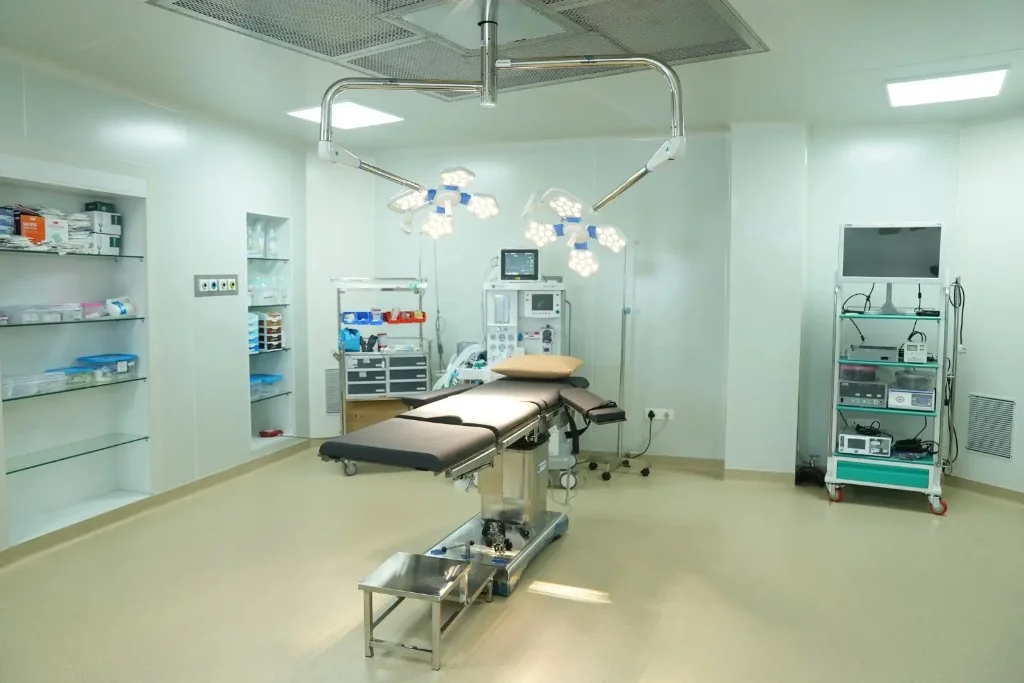
- ✓ Modern operation theatres with advanced laser, laparoscopic, and monitoring equipment for planned and emergency procedures.
- ✓ In-patient bed facility with structured nursing care and 24/7 hospital access when your surgeon advises admission or observation.
- ✓ Insurance & TPA desk — cashless treatment with 50+ partners where your policy allows; documentation support for reimbursement claims.
- ✓ EMI options for eligible non-insured patients, discussed transparently after your treatment plan is clear.
- ✓ Location in Pimple Nilakh with straightforward access for people travelling from Wakad, Hinjewadi, Baner, Balewadi, and nearby Pune localities.
Meet Dr. Kundan Kharde
Your Specialist
Dr. Kundan Kharde
MBBS, MS (General Surgery), FMAS
MBBS · MS (General Surgery) Maharashtra Medical Council Reg. No. 2013113384 Verify on the MMC register →
✓ Registered Medical Practitioner ✓ FMAS Certified ✓ 6,000+ Surgeries
19+
Years Exp
11+
As Specialist
4.9★
140+ Google reviews
Dr. Kundan Kharde has extensive expertise in laser and minimally invasive proctology procedures. He focuses on clear diagnosis, personalized treatment planning, and structured follow-up care for safe recovery.
View Full Profile → Visit Dr. Kharde's website →Learn more about Dr. Kundan Kharde, Fistula Surgeon .
Cost Breakdown — Fistula Surgery in Pune
FiLaC surgery cost in Pune depends on tract complexity and imaging — see the technique page for what drives it.
| Procedure | Starting Cost* | Hospital Stay |
|---|---|---|
| FiLaC laser fistula surgery (Fistula-tract Laser Closure) | ₹60,000 | Same-day discharge |
| VAAFT Surgery | ₹70,000 | Same-day discharge |
| LIFT Procedure | ₹65,000 | 1 day |
| Complex or recurrent fistula | ₹85,000+ | 1–2 days |
| MRI Fistulography / trans-rectal ultrasound (almost every patient, before surgery) | ₹3,000–₹5,000 | Day-care |
*Final cost depends on fistula type, anaesthesia, admission needs, and insurance coverage. Cashless support with 50+ TPAs. EMI options available.
Which technique suits which fistula?
Orientation only — the technique is confirmed after examination and imaging (how Dr. Kharde decides). Each technique name opens its own page.
| Technique | Best for | Sphincter cut? | Day-care? | Typical return to desk work | Published healing range* | Recurrence risk |
|---|---|---|---|---|---|---|
| Fistulotomy / fistulectomy | Simple, superficial tract, <30% sphincter | Yes, minimal | Yes | 3–7 days | ~90–95% | Low |
| LIFT | Trans-sphincteric tract; intact sphincter needed | No | Yes | 5–10 days | ~60–80% | Moderate |
| FiLaC (laser) | Trans-sphincteric tract; patient wants no cut | No | Yes | 2–5 days | ~60–70% | Moderate |
| VAAFT | Complex / branched tract, unclear internal opening | No | Yes | 3–7 days | ~70–80% | Moderate |
| Seton (staged) | Active sepsis; high / recurrent / horseshoe; Crohn's | No (drainage) | Yes (stage 1) | 2–5 days per stage | Bridge to definitive operation | n/a |
*Published literature ranges, not Sharvari outcome data; results vary and depend on tract anatomy.
Traditional Surgery vs. Laser Treatment
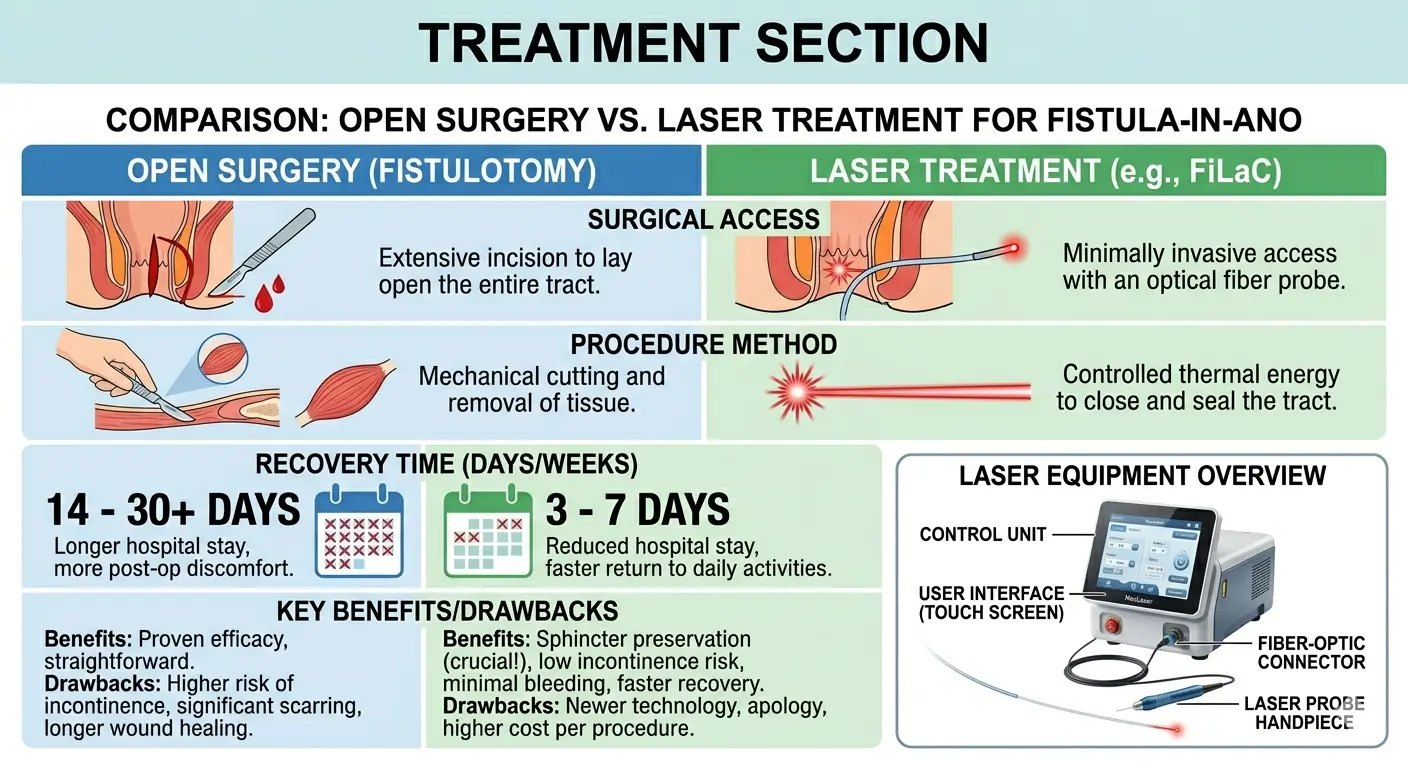
| Feature | Traditional | Laser at Sharvari |
|---|---|---|
| Pain Level | Can be significant | Reduced with minimally invasive approach |
| Recovery | Longer wound healing | Faster healing with structured protocol |
| Hospital Stay | May need longer stay | Usually same-day discharge |
| Scarring | More tissue disruption | Tissue-sparing laser precision |
| Follow-Up | Standard wound checks | Structured recovery + infection control |
Ready to get treated? Book your consultation now.
₹60,000* onwards · Insurance accepted · No-Cost EMI from ₹5,000/mo* · Same-day consultation
Have more questions? Talk to Dr. Kharde directly.
Get a clear diagnosis and treatment plan in your first visit.
Book Appointment →
Patient Education
Watch: Anal Fistula Symptoms & Laser Treatment Explained
Dr. Kundan Kharde explains the warning signs of anal fistula — pain while sitting, swelling and recurrent pus discharge — plus the causes and the advanced laser treatment options at Sharvari Hospital, Pune.
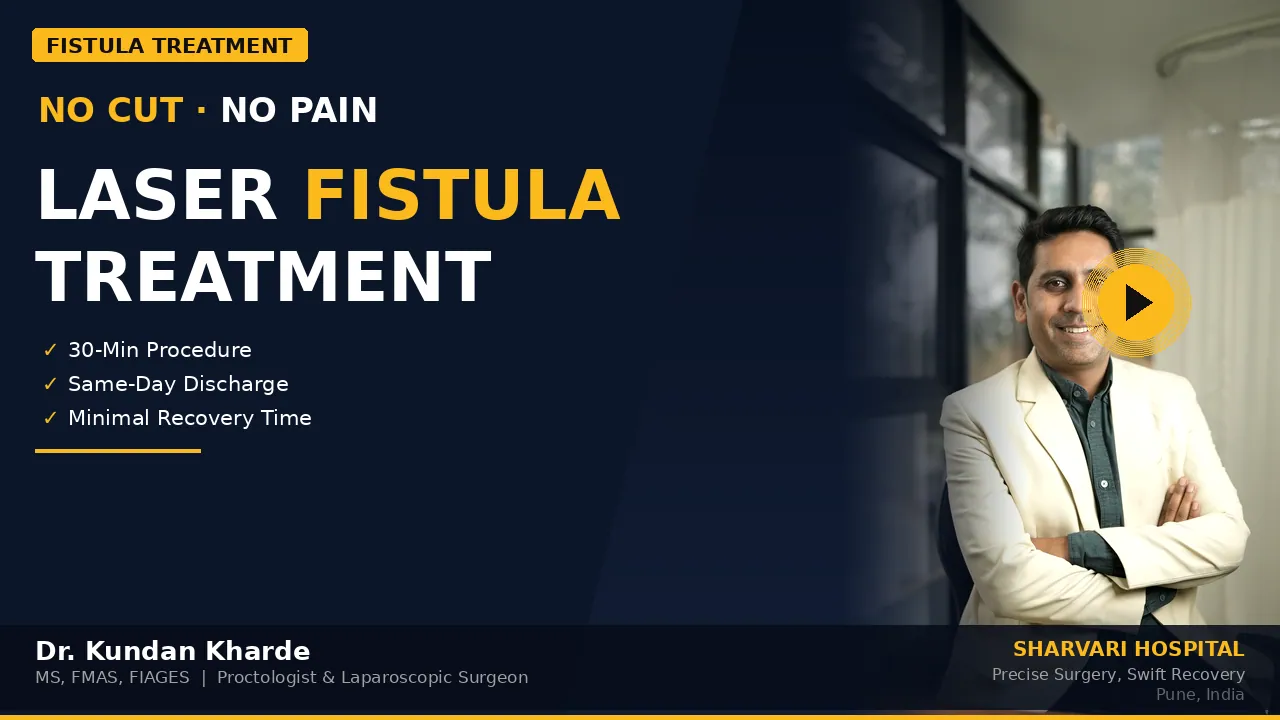
No Stitches Required
30-Minute Procedure
Same-Day Discharge
Complex, recurrent and high-complexity fistula
Not every fistula is a simple low tract. High trans-sphincteric, supra-sphincteric, horseshoe and multi-tract fistulas — and especially fistulas that have recurred after multiple previous operations — need MRI mapping, a seton-first strategy and sphincter-preserving techniques such as LIFT, VAAFT or FiLaC. Dr. Kundan Kharde takes referrals for these recurrent and high-complexity fistulas from across Pune and PCMC. Complex & recurrent fistula treatment →
FAQs
Dr. Kundan Kharde decides from the tract itself, not from a fixed package. Almost every fistula is imaged first — an MRI fistulogram or a trans-rectal ultrasound — to show the tract's depth, its branches and how much sphincter muscle it crosses. An early, simple, superficial tract is then treated with fistulotomy. A mature, fibrosed superficial tract is treated with fistulectomy, which removes the hardened tract rather than only opening it. When the tract is deep and involves more than 50% of the external sphincter, he uses a combination technique — proximal fistulotomy with distal core-out, adding a seton or laser (FiLaC) as required — so the tract is cleared while continence is protected. Recurrent, multiple or horseshoe tracts are treated in stages. The final decision is confirmed at surgery.
Almost every fistula patient at Sharvari Hospital is imaged before surgery — an MRI fistulogram or a trans-rectal ultrasound. A fistula is a tunnel, and only part of it is visible from outside: imaging shows how deep the tract runs, whether it has side branches, and how much of the sphincter muscle it crosses, and those three findings decide whether a simple fistulotomy is safe or a sphincter-preserving combination technique is needed. In one recent case the MRI mapped a trans-sphincteric tract from the 6 o’clock internal opening to a 4 o’clock external opening, the probe in theatre confirmed it exactly, and the plan changed from a full lay-open to a hybrid fistulotomy + FiLaC. In a second, recurrent case, the MRI found a 6 cm horseshoe abscess and a tract crossing the external sphincter behind one small skin opening with almost no discharge — none of which could be seen from outside. How the map is read is explained on our MRI fistula mapping page.
Most persistent fistulas require a procedure to close the tract. Conservative measures may provide temporary relief but typically do not eliminate the underlying pathway.
Recovery varies with fistula complexity and the procedure used. Your surgeon will give activity and wound care guidance to support smooth healing.
Recurrence risk depends on fistula type. Choosing the right technique and following follow-up care reduces the chance of repeat problems.
Some patients may benefit from laser or minimally invasive options depending on the fistula type. Your consultation will confirm the safest approach for your anatomy.
Fistulas are often classified by how much anal sphincter muscle the tract crosses — such as intersphincteric, transsphincteric, suprasphincteric, or extrasphincteric patterns. Complex tracts need careful mapping because the risk-to-benefit balance of fistulotomy, drainage, or sphincter-sparing options changes with anatomy.
Magnetic resonance imaging can outline deep or branching tracts, secondary abscess pockets, or unexpected extensions before surgery. At Sharvari Hospital almost every fistula is imaged before surgery — an MRI fistulogram or a trans-rectal ultrasound — because the tract's depth and branches cannot be judged from the external opening alone.
Many insurance plans cover fistula procedures. Our team assists with cashless claims and documentation. Contact us for a cost estimate.
The operation itself is done under anaesthesia, so you do not feel pain during it. Afterwards, discomfort is usually manageable with prescribed tablets. Laser (FiLaC), VAAFT and other sphincter-preserving procedures generally cause less post-operative pain than a wide open lay-open, though individual experience varies.
A simple fistulotomy or laser case usually takes under an hour of operating time. Complex mapping, examination under anaesthesia or combined procedures take longer. Most day-care patients spend about half a day at the hospital in total.
Yes, for most eligible laser and limited procedures — same-day discharge is the norm at Sharvari Hospital. Complex or staged cases may need overnight observation. Dr. Kharde confirms this with you before surgery.
There is no official ranking of fistula specialists in Pune, so judge a surgeon on what they actually do. Dr Kundan Kharde, MS (General Surgery), FMAS — 19+ years in practice and 6,000+ surgeries — performs all five fistula techniques (FiLaC laser, VAAFT, LIFT, seton and fistulotomy) and images almost every tract with an MRI fistulogram or trans-rectal ultrasound before choosing between them. He operates at Sharvari Hospital, Pimple Nilakh, near Wakad Chowk. Results vary.
Fistula surgery at Sharvari Hospital is performed by Dr Kundan Kharde, MS (General Surgery), FMAS — 19+ years in practice and 6,000+ Surgeries. He performs FiLaC laser, VAAFT, LIFT, seton and fistulotomy, and picks the technique from the tract anatomy on an MRI fistulogram or trans-rectal ultrasound. The hospital is in Pimple Nilakh, near Wakad Chowk, Pune.
Ask four things. Which techniques does the surgeon actually perform — a centre offering only one operation will fit you to it. Is the tract imaged before surgery, as ASCRS clinical practice guidance advises for complex or recurrent fistula. What is the plan if it recurs. And which sphincter-preserving options apply to your anatomy, since continence is the risk that matters. Our 12 questions to ask before fistula surgery covers each one.
Yes. Dr. Kundan Kharde holds MBBS (2007, I.M. Sechenov Moscow Medical Academy) and MS General Surgery (2013, Dr. D. Y. Patil Medical College, Pimpri, Pune), and is registered on the Maharashtra Medical Council's modern-medicine (allopathic) register — MMC Reg. No. 2013113384, valid to 12/11/2028. He examines and operates personally. Verify on the MMC register →
Find Sharvari Hospital
Fistula treatment by Pune area
Same hospital (Pimple Nilakh) — local guides for travel time and suburb context. Most patients come from the Wakad & west Pune corridor, and we also run a dedicated guide to fistula treatment in PCMC (Pimpri-Chinchwad).
Also serving: Aundh · Pimple Saudagar · PCMC · Ravet · Tathawade · Thergaon
हिंदी: भगन्दर का इलाज (Bhagandar Ka Ilaj)
मराठी: मुख्य फिस्टुला मार्गदर्शन · वाकड · हिंजवडी · बाणेर · बालेवाडी
Related condition: Perianal Abscess Treatment (urgent drainage) → · Anal Fissure Treatment (sharp pain with stool) →
Helpful reading: Diet after fistula surgery — what to eat & avoid → · MRI fistula mapping before surgery →
Piles by area: Wakad Hinjewadi Hernia Surgery → मराठी: वाकड हिंजवडी
Recovery roadmap
Your Laser Fistula Surgery (FiLaC / VAAFT / LIFT) recovery — Day 1, 7 & 30
Fistula recovery is gradual and depends on tract length. Sphincter-sparing laser typically allows desk work within a week.
- 1
Day 1 — Surgery Day
Day-care procedure
- 45–90 min sphincter-sparing laser procedure
- Anaesthesia type confirmed in pre-op assessment
- Same-day or overnight discharge after observation
- Wound dressing taught to attendant before discharge
- Oral antibiotics + painkillers as prescribed
- 2
Day 7 — First Follow-up
Healing begins
- Daily sitz baths + Betadine wash
- Most desk workers return to office by Day 5–7
- First wound review at hospital (free)
- Discharge from external opening reduces visibly
- Mild discomfort during bowel movements expected
- 3
Day 30 — Healing Review
External tract closed
- External opening typically closed/closing well
- Resume gym, cycling, prolonged sitting
- Final follow-up + MRI review if indicated
- Sphincter function fully preserved (vs traditional fistulotomy)
- Long-term hygiene + diet guidance
Note: Complex / high / recurrent fistulae may need 6–8 weeks for full healing. VAAFT and LIFT recoveries differ slightly — your surgeon will explain your specific plan.
What our fistula patients say
Verified Google reviews from Sharvari Hospital patients, Pimple Nilakh, Pune.
★★★★★
“Excellent experience for my laser surgery. Minimal pain, quick discharge and detailed follow-up instructions. The doctor answered all my questions without rushing.”
Sumeeran Kesarkar
Pune (Pimple Nilakh / Wakad / PCMC)
Minimal pain · Quick discharge ★★★★★
“Highly recommend Sharvari Hospital for laser and laparoscopic surgeries. Good follow-up and very approachable team. Recovery matched what was discussed during counselling.”
Chandan M Shahu
Pune (Pimple Nilakh / Wakad / PCMC)
Recovery matched plan ★★★★★
“Very professional and caring team. The doctor explained the procedure clearly and my recovery was smooth and comfortable. I appreciated the calm environment and the way staff coordinated admission and discharge through every step.”
Ameya
Pune (Pimple Nilakh / Wakad / PCMC)
Smooth recovery ★★★★★
“From admission to discharge, everything was well organized. Nurses and staff were very supportive throughout my stay. Instructions after surgery were clear and follow-up was easy to arrange.”
Omkar Salanki
Pune (Pimple Nilakh / Wakad / PCMC)
Well-organised stay ★★★★★
“The hospital ambience is clean and calm. The doctor listens patiently and gives confidence to the patient and family. I felt informed before consenting for the procedure.”
Suryanarayana Kotnak
Pune (Pimple Nilakh / Wakad / PCMC)
Clear counselling ★★★★★
“I came here on a friend's recommendation and was very happy with the treatment and the prompt response of staff. Billing and documentation were explained simply.”
Robin John
Pune (Pimple Nilakh / Wakad / PCMC)
Prompt responseRelated Conditions & Treatments
Related articles on fistula & proctology
General
Anorectal Abscess and Fistula: Understanding the Connection and Treatment Options
Anorectal Abscess and Fistula: Understanding the in Pune: symptoms, treatment options, and recovery guidance at Sharv…
Read more →
General
Piles, Fissure & Fistula Diet: What to Eat (and Avoid) — Pune Surgeon Tips
Doctor-reviewed diet guide for piles, anal fissure and fistula — foods that soften stool, foods that trigger pain, an…
Read more →
Proctology
Fistula With Crohn's or Tuberculosis: Why Some Fistulas Won't Heal
Fistula keeps coming back despite surgery? Tuberculosis or Crohn's disease may be the cause. A Pune surgeon explains…
Read more →
Proctology
Recurrent & High-Complexity Anal Fistula: Getting a Second Opinion After Multiple Failed Operations (Pune, 2026)
Fistula back after 2-3 operations? Why recurrent and complex anal fistulas fail, what a second opinion should involve…
Read more →
Proctology
Complex Fistula Treatment: How Specialists Handle Difficult Cases
How specialists manage complex anal fistulas: imaging, setons, staged surgery, and continence protection. Expert care…
Read more →
Proctology
5 Reasons Sharvari Hospital Excels at Fistula Care Near Wakad
Best fistula hospital near Wakad: 5 reasons patients choose Sharvari for safe surgery, insurance support, and practic…
Read more →
Plan Fistula Treatment in Pune
Call Sharvari Hospital for imaging-guided fistula care, cashless insurance support, and a clear recovery roadmap.