Some of the most frustrated patients I meet are not people with a new fistula. They are people who have had two, three, sometimes four operations — and the discharge is back within months. Often the surgery was not the problem. The problem was that nobody asked why the fistula formed in the first place.
In India, two underlying diseases deserve to be looked for in every stubborn fistula: tuberculosis (TB) and Crohn’s disease. Both can make a fistula behave like an ordinary one on the outside while refusing to heal on the inside. This guide explains how they are recognised, which tests matter, and why the order of treatment decides the outcome. If you are looking for surgical options for a fistula that is complex or recurrent, see our complex fistula treatment page and the main fistula treatment service.
What is a “disease-driven” fistula, and how is it different from a normal one?
Most anal fistulas are “cryptoglandular” — they start from an infected anal gland and heal well after correct surgery. A disease-driven fistula is caused by an ongoing illness such as tuberculosis or Crohn’s disease. Because the illness keeps producing inflammation, the tract re-forms after surgery until the disease itself is treated with medicines.
Think of it like a leaking roof. An ordinary fistula is a broken tile — replace it and the leak stops. A TB or Crohn’s fistula is a roof in constant rain with a weak structure — patching one tile will not help for long.
| Feature | Ordinary (cryptoglandular) fistula | Tubercular fistula | Crohn’s fistula |
|---|---|---|---|
| Cause | Infected anal gland | Mycobacterium tuberculosis infection | Chronic inflammatory bowel disease |
| Typical openings | Usually one | Often multiple, may be recurrent | Often multiple, complex |
| Skin around opening | Normal or mildly red | Undermined edges, thin watery discharge | Bluish, swollen skin, deep ulcers, fleshy tags |
| General symptoms | Usually none | Sometimes fever, weight loss, night sweats, cough | Loose stools, abdominal pain, weight loss |
| Heals with surgery alone? | Usually yes | Usually no — needs anti-TB treatment | Usually no — needs medical control |
| Key test | MRI for tract mapping | Histopathology + GeneXpert/PCR | Colonoscopy with biopsy + MRI |
How common is a tubercular fistula in India?
Anal tuberculosis is rare worldwide, but India carries the world’s largest TB burden, so surgeons here see it more often. Indian studies have found TB in a small but meaningful share of anal fistulas — enough that any fistula which recurs repeatedly, has multiple openings, or behaves unusually should be tested for TB.
Exact figures vary widely between studies depending on the test used. What is consistent is that TB is under-diagnosed in fistula patients, for one simple reason: the removed tissue is often not sent for testing, or is tested only by one method with limited sensitivity. Many patients in Pune — including young working professionals in Hinjawadi and Wakad who otherwise feel perfectly healthy — have no chest symptoms at all. Isolated anal TB is possible.
Which symptoms should make me suspect TB or Crohn’s behind my fistula?
Suspect an underlying disease if your fistula has recurred after surgery, you have more than one opening, the wound stays open and weepy for months, or you have fever, weight loss, night sweats, chronic loose stools, abdominal pain or blood and mucus in stool. A past or family history of TB or bowel disease also matters.
Warning patterns I look for in the clinic:
- Two or more recurrences after technically sound surgery
- Multiple external openings, or new openings appearing in different places
- A wound that never heals — still discharging three months after surgery
- Unusual appearance — undermined bluish edges, painless deep ulcers, swollen “elephant-ear” skin tags
- Bowel symptoms — diarrhoea for weeks, cramping, urgency, mucus
- Systemic symptoms — low-grade evening fever, unexplained weight loss, loss of appetite
- Young age at onset, especially in teens and twenties with recurrent perianal abscesses
None of these proves TB or Crohn’s. They are reasons to test before operating again.
Which tests actually confirm TB or Crohn’s in a fistula?
No single test is perfect, so the diagnosis is built from several. For TB: histopathology of the tract wall plus GeneXpert (CBNAAT) or PCR on pus or tissue, and a chest X-ray. For Crohn’s: colonoscopy with ileal and colonic biopsies, blood tests, and a pelvic MRI to map the tracts.
| Test | What it looks for | Why it matters |
|---|---|---|
| Histopathology of excised tract | Granulomas (caseating in TB; non-caseating in Crohn’s) | Classic evidence, but can miss TB in a significant share of cases |
| GeneXpert / CBNAAT on pus or tissue | TB DNA and rifampicin resistance | Fast; Indian studies show useful accuracy on fistula pus |
| PCR for TB | TB DNA | More sensitive than histopathology in some Indian series |
| Chest X-ray | Old or active lung TB | Supports the diagnosis; guides the physician |
| Colonoscopy with biopsies | Crohn’s ulcers, strictures, intestinal TB | Separates Crohn’s from intestinal TB and ordinary fistula |
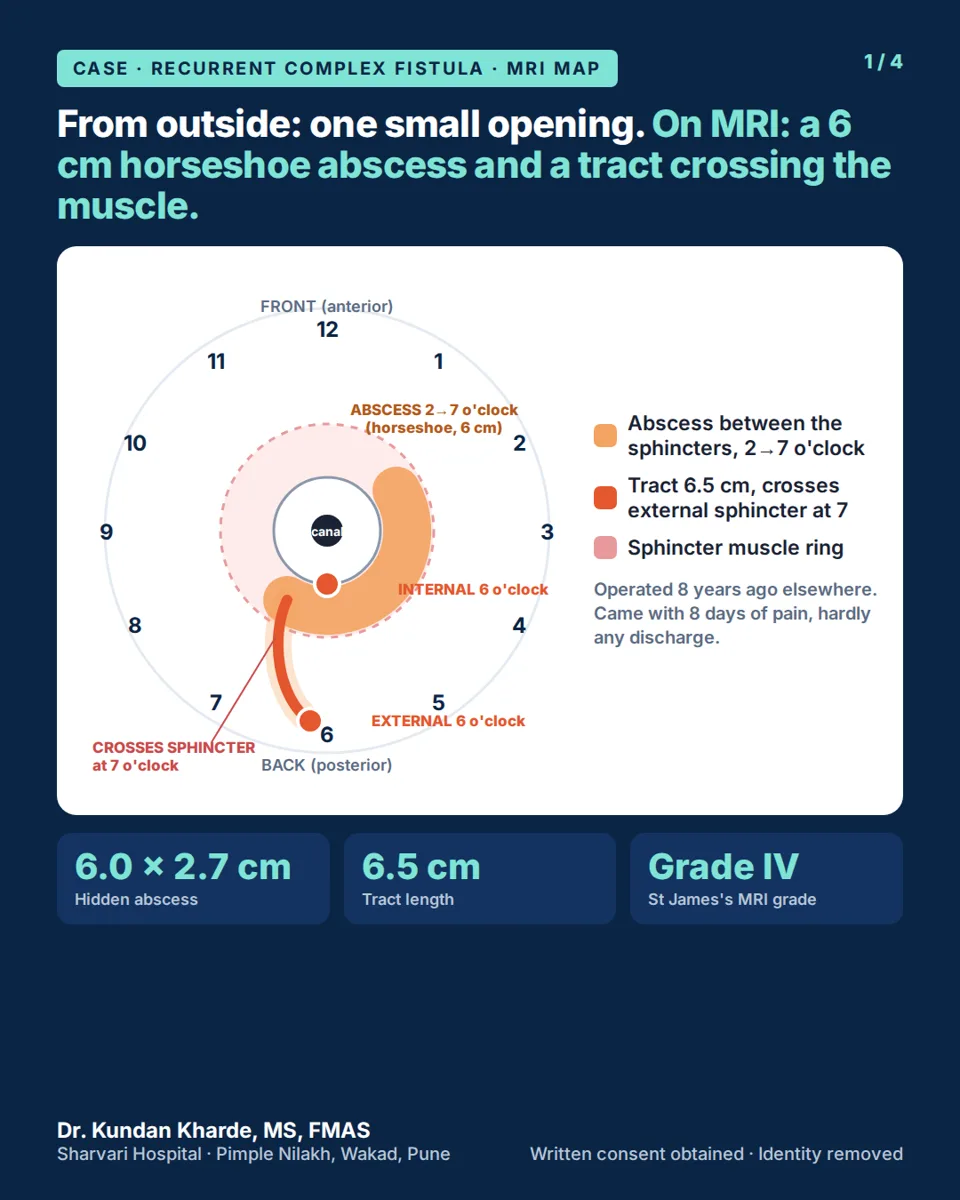
| MRI fistulogram | Tract anatomy, abscesses, horseshoe extensions | Essential for safe surgery in any complex fistula |
| Blood tests (CBC, ESR/CRP, HIV, blood sugar) | Inflammation, immunity, diabetes | HIV and uncontrolled diabetes also impair healing |
One practical tip: tissue must be sent correctly. For TB testing, part of the specimen should go in saline (not only formalin), because formalin destroys what GeneXpert and culture need. This is a small step that is frequently missed — and it is one of the first things I check in a patient’s old reports. For more on imaging, see how an anal fistula is diagnosed.
Why is it so important to tell TB and Crohn’s apart in India?
Because the treatments are opposite. Crohn’s is treated by suppressing immunity — steroids, immunomodulators and biologics such as infliximab. Those same drugs can flare or reactivate tuberculosis. TB and Crohn’s can look alike on colonoscopy and biopsy, so a wrong label can cause months of harmful treatment.
This is the single most India-specific point in this article. In Western countries, a young patient with a complex perianal fistula and bowel symptoms is assumed to have Crohn’s until proven otherwise. In India, intestinal TB is a genuine mimic, and doctors are trained to exclude it carefully. Standard practice before starting any biologic drug is screening for latent TB.
Equally, I discourage starting a “trial” of anti-TB drugs for a fistula without any supporting evidence. Six months of medicines have side effects, and if the real cause is Crohn’s, precious time is lost while the fistula worsens. The right approach is to gather proper evidence first, with the gastroenterologist or physician involved when needed.
How is a tubercular fistula treated?
A tubercular fistula is treated with a full course of anti-tubercular therapy (ATT) — at least six months, starting with four drugs for two months — combined with sensible, sphincter-safe surgery to drain pus and remove or lay open the tract. Surgery alone usually fails; medicines alone may not clear established tracts.
What this looks like in practice:
- Confirm the diagnosis — histopathology, GeneXpert/PCR, chest X-ray.
- Start ATT through the treating physician. In India, anti-TB medicines are provided free under the National TB Elimination Programme, and patients are registered for follow-up. Some patients with extensive or relapsing anal TB need longer courses; that decision rests with the physician.
- Surgery, timed sensibly. Abscesses are drained immediately. Definitive tract surgery (fistulotomy for low tracts, or sphincter-saving options for high ones) is often done once ATT has begun and inflammation has settled.
- Complete the course. Stopping ATT early because “the wound looks better” is the commonest reason for relapse — and for drug-resistant TB.
The encouraging news: Indian research shows that once TB is properly treated, healing rates of tubercular fistulas are comparable to ordinary fistulas, even though the tracts are often more complex.
How is a Crohn’s fistula treated?
A Crohn’s fistula is managed jointly by a surgeon and a gastroenterologist. The surgeon drains any abscess and places a loose “draining” seton to keep the tract open and infection-free. The gastroenterologist controls inflammation with medicines, often biologics. Definitive closure is attempted only after the rectum is calm.
| Step | Who | Purpose |
|---|---|---|
| Examination under anaesthesia + drain abscess | Surgeon | Remove pus, map tracts with MRI |
| Loose (draining) seton | Surgeon | Prevents abscess from re-forming; protects sphincter |
| Antibiotics + biologic therapy (after TB screening) | Gastroenterologist | Heals the bowel and reduces fistula activity |
| Assess the rectum again | Both | Definitive repair only if there is no active proctitis |
| Selected closure — LIFT, advancement flap, or seton removal | Surgeon | Closes tract while preserving continence |
Published guidance supports combining drainage and seton placement with medical therapy, rather than either alone. What we avoid in Crohn’s is aggressive cutting: a wide fistulotomy through inflamed tissue can leave a non-healing wound and damage continence. Patience — sometimes months with a comfortable seton — is part of good care.
Can laser or “no-cut” procedures cure a TB or Crohn’s fistula?
Not by themselves. Laser (FiLaC), VAAFT and LIFT close or destroy the tract mechanically, but if TB or Crohn’s inflammation is still active, the tract tends to re-form. These procedures can be useful after the disease is controlled — never as a replacement for diagnosing and treating it.
This is where honesty matters. Patients are often told that a quick laser procedure will solve a fistula that has already failed two operations. For an ordinary fistula, laser and other sphincter-saving methods have a real role — see our comparison of LIFT, VAAFT and FiLaC. But for a fistula driven by an active disease, no technique — laser, flap or seton — replaces treating the disease. If anyone offers a guaranteed cure without testing for the cause of repeated failure, ask why.
What does recovery look like for a TB or Crohn’s fistula?
Recovery is measured in months, not days. TB fistulas usually heal during or soon after the six-month anti-TB course. Crohn’s fistulas may need a seton for several months while medicines work. The aim is steady improvement — less discharge, no abscesses, protected continence — rather than a single-day cure.
| Timeline | Tubercular fistula | Crohn’s fistula |
|---|---|---|
| Weeks 0–2 | Tests, abscess drainage, ATT started | EUA, drainage, seton, colonoscopy |
| Months 1–2 | Intensive ATT phase; wound care | Biologic/medical induction |
| Months 2–6 | Continuation ATT; definitive surgery if needed | Reassessment; seton kept or removed |
| Beyond 6 months | Most healed; follow-up for relapse | Selected closure; long-term IBD follow-up |
During this period, regular wound reviews matter. For patients from Wakad, Hinjawadi, Baner, Aundh or Tathawade, getting these reviews close to home — instead of crossing the city every fortnight — is what keeps people from skipping visits, and skipped visits are when abscesses get missed.
When should I see a doctor urgently?
Seek care the same day if you have a painful, swollen lump near the anus with fever, pus that has suddenly stopped draining with rising pain, difficulty passing urine, or you feel unwell while on TB or Crohn’s medicines — for example yellow eyes, severe vomiting, rash or new breathlessness.
Red flags:
- Fever with rapidly increasing perianal pain or swelling (abscess)
- Spreading redness, blackening of skin, or severe pain out of proportion — rare but serious infection
- Jaundice, severe nausea or vision changes while on anti-TB drugs (drug side effects — contact your physician)
- Bleeding with weight loss or change in bowel habit — needs colonoscopy
- Any new loss of control over gas or stool
Why Choose Sharvari Hospital for a Non-Healing Fistula?
- We look for the cause, not just the tract. Dr. Kundan Kharde (MBBS, MS – General Surgery, FMAS, 19+ years of surgical experience) reviews old operation notes, pathology reports and imaging before recommending another operation.
- Proper tissue testing. Specimens are sent for histopathology and, where indicated, GeneXpert/PCR — collected the right way.
- MRI fistula mapping for every complex or recurrent case.
- Team approach. We coordinate with physicians and gastroenterologists for anti-TB therapy and Crohn’s care, so surgery happens at the right time.
- Every technique available, used honestly — fistulotomy, seton, LIFT, VAAFT, FiLaC and flap repair — chosen for your anatomy and disease status, not sold as a package.
- Close to home for the long follow-up — about 5 minutes from Wakad and 10 minutes from Hinjawadi Phase 1, with easy access from Baner, Aundh and the PCMC belt.
- Transparent estimates and cashless insurance support.
Had more than one fistula operation, and it is back again? Bring your reports — let us find out why.
- 📞 Phone / WhatsApp: +91 951 951 1928
- 📧 Email: [email protected]
- 📍 Sharvari Hospital, Pimple Nilakh, Pune — 411027
- 🔗 Complex fistula treatment · Fistula treatment at Sharvari · Fistula treatment in Wakad · Fistula treatment in Hinjewadi
Related Reading
- Recurrent or Complex Fistula? When to Get a Second Opinion
- What Causes a Recurrent Fistula — and How to Prevent It
- Types of Anal Fistula: Simple vs Complex
- How Is an Anal Fistula Diagnosed? MRI, Ultrasound and Tests
- Fistula Came Back After Surgery: A Hidden Abscess Found on MRI
Written and reviewed by Dr. Kundan Kharde, MBBS, MS – General Surgery, FMAS, Sharvari Hospital, Pune. Last reviewed: September 2026.
This article is for patient education only and does not replace an in-person consultation. Anti-tubercular and Crohn’s medicines must be prescribed and monitored by a qualified physician or gastroenterologist; never start or stop them on your own.