Part of the Sharvari Proctology Centre
Piles Treatment in Wakad — Sharvari Hospital, Pune
Piles (haemorrhoid) treatment for Wakad residents is done at Sharvari Hospital, Pimple Nilakh — 5 minutes from Wakad Chowk — by Dr. Kundan Kharde (MS, FMAS), a laser surgeon with 19+ years' experience and 6,000+ surgeries. Suitable cases get laser haemorrhoidoplasty as a day-care procedure: most patients go home the same day and are back to desk work in 2–3 days — results vary.

Wakad's skyline of glass towers, the constant motion near the chowk, and the long ride from Hinjewadi every evening make it easy to write off bleeding piles as "just stress" or "just diet." Yet fresh red blood on tissue paper, a lump that prolapses on straining, an ache that worsens on a 10-hour office chair — these are not lifestyle problems waiting for a smoothie. They are graded vascular cushions misbehaving, and they need a proctologist's eye, not another tube of cream.
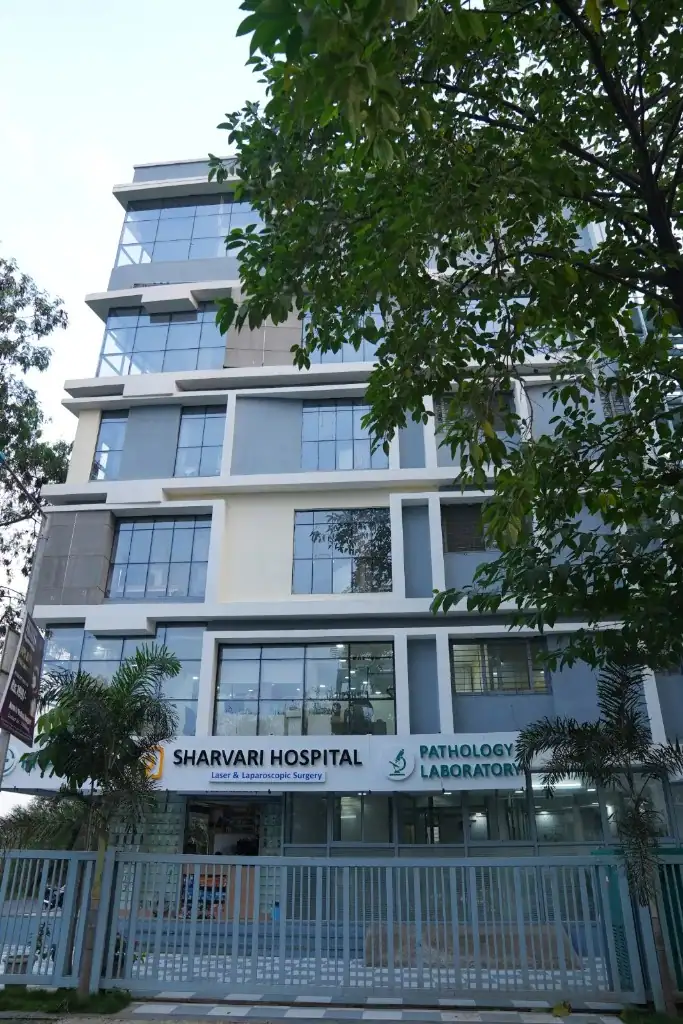
Sharvari Hospital sits in Pimple Nilakh, behind Gulmohor Park — about 2.1 km from Wakad chowk, often a 5-minute drive when signals cooperate. For Wakad residents, Vishal Nagar professionals, and the Hinjewadi IT corridor, that proximity matters more than any glossy brochure: post-procedure follow-up is realistic when the hospital is nearer than your supermarket, not across the city.
Dr. Kundan Kharde brings 19+ years of surgical experience and over 6,000+ surgeries to this campus. Piles care here is not one laser slogan — it is matching the right intervention (rubber band ligation, stapled MIPH, laser hemorrhoidoplasty, or selective excision) to your grade and symptoms. The hospital is ISO 9001:2015 certified, partners with 50+ insurers for cashless support, and keeps emergency teams running 24/7 for the rare bleeding spikes that arrive on a Saturday night.
Residents from Wakad–Hinjewadi Road, Vishal Nagar's apartment clusters, the mall corridor, and Tathawade's bridges choose us for same-day clinical assessments, structured recovery plans tailored to desk-bound jobs, and an insurance desk that speaks plainly. This page is a complete guide to laser and minimally invasive piles treatment from Wakad — what the surgery looks like, what it costs, how to reach us, and how Wakad's specific lifestyle factors into your plan.
Sharvari Assure™
Our structured 30-day recovery pathway for every piles treatment — so you never feel alone after surgery.
Week 1
Daily wound check and dressing guidance via call
Week 2-3
In-person follow-up, diet, and healing assessment
Day 30
Final clearance visit and recovery confirmation
Who is the piles doctor for Wakad patients?
Dr. Kundan Kharde (MBBS · MS (General Surgery)) is the consultant proctologist Wakad patients see at Sharvari Hospital, Pimple Nilakh — 2.1 km away via Wakad Chowk and Vishal Nagar. He has 19+ years in general and laparoscopic surgery and 6,000+ Surgeries behind him. Piles are graded at the first visit, then matched to banding, laser or stapler day-care surgery. Results vary between patients.
Piles in plain language — what they are, what they are not
Piles (the medical term is haemorrhoids) are cushions of vascular tissue that everyone is born with — they help seal the anal canal and keep stool from leaking. They become a problem only when those cushions swell, stretch, bleed, prolapse outside, or thrombose. So when someone says "I have piles," they almost always mean "I have symptomatic piles."
Internal piles are above the dentate line; they bleed but rarely hurt. External piles are below it; they hurt — especially when a clot forms (thrombosed external pile). Many people in Wakad walk into our OPD with a mix of both, which is why grading and examination matter more than anecdote.
Things that worsen piles in the Wakad-Hinjewadi belt: prolonged sitting, straining on hard stools, low-fibre diets dominated by tiffin services and Swiggy orders, dehydration during summer commutes, weightlifting without breath control, late-pregnancy pelvic pressure, and chronic cough from PM2.5 exposure. None of these cause piles by themselves — they unmask or accelerate them.
Symptoms — when piles need a doctor, not another cream
Wakad residents tell us they ignored symptoms for weeks or months because life was busy. Here is the practical threshold to walk in:
- Bright red blood on stool, tissue, or in the bowl — once is worth a check; twice is non-negotiable.
- A lump that prolapses on straining — even if it returns inside on its own.
- A lump that does not return inside — that is Grade 4 territory and creams will not fix it.
- Itching, mucous staining underwear, incomplete-evacuation feeling — chronic, not one bad day.
- A new, painful, hard lump near the anus — likely thrombosed external pile, best drained early.
- Fatigue, breathlessness on stairs, pale palms — your piles may be quietly anaemising you.
Red flags — go to emergency, not OPD: heavy bleeding (toilet bowl turns red, not just streaks), fever with severe perianal pain, spreading redness, inability to pass urine after a bleeding episode. Use our 24/7 line: +91 951 951 1928.
Grading of piles — the single most important question
Treatment depends entirely on grade. A Grade 1 patient who is told to undergo Grade 4 surgery has been overtreated; a Grade 4 patient told to "try fibre" has been undertreated. We grade in the OPD before discussing options:
- Grade 1: Bleeding without prolapse. Often handled with diet, sitz baths, RBL, or laser.
- Grade 2: Prolapse on straining, returns spontaneously. RBL, laser hemorrhoidoplasty, or stapler suit most.
- Grade 3: Prolapse on straining, requires manual reduction. Stapler MIPH, laser, or selective excision.
- Grade 4: Permanent prolapse, often with thrombosis or skin tags. Excision or stapler with tag work.
Skipping the grading step is the most common reason a Wakad patient gets the wrong surgery elsewhere and ends up with us six months later for a redo. Not every problem after a previous procedure is recurrence, though — persistent pain, thin stools or a wound still open months later can mean scar narrowing, as in this real case of anal stenosis after piles surgery corrected with mucoplasty.
Treatment options — laser, stapler, RBL, excision
Every option has its place. Here is what we offer at Sharvari Hospital, in plain English:
Laser hemorrhoidoplasty / laser ablation: A diode laser fibre is introduced through a small port; controlled energy shrinks the symptomatic vascular tissue. Stitches are minimal, day-care discharge is typical, and most desk workers are back to work in 5-7 days. Best for selected Grades 1-3.
Stapled haemorrhoidopexy (MIPH / PPH): A circular stapler repositions prolapsed mucosa back inside the canal and removes a ring of redundant tissue. Excellent for circumferential Grade 3-4 prolapse. Less external skin work, faster ambulation than open surgery.
Rubber band ligation (RBL): An office-friendly procedure for selected internal piles without major prolapse — bands cut off blood supply, the pile shrivels and falls off in a week. Cheap, effective for the right grade, repeatable.
Open / excisional haemorrhoidectomy (Milligan-Morgan): Reserved for very large external complexes, mixed Grade 4 with massive skin tags, or where laser/stapler would leave residual disease. More post-op pain, longer recovery — but the right answer for a small minority of patients.
Conservative bridge: While we plan the right surgery, we put you on fibre, stool softeners, sitz baths, and pain relief. Crucially, we set a stop date for conservative care so you do not coast on creams for years.
Why Wakad's IT and corporate workforce gets piles more
We see a clear pattern in the Wakad-Hinjewadi corridor: piles peak in the 28-42 age band, often coincide with promotion cycles and high-pressure deliveries, and worsen during quarter-end weeks. Common contributors:
- 10+ hours of sitting on suboptimal chairs; venous return suffers, anal cushions engorge.
- Skipping breakfast, late dinners: fibre intake collapses; stools harden.
- Coffee-driven dehydration: 4 espressos and 600 ml water is not hydration.
- Cab commutes from Hinjewadi: 90 minutes of stationary pelvic pressure twice daily.
- Gym intensity without form: deadlifts with breath-holding (Valsalva) raise rectal pressure dramatically.
- Late-stage pregnancy and post-partum: pelvic floor changes, often missed because mothers do not complain early.
Treatment fixes the local problem; lifestyle keeps it fixed. Our discharge plan addresses both — including a printable desk-job recovery cheat sheet for IT roles.
Why IT professionals get piles & fissures more

Dr. Kundan Kharde explains why IT professionals in the Wakad–Hinjewadi corridor face a higher risk of piles and fissures — long sitting hours, low-fibre meals, dehydration and stress all play a part — and shares simple desk-job habits that protect bowel health. When symptoms persist, a specialist check matters.
Cost, insurance, and EMI — what to expect
Piles surgery is one of the few procedures where pricing is highly variable in Pune — copy-paste packages from social media often hide consumables, room differentials, anaesthesia time, and follow-up costs. We itemise every line before you sign consent so there are no surprises after discharge.
Cost drivers: grade and number of pile columns, anaesthesia type (local vs spinal vs general), room category (general / semi-private / private / deluxe), need for pre-op investigations, length of stay (day-care vs overnight), and any associated procedure (skin tag excision, fissurectomy add-on, sentinel skin tag).
Insurance: Most major corporate and retail health insurance policies cover piles surgery as a listed condition when medical necessity is documented (anaemia, prolapse needing reduction, recurrent thrombosis, failed conservative care). We are empanelled with 50+ insurers including major TPAs serving Hinjewadi corporates: MediAssist, Health India, FHPL, Paramount, Vidal Health, Vipul, Ericson, Raksha, and others. Bring your e-card and ID; cashless pre-authorisation can be initiated in OPD itself once surgery is advised.
EMI: For self-pay or copay shortfalls we partner with healthcare-specific EMI providers — typically 0% interest for short tenures or low-cost extended tenures for larger procedures. Our finance desk will run a 5-minute eligibility check during OPD.
Day of procedure — what actually happens
For most laser or stapler day-care cases, here is the real timeline:
6 hours before:
Stop solid food. Clear fluids may be allowed up to 2 hours before — surgeon decides.
On arrival:
Admission paperwork, change to OT gown, IV cannula, surgical safety check.
Pre-anaesthesia:
Anaesthetist reviews fitness; for short cases, spinal or local-with-sedation is common.
Procedure:
Laser 30-45 min; stapler 30 min; RBL 10 min; open 45-75 min.
Recovery room:
1-2 hours; vitals, pain check, ability to pass urine before discharge.
Discharge:
Most laser/stapler patients leave the same evening; open haemorrhoidectomy may need overnight stay.
Recovery week-by-week
Recovery varies by grade, technique, and your starting fitness — but a typical desk-job patient after laser or stapler can plan around this:
Days 1-2:
Mild soreness, slightly sticky discharge, easier toilet visits than expected. Sit on a soft cushion. Pain control is oral.
Days 3-5:
Most desk workers transition to work-from-home. Walking is encouraged; avoid driving two-wheelers.
Days 6-10:
First follow-up visit — wound check, suture/clip removal where applicable, return-to-office sign-off.
Weeks 2-4:
Progressive return to gym (no heavy lifting yet), longer walks, normal stool routine.
Week 6:
Final review — most patients are fully back to baseline activity, including weights with proper breathing.
Open excisional cases take longer: figure on 3-4 weeks for full comfort. We will be honest with you about your specific timeline rather than quote averages.
How to reach Sharvari Hospital from Wakad
From Wakad chowk, head into Vishal Nagar's internal road grid and aim for Gulmohor Park. Sharvari Hospital is immediately behind the park: SR. NO. 19(P), Pimple Nilakh, Pune 411027. Average travel time is 5-8 minutes over 2.1 km on a normal afternoon; peak evenings (6:30-9:00 pm) can stretch this to 12-15 minutes.
Best route: Wakad Chowk → Vishal Nagar road → behind Gulmohor Park → Sharvari Hospital. Bus stops: Wakad Chowk, Vishal Nagar, Bhumkar Chowk are all under 10 minutes by foot/auto. Metro: PCMC Metro Station and Sant Tukaram Nagar Metro Station are the practical options with a short auto for the last mile.
Parking: Dedicated patient parking is available near the hospital entrance — security staff guide entry during peak OPD hours. Two-wheelers fit close to the gate; cars use the dedicated lot.
Distance from Wakad: 2.1 km (approx 5-8 min drive)
Nearest bus stops: Wakad Chowk, Vishal Nagar, Bhumkar Chowk. Nearest metro: PCMC, Sant Tukaram Nagar.
Landmarks on the route: Wakad Chowk · Vishal Nagar signal · Gulmohor Park.
Why patients from Wakad choose Sharvari Hospital
Distance is the obvious reason — under 5 minutes from much of Wakad — but it is not the only one. Patients from Vishal Nagar, Tathawade, and the Hinjewadi corridor consistently mention three things: judgement that is not laser-only marketing, an insurance desk that explains denials in plain language, and a structured follow-up that does not vanish after surgery.
Technology with judgement: Laser is available, not mandatory. We have done thousands of non-laser cases when laser was not the right answer.
Insurance desk that talks: Pre-auth denials are explained; we tell you what document fixes the denial. Cashless workflows are common across our 50+ partners.
Women-friendly teams: Female nursing on request; chaperoned examinations; brief and respectful.
Same campus, multiple specialities: If your case overlaps with a fistula, fissure, anaemia workup, or pregnancy concern, we have the specialists in-house — see also fistula care near Wakad. Patients on the Pimpri-Chinchwad side can use our dedicated piles treatment in PCMC page instead.
Patient from Wakad
"I chose Sharvari because it was nearby and had laser options. The team gave me practical diet and recovery guidance that helped a lot — I was back at my Hinjewadi office in a week."
Dr. Kundan Kharde — credentials and operating philosophy
Dr. Kundan Kharde is the Director and lead proctology surgeon at Sharvari Hospital, with 19+ years of surgical practice and over 6,000+ proctology and laparoscopic surgeries to his name. He focuses on graded, technique-matched care — not procedure-first marketing.
What that means in practice: a Grade 2 patient is offered RBL or laser before being upsold to a stapler; a Grade 4 patient with massive tags is told plainly when laser will not deliver a complete result. The surgical plan is shared with you and your family in plain language, with the trade-offs of each option spelt out before consent. Our dedicated page on advanced grade 3–4 piles explains those surgical choices in depth.
Prolapsed and grade 4 piles treatment near Wakad
Laser works well for grade 2 and many grade 3 piles, but major prolapsed or grade 4 piles that stay outside the anus need a different plan — stapler haemorrhoidopexy (MIPH), LigaSure or Ferguson haemorrhoidectomy. Dr. Kundan Kharde assesses these cases at Sharvari Hospital, Pimple Nilakh, about 2.1 km from Wakad. See grade 4 and prolapsed piles treatment.
Frequently asked questions
Where can I get laser piles treatment near Wakad chowk?
Sharvari Hospital, Pimple Nilakh (behind Gulmohor Park, Vishal Nagar) is roughly 2.1 km — about five minutes from much of Wakad on a normal afternoon. We offer laser hemorrhoidoplasty, stapled haemorrhoidopexy (MIPH), rubber band ligation, and excisional surgery — chosen after grading, not before.
I sit at a desk in Hinjewadi all day — is laser piles a permanent fix?
Laser shrinks the symptomatic vascular tissue with controlled energy and helps most Grade 2-3 patients return to desk work within a few days. It is not a forever guarantee against new piles if fibre intake stays low, water stays low, and you keep sitting 10+ hours uninterrupted. Recurrence risk drops sharply when grading is correct, technique matches the grade, and lifestyle is corrected.
Is piles surgery painful if I live alone in a Wakad apartment?
Modern day-care techniques focus heavily on multimodal pain control. Most laser/stapler patients describe day 1 as soreness rather than sharp pain, well-managed with oral analgesics. Even so, you should arrange a helper or family member for the first 24 hours after anaesthesia — driving home, keeping fluids in, and night-time monitoring. After that you can self-manage in a Wakad PG or 1BHK with our written discharge plan.
Can I use cashless insurance from my Wakad IT company?
Most major corporate policies (TPAs like MediAssist, Health India, FHPL, Paramount, Vidal Health, Vipul, etc.) cover piles surgery when medical necessity is documented. Sharvari Hospital empanels with 50+ insurers. Bring your e-card, employee ID, and prior consultation notes to start cashless pre-authorisation early — pre-auth is the rate-limiter, not surgery prep.
How soon can I return to my Wakad office after laser piles surgery?
For desk-based IT roles: many patients work from home from day 2-3 and return to office in roughly 5-7 days, provided the wound check is clean. Heavy lifters, factory floor staff, traffic police and field roles wait 10-14 days. Your surgeon sets a personal timeline at the first follow-up — never copy-paste from a forum.
Do Wakad patients confuse piles with fistulas or fissures?
Yes — frequently. Bright red blood after a hard stool with no discharge usually points to piles or fissure. Pus or serous fluid leaking through a small external opening near the anus suggests fistula. Sharp tearing pain only at defecation, lasting hours after, is classic fissure. Examination differentiates them in minutes; do not self-diagnose. We also run a separate page for fistula care near Wakad and fissure treatment for clarity.
Is same-day laser piles surgery realistic for Wakad residents?
If your fasting status is right, your blood work is recent, and you have no uncontrolled diabetes, hypertension or anticoagulant complication, short-stay laser hemorrhoidoplasty is often possible the same day. We will not force same-day if pre-op safety margins are tight — quality outcomes beat convenience.
What if I bleed heavily while still at Wakad?
Bright red blood that soaks tissue or fills the toilet bowl in one episode is an emergency. Use our 24/7 emergency line on +91 951 951 1928 — do not wait for office OPD. Sustained bleeding can drop haemoglobin enough to need admission and IV iron or transfusion.
Can diet alone fix piles for Wakad patients?
Grade 1 and some Grade 2 piles stabilise with high-fibre diet, 3 litres of water daily, regular squats/walking, and avoiding straining. Beyond that — bleeding that causes anaemia, prolapse that needs manual reduction, recurrent thrombosis — diet is necessary but not sufficient. We set a stop date so you do not coast on creams forever.
I am a woman and uncomfortable about examination. What can I expect?
Female nursing staff are available on request. Examinations are brief (under 60 seconds typically), conducted with a chaperone, and never extended beyond what is clinically necessary. Many of our piles patients are working women in Wakad-Hinjewadi who told us afterwards the experience was less awkward than the months of online searching that preceded it.
Are there parking and entry shortcuts for Wakad two-wheelers?
Yes. Mention your vehicle type when booking and the front desk will guide you to the closest two-wheeler parking. Post-procedure days, we discourage two-wheelers — speed breakers in Vishal Nagar and Wakad gaothan are uncomfortable on a fresh wound. Use a cab or family car for the first 4-5 days.
How does Dr. Kundan Kharde decide between laser, stapler, and excision?
Grade of piles, presence of skin tags, thrombosis, prolapse pattern, and your pain tolerance all factor in. Grades 1-2 with bleeding often suit laser or RBL. Grades 3-4 with prolapse may need stapler MIPH. Mixed external-internal complexes with large skin tags occasionally still need open excision for a complete result. The decision is always shared with you in plain language before consent.
Will piles come back after surgery?
Recurrence depends on technique appropriateness and lifestyle. Long-term studies suggest 5-10% may experience some recurrence over years, often manageable with conservative care. Sustained fibre intake, hydration, weight control, and avoiding prolonged straining keep that number lower.
Nearby areas we also serve
- Piles — Hinjewadi
- Piles — Baner
- Piles — Aundh
- Piles — Balewadi
- Piles — Pimple Saudagar
- Piles — Tathawade
- Piles — Ravet
- Piles — PCMC
- Piles — Thergaon
- Piles — Kalewadi
- हिंदी: वाकड में बवासीर का इलाज
- Fissure — Wakad
- Varicose veins — Wakad
- Fistula — Wakad
- Fistula — Hinjewadi
- Fistula — Baner
- Fistula — Balewadi
- Fistula — Aundh
- Fistula — Pimple Saudagar
- Fistula — Tathawade
Ready for a specialist opinion?
Book online, call our desk, or message on WhatsApp. If you have heavy bleeding, fever, or severe pain, use the 24/7 emergency route — do not wait for a routine slot.