Laser Pilonidal Sinus Surgery in Wakad, Pune at Sharvari Hospital
Dr. Kundan Kharde · MS, FMAS — 19+ years of experience in laser proctology.
Laser pilonidal sinus surgery is a minimally invasive, day-care alternative to
traditional open excision. A thin laser fibre is used to ablate the sinus tract from within, preserving
natural anatomy and supporting a faster recovery. Starting at ₹80,000* with
same-day discharge, modern OT setup, and cashless insurance support at Sharvari Hospital,
Pimple Nilakh.
*Starting price for uncomplicated laser pilonidal sinus surgery. Final cost varies —
see cost factors below.
What Is Pilonidal Sinus?
A pilonidal sinus is a small tunnel or cavity that forms in the skin at the top of the buttock cleft
(the natal cleft, just above the tailbone). The word pilonidal literally means "nest of hair"
— and that is essentially how the condition develops. Hairs, dead skin, and debris collect in the deep
cleft, where repeated friction and pressure can push them under the skin. The body reacts to these
trapped foreign bodies with inflammation, and over time a tract or cavity forms.
Once a sinus is established, it can stay quiet for long periods and then suddenly flare up as a painful
swelling, infection, or abscess. Pilonidal disease is most common in young men aged
15–30, and it is seen more often in people with a sedentary lifestyle, prolonged sitting, or
occupations such as long-distance driving, IT desk work, and full-time studying.
Because both conditions cause a discharging opening near the buttocks, a pilonidal sinus is often confused
with an anal fistula — the location and treatment, however, differ completely. See
pilonidal sinus vs anal fistula — how to tell the difference.
Patient Education
Watch: Pilonidal sinus explained
Watch Video
Dr. Kundan Kharde explains what a pilonidal sinus is — a small tunnel under the skin at the top of the tailbone cleft that traps hair and gets infected — who is most at risk, the typical symptoms, and how modern treatment works. A clear overview before your consultation. Individual outcomes differ — results vary.
Symptoms — When You Should See a Doctor
Pilonidal sinus symptoms can be subtle in the early stages and dramatic during flare-ups. Common
warning signs include:
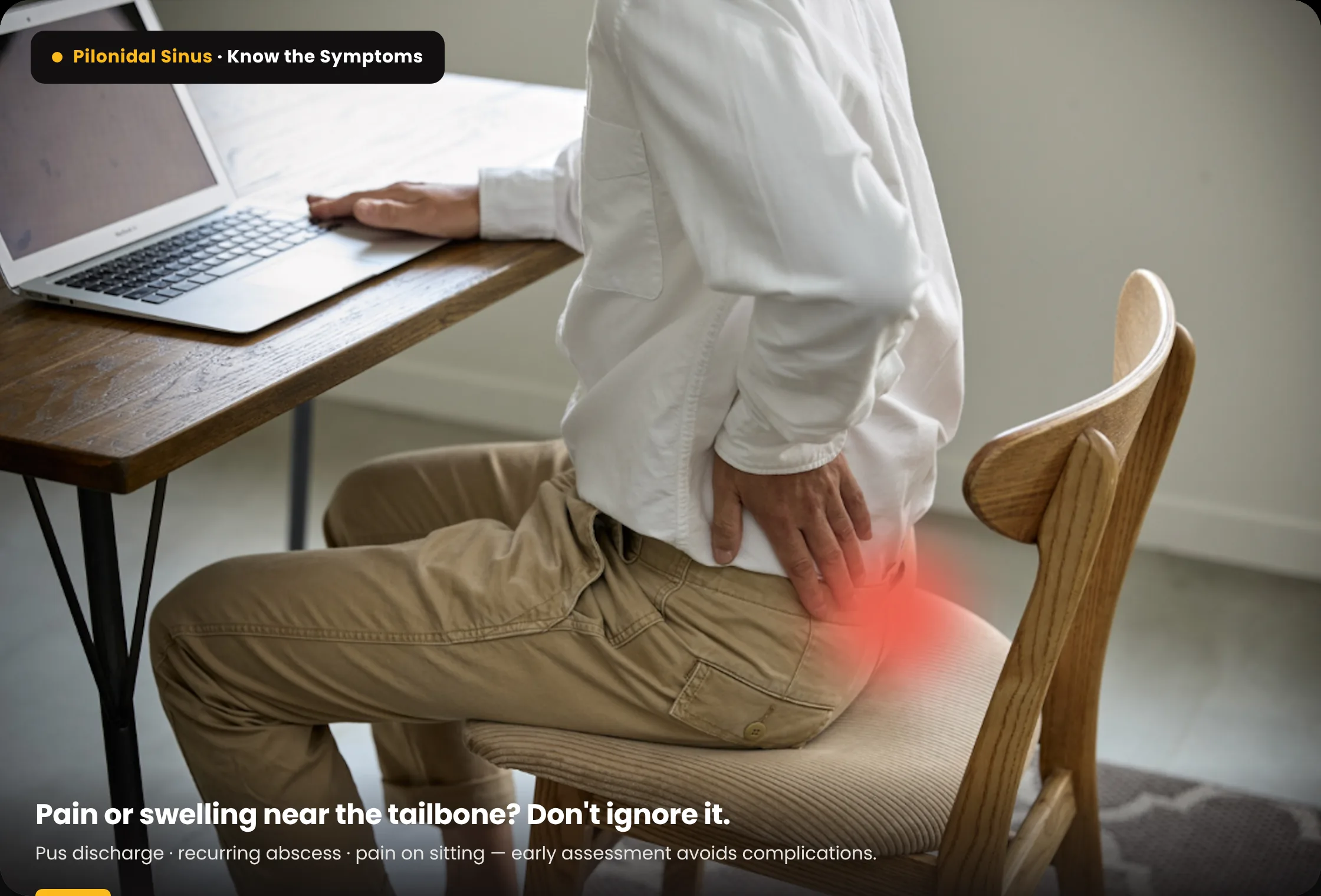
Pain or swelling at the top of the buttock cleft, especially when sitting or moving
Pus discharge from a small opening in the skin (often blood-tinged) and a noticeable foul odour
Recurrent abscess formation in the same area despite previous drainage
One or more small openings (pits) visible in the skin over the tailbone
Redness, warmth, and tenderness suggesting active infection
If you notice any of these symptoms, consult a specialist for proper evaluation. Early assessment helps
avoid repeated abscesses, reduces the chance of disease becoming complex, and allows discussion of
minimally invasive options such as laser surgery.
Causes & Risk Factors
Pilonidal sinus develops from a combination of anatomy, lifestyle, and hygiene factors. While not every
person with these risk factors develops the condition, they meaningfully raise the likelihood.
Excessive body hair in the lower back and natal cleft area
Sedentary lifestyle and prolonged sitting — common among drivers, IT professionals, students, and office workers
Obesity and a deeper natal cleft, which traps hair and debris more readily
Family history of pilonidal disease
Poor local hygiene or difficulty keeping the area clean and dry
Tight clothing and friction in the buttock cleft area
Excessive sweating and a moist local environment that supports infection
Many of these factors are addressable after surgery, which is why lifestyle counselling is a key part of
the long-term care plan at Sharvari Hospital.
Laser Pilonidal Sinus Surgery — The Modern Approach
Laser pilonidal sinus surgery (also called laser pilonidal sinus ablation) is the primary
technique used at Sharvari Hospital for most uncomplicated cases. It is a minimally invasive,
day-care procedure performed under local or spinal anaesthesia.
During the procedure, a thin laser fibre is introduced into the sinus tract through its
opening. Controlled laser energy is then delivered along the inside of the tract. The energy destroys
the diseased lining of the sinus from within, and over the following weeks the tract heals closed from
the inside out. Because there is no large open wound, the natural anatomy of the natal cleft is
preserved.
Key advantages over traditional open surgery:
Minimally invasive — no large wound, only a small puncture access
Day-care procedure — same-day discharge for most patients
Faster recovery — most patients return to office work in three to seven days
Lower recurrence rate in suitable cases compared with traditional open excision (studies suggest)
Sphincter-sparing and anatomy-preserving, with no large skin defect to heal
Smaller scar and a better cosmetic outcome
Significantly reduced post-operative pain for most patients compared with traditional surgery
The procedure is performed under local or spinal anaesthesia and typically takes
thirty to sixty minutes for a single-tract case. Most patients are observed for a short
period and discharged the same day with antibiotics, painkillers, and clear wound-care instructions.
Who performs laser pilonidal sinus surgery at Sharvari Hospital: Laser pilonidal sinus
surgery is performed at Sharvari Hospital by
Dr. Kundan Kharde
(Director and Lead Surgeon, MS · FMAS, with 19+ years of experience in laser surgical
techniques). Each treatment plan is individualised after clinical examination and a transparent
discussion of options.
Procedure Explained
Watch: How pilonidal sinus treatment is performed
Watch Video
Dr. Kundan Kharde walks through how pilonidal sinus treatment is performed — from cleaning out the infected tract to sealing it with a thin laser fibre through a small opening, and how day-care patients usually go home the same day with simple wound-care instructions. Individual healing times differ — results vary.
Open Excision & Flap Surgery — When Required
Although laser surgery suits most uncomplicated pilonidal cases, certain patients benefit from
traditional surgical techniques for the best long-term outcome. Open excision or flap surgery is
typically considered when the disease is more complex.
When traditional surgery is preferred:
Complex multi-tract disease with extensive branching beneath the skin
Very large cavities or recurrent disease where a previous laser attempt has not succeeded
Cases with significant active infection or skin loss that require formal reconstruction
Technique: Open excision involves the surgical removal of the sinus tract along with a
margin of surrounding skin. For larger defects, a flap procedure is used: a flap of
healthy nearby skin is rotated to close the wound, shifting the suture line off the midline. Common
techniques include the Limberg flap and the Karydakis flap, both of
which are designed to flatten the natal cleft and reduce recurrence.
Recovery after open or flap surgery is longer than after laser ablation, typically four
to six weeks before full healing, with stricter activity and sitting restrictions in the early weeks.
Patient-specific approach: Dr. Kharde assesses each patient and recommends the
appropriate technique based on disease complexity, prior treatment history, and individual factors.
Some complex cases genuinely need traditional surgery for the best outcome, and we are transparent
about that recommendation when relevant.
Which Technique Is Right For You
Laser vs Open Surgery — Pilonidal Sinus
A clear comparison for suitable candidates. The final technique is decided at consultation.
Compare
The key differences that matter to patients
Laser Surgery
RECOMMENDED FOR MOST CASES
Open Excision / Flap
FOR COMPLEX CASES
Recovery time
LASER
3–7 days
Back to desk work for most patients
OPEN
4–6 weeks
To complete healing
Wound size
LASER
Tiny puncture access
No large open wound to heal
OPEN
Larger wound or flap
Surgical excision with margin
Hospital stay
LASER
Day-care · same-day
Discharged the same day for most
OPEN
Day-care or short stay
Sometimes one night
Recurrence
LASER
Lower in suitable cases
Anatomy preserved (studies suggest)
OPEN
Acceptable in complex cases
With proper flap technique
Best for
LASER
Most uncomplicated cases
Single-tract pilonidal disease
OPEN
Complex / recurrent disease
Multi-tract or branching sinus
Dr. Kundan Kharde assesses each patient individually · The final technique depends on disease grade, recurrence history & individual factors.
Sharvari Hospital · Laser Proctology & Laparoscopic Surgery · Pimple Nilakh, Pune
Procedure Day — What to Expect
Laser pilonidal sinus surgery at Sharvari Hospital is planned as a structured day-care visit. Knowing
the sequence in advance helps you and your family feel comfortable.
Pre-procedure consultation: clinical examination, review of any imaging if needed, baseline investigations, and antibiotic prophylaxis are planned.
Arrival & admission: you check in to the day-care suite. Vitals are recorded, the surgical site is prepared, and the team explains the steps once more.
Anaesthesia: local or spinal anaesthesia is administered. Most patients describe this as the most sensitive part of the day — once it sets in, the area is numb for the rest of the procedure.
Procedure: the laser fibre is introduced into the sinus tract and energy is delivered to ablate the diseased lining. For open or flap cases, the surgeon excises the tract and closes the wound with the appropriate flap technique. Duration is typically 30–60 minutes for laser, longer for open or flap surgery.
Recovery & observation: dressing is applied. You rest for a short observation period while the team checks vitals, pain, and walking.
Discharge: same-day discharge for most laser cases; possibly the next day for open or flap procedures. You leave with antibiotics, painkillers, dietary advice, and clear wound-care instructions.
Most patients walk out the same day with minimal discomfort after laser pilonidal surgery. Your surgeon
and the anaesthesia team monitor you throughout, and any concerns can be flagged at any point.
Recovery Timeline
Recovery depends on the technique used — laser ablation generally allows a faster return to routine than
open or flap surgery. Individual healing varies, and your surgeon at Sharvari Hospital tailors
restrictions and clearance to your specific case.
Recovery Timeline
Your Recovery After Laser Pilonidal Surgery
A typical day-care recovery path. Most desk-job patients are back to work within a week.
DAY 0
Same-day discharge
You walk to the car. Eat normally and follow basic activity advice. Home with antibiotics & pain relief.
DAYS 1–3
Light activity
Gentle movement at home, warm sitz baths as advised, daily dressing changes, avoid prolonged sitting.
DAYS 3–7
Back to desk work
Most patients with office jobs return now. The first clinical follow-up is usually planned in this window.
WEEK 2
Healing well
The wound is settling. Gradual return to your regular daily routine and normal activity.
WEEKS 4–6
Complete healing
Full recovery for most patients — gym & physically demanding activity resume after clearance.
Recovery varies by individual healing, technique used & job profile. Dr. Kharde individualises your clearance at follow-up.
Sharvari Hospital · Laser Proctology & Laparoscopic Surgery · Pimple Nilakh, Pune
After Open Excision or Flap Surgery
Weeks 1–2: rest, regular dressing changes, careful local hygiene, and graded mobilisation. Sitting is restricted as advised.
Weeks 3–4: gradual return to light activity, with continued local care and follow-up reviews.
Week 6 and beyond: complete healing for most patients, with full clearance for routine activity.
Recovery timelines vary by individual healing, the technique used, and your job profile. Your surgeon
individualises clearance based on follow-up review.
Cost Factors
Laser pilonidal sinus surgery at Sharvari Hospital starts from ₹80,000*.
The final cost is individualised after clinical assessment because pilonidal disease varies significantly
between patients.
*Starting price for uncomplicated laser pilonidal sinus surgery. Final cost varies by:
disease complexity (single vs multi-tract),
technique chosen (laser vs open excision vs flap surgery),
anaesthesia type (local vs spinal vs sedation),
room category (day-care vs single occupancy),
antibiotic and post-op medication needs, and
insurance approval status. Open excision and flap surgery may cost more because of
longer operating-theatre time and a longer recovery pathway.
Call +91 951 951 1928 for a
personalised quote.
Sharvari Hospital is empanelled with 50+ insurance partners and supports
cashless treatment wherever your policy allows. Our insurance desk reviews your insurer,
sum insured, waiting periods, and pre-authorisation requirements before scheduling, so there are no
financial surprises on the procedure day.
Risks & Complications
All medical procedures carry some risk. Honest, upfront discussion of these risks is part of informed
consent at Sharvari Hospital. For pilonidal sinus surgery, possible — though usually mild — issues
include:
Common: bruising, mild discomfort, and temporary numbness around the treated area
Uncommon: bleeding, local infection, or delayed wound healing
Rare: recurrence of the sinus — any technique can have recurrence, and lifestyle factors matter
Rare: skin reactions or stitch-related issues with open or flap surgery
The laser technique generally minimises wound-related risks compared with traditional open surgery
because there is no large open wound to heal. As with any medical procedure, individual outcomes vary,
and your surgeon will review your specific risk profile during consultation.
Why Sharvari Hospital for Pilonidal Sinus Treatment
50-bed ISO 9001:2015 certified facility with a modern day-care surgical suite for laser proctology procedures.
24/7 availability for emergencies, follow-up concerns, and post-procedure queries.
Advanced laser system for proctology procedures, supported by a structured pre- and post-operative care pathway.
50+ insurance partners with cashless treatment support for eligible policies.
Accessible location in Pimple Nilakh, Pune — easy reach from Wakad, Hinjewadi, Baner, Aundh, Balewadi, Pimple Saudagar, Tathawade, and Pimpri-Chinchwad.
Integrated care: consultation, surgery, dressing follow-ups, and lifestyle counselling under one roof.
About Dr. Kundan Kharde
Primary Surgeon — Laser Pilonidal Sinus Surgery
Dr. Kundan Kharde
MS (General Surgery), FMAS Certified
Director and Lead Surgeon at Sharvari Hospital, Pune
19+ years of experience in laser proctology and laparoscopic surgery
6,000+ successful surgeries across proctology, laparoscopy, and vascular procedures
Specialises in laser pilonidal sinus, laser piles, laser fistula, laparoscopic hernia, and EVLT for varicose veins
Questions we hear most often from patients considering laser pilonidal sinus surgery in Pune. For
anything not covered here, please call us directly.
What's the difference between laser pilonidal sinus surgery and traditional open excision?+
Traditional open excision is a surgical procedure that physically removes the sinus tract along with surrounding skin, often leaving an open wound that heals over four to six weeks. Laser pilonidal sinus surgery is a minimally invasive technique that uses a thin laser fibre to ablate the sinus tract from within through a small puncture, preserving normal anatomy and allowing the cavity to heal closed. Most patients suitable for the laser approach experience a smaller wound and a noticeably shorter recovery compared with traditional open surgery.
Can women get pilonidal sinus?+
Yes. Although pilonidal sinus is more common in young men, women develop it too — especially with long sitting hours, a deeper natal cleft, coarse hair in the tailbone area, or a family history. Symptoms, diagnosis and treatment (laser or excision, depending on complexity) are the same as in men. Early review avoids repeated abscesses.
How long does laser pilonidal sinus surgery take?+
A single-tract laser pilonidal sinus procedure is typically completed in about thirty to sixty minutes, depending on the number of tracts and the size of the cavity. Including pre-procedure preparation and post-procedure observation, most patients spend only a few hours at the hospital and are discharged the same day. Your surgeon shares an individualised estimate after clinical examination.
Is laser pilonidal sinus surgery painful?+
Laser pilonidal sinus surgery is typically performed under local or spinal anaesthesia, so most patients describe the procedure itself as well-tolerated. Mild soreness or a pulling sensation around the treated area is common in the first few days and is usually managed with simple oral pain medication. Significant pain is uncommon with the laser approach and should be reported to your surgeon.
How soon can I return to work after laser pilonidal sinus surgery?+
Most patients with desk-based jobs return to work within three to seven days after laser pilonidal sinus surgery. Those with physically demanding work or jobs that involve prolonged sitting may need a slightly longer break. Light walking is encouraged from the same day, and your surgeon individualises return-to-activity advice based on your job profile and how you respond at the first follow-up.
Will the pilonidal sinus come back after laser surgery?+
Studies suggest that the laser approach has a lower recurrence rate than traditional open excision in suitable cases because it preserves natural anatomy and avoids large open wounds. However, recurrence remains possible with any pilonidal sinus technique, particularly when underlying risk factors such as excessive hair growth, prolonged sitting, or poor local hygiene persist. Long-term hair control, weight management, and hygiene measures help reduce the chance of recurrence.
Does insurance cover pilonidal sinus surgery in India?+
Many Indian health insurance policies cover pilonidal sinus surgery when it is medically indicated, including the laser approach. Coverage depends on your policy terms, waiting periods, and pre-authorisation requirements. Sharvari Hospital is empanelled with over 50 insurance partners and supports cashless workflows where eligible — please share your insurer details before scheduling so approvals can be checked early.
When is open excision or flap surgery recommended over laser?+
Open excision or flap surgery (such as the Limberg or Karydakis flap) is typically considered when the disease is complex — for example, multi-tract or extensively branching sinuses, very large cavities, or recurrent disease where a previous laser attempt has failed. Dr. Kharde assesses each patient with clinical examination and, where needed, imaging before recommending the appropriate technique based on disease complexity and individual factors.
How do I prevent pilonidal sinus from recurring after surgery?+
Recurrence prevention typically includes regular hair removal in the natal cleft (laser hair reduction or careful trimming as advised), keeping the area clean and dry, avoiding prolonged sitting where possible, weight management, and wearing loose, breathable clothing. Your surgical team at Sharvari Hospital reviews these measures with you before discharge and at follow-up. Most patients who follow lifestyle and hygiene guidance see good long-term outcomes.
Quick Answer
Can women get pilonidal sinus too?
Watch Video
Yes — women get pilonidal sinus too. In this short, Dr. Kundan Kharde explains why the condition is not limited to men, how long sitting hours and hair in the tailbone cleft raise the risk for women, and which early signs deserve a check-up. Treatment options are the same for both — results vary.
Explore Our Core Procedures
Sharvari Hospital's minimally invasive surgical programme also covers other Core 7 procedures across
laser proctology and vascular surgery.
Need help planning your visit? Contact us
for directions, insurance pre-authorisation, or to coordinate with an accompanying family member.
Book Your Consultation
Talk to our team at Sharvari Hospital for a transparent assessment and clear pricing for laser
pilonidal sinus surgery in Pune. We see patients from Wakad, Hinjewadi, Baner, Aundh, Pimple Saudagar,
Tathawade, and across Pimpri-Chinchwad.