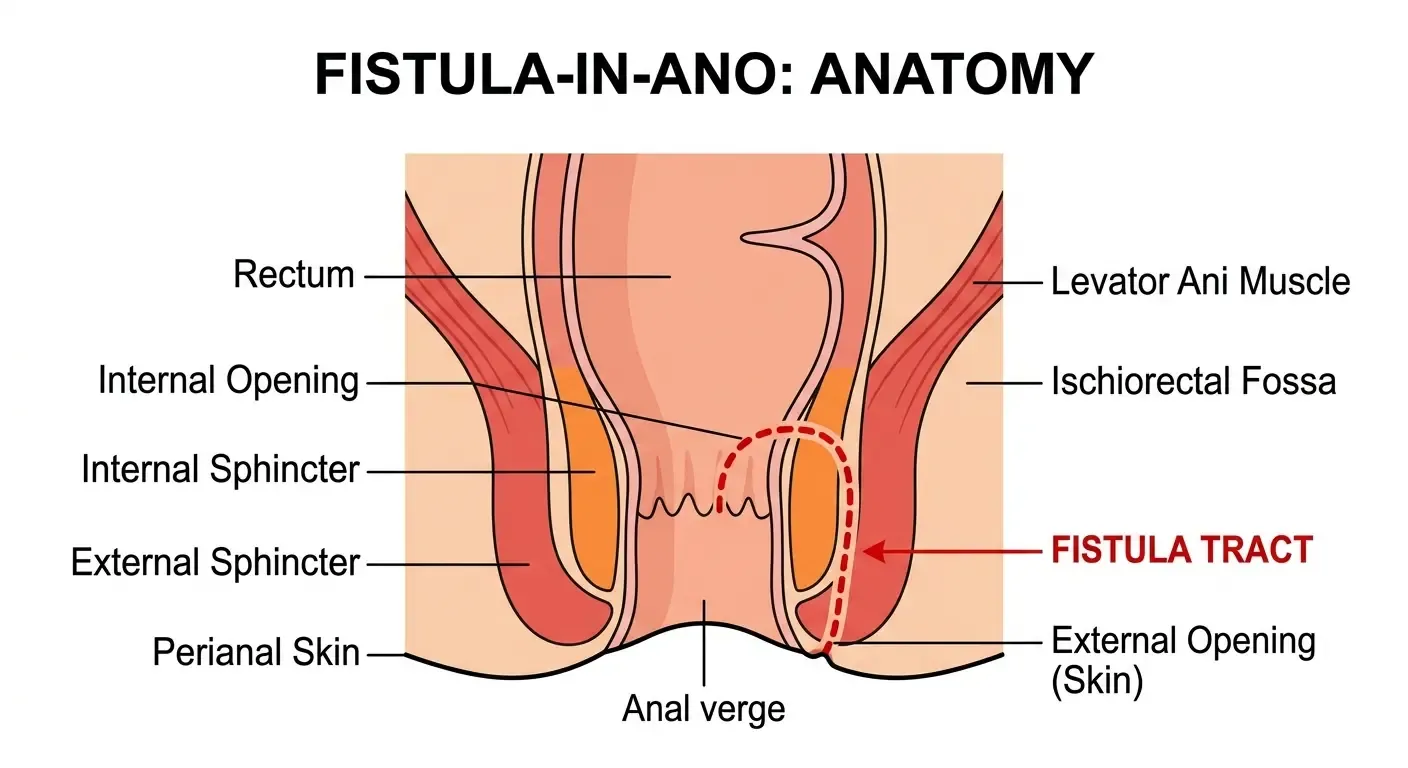
Understanding FiLaC, laser ablation, fistulotomy and why the anatomy of your fistula should decide the operation.
Quick answer: No, the laser does not seal the fistula. FiLaC delivers heat along the tract, which destroys its lining and makes it shrink. Closure happens afterwards, as your body heals and scars the tract shut. For a simple, low fistula, a conventional fistulotomy usually heals more reliably. For a complex fistula, laser is one of several sphincter-preserving options and works best as part of a tailored plan, not as a standalone fix.
I am Dr. Kundan Kharde, a proctology and laparoscopic surgeon at Sharvari Hospital, a 50-bed surgical hospital in Pimple Nilakh, Pune, serving patients from Wakad, Hinjawadi, Baner, Aundh and PCMC. A large share of the fistula patients I see have already had one operation, often a laser procedure, that did not hold. This article explains what laser does, when it is the right choice and when it is not.
What is FiLaC surgery?
FiLaC stands for Fistula-tract Laser Closure. It is a minimally invasive, sphincter-preserving technique for anal fistula.
A thin, radial-emitting laser fibre is passed into the fistula through its external opening on the skin. The fibre is slowly withdrawn while laser energy is delivered in a circle along the tract. The intended effects are:
- Thermal destruction of the tract lining.
- Denaturation of tissue proteins.
- Contraction and shrinkage of the tract.
- Fibrosis and healing over the following weeks, which may finally obliterate the tract.
The aim is to heal the fistula without cutting the anal sphincter muscles that control continence. One point matters above all: laser energy does not mechanically seal the tract the way a suture closes a wound.
Does laser really close the fistula tract?
No, not directly. The word “closure” in FiLaC describes the hoped-for result, not an immediate action.
Three separate things happen:
- Laser ablation: heat destroys the tract lining.
- Tract contraction: the tract shrinks from the thermal effect.
- Tract obliteration: fibrosis and healing fill the tract over time.
Only the first two happen in the operating theatre. The third depends on your body, and it is where FiLaC can fail. If the internal opening inside the anal canal stays open, if a side branch or abscess cavity is left undrained, or if healing is poor, the fistula keeps discharging or comes back.
For this reason, FiLaC should never be presented as a procedure that guarantees sealing of every fistula.
Is FiLaC different from laser ablation of the fistula tract (LAFT)?
Not really. FiLaC and LAFT (laser ablation of the fistula tract) describe the same radial laser treatment. FiLaC is the established brand-style name; laser ablation describes the tissue effect more plainly. Describing the operation as “radial laser ablation of the fistula tract using the FiLaC technique” is accurate. Presenting them as two different operations is not.
Does every anal fistula need laser surgery?
No. There is no single operation that suits every fistula. The choice depends on:
- How the tract relates to the internal and external sphincter.
- How much sphincter muscle is involved.
- Whether the fistula is simple or complex.
- Side branches, horseshoe extensions or abscess cavities.
- Previous fistula operations.
- Your baseline continence and sphincter strength.
- Associated conditions such as Crohn’s disease or tuberculosis.
The goals are the same every time: durable healing, control of infection and preservation of continence.
Simple, superficial fistulas: fistulotomy is often the better option
For a low fistula that involves little or no external sphincter, conventional fistulotomy remains the established treatment. The tract is laid open and the wound heals from its base.
In suitable patients this gives:
- Direct view of the whole tract.
- Treatment of the entire tract, not just its lining.
- Predictable healing.
- No need for extra technology or its cost.
The 2022 American Society of Colon and Rectal Surgeons (ASCRS) clinical practice guideline recommends lay-open fistulotomy for simple anal fistulas in patients with normal sphincter function, reporting healing in more than 90% of well-selected patients.
Not every low fistula suits fistulotomy. Previous anal surgery, weak baseline continence, obstetric sphincter injury and recurrence all change the decision. But the principle is clear: there is no reason to use a sphincter-preserving technique when a safe fistulotomy can heal the fistula without meaningful sphincter damage.
Laser is not better simply because it is newer.
Complex transsphincteric fistulas: when sphincter preservation matters
A high transsphincteric fistula crosses a large part of the external sphincter. Laying it open from end to end would divide that muscle and risk incontinence. Here, preserving the sphincter becomes the priority.
Depending on the anatomy, options include:
- LIFT (ligation of the intersphincteric fistula tract).
- Advancement flap.
- Draining seton followed by definitive surgery.
- FiLaC or other laser-based techniques.
- Hybrid approaches combining these principles.
My hybrid approach for complex fistulas
For most complex transsphincteric fistulas, I combine two techniques in one operation.
First, a proximal fistulotomy. I lay open only the inner part of the tract, from the internal opening to the intersphincteric space. This removes the internal opening and the infected anal gland where the fistula usually begins. Only internal sphincter muscle is divided. The external sphincter, which matters most for continence, is left intact.
Second, laser ablation of the remaining tract. The part of the tract that crosses the external sphincter and runs out to the skin is treated with radial laser ablation. This treats the tract without cutting the external sphincter.
Why combine them? The internal opening is the most common reason laser alone fails. Dealing with it directly, rather than hoping heat alone will close it, addresses the weak point of FiLaC while keeping its main advantage. The approach follows the same principle as the TROPIS technique described by Garg, which lays open the intersphincteric part of the tract through the anal canal.
Dividing part of the internal sphincter carries a small risk of minor continence changes, similar to a sphincterotomy. I decide case by case, with extra care in women, in patients who have had anal surgery before and in anyone whose continence is already weak.
This is a technique tailored to your anatomy, not a standard package. MRI mapping, drainage of side branches and abscess cavities, and careful patient selection all matter as much as the laser itself.
Why I advise MRI for every complex fistula
For every complex, recurrent or branching fistula, I advise an MRI before surgery. It maps the exact course of the tract, how much sphincter it crosses, and any side branches or hidden abscess cavities. That map decides which operation is safe for you.
A simple, low fistula that can be clearly assessed on examination usually does not need imaging. The 2022 ASCRS guideline likewise recommends MRI or endoanal ultrasound for complex and recurrent fistulas.
Missed side branches and hidden abscesses are among the most common reasons fistula surgery fails. An MRI costs far less than a second operation.
Extrasphincteric fistulas need special attention
Extrasphincteric fistulas pass outside the external sphincter and are uncommon. They should not be assumed to be ordinary cryptoglandular fistulas. Causes include previous surgery or trauma, inflammatory bowel disease, tuberculosis and other pelvic disease.
Treatment depends on the cause, the anatomy, associated sepsis and sphincter function. Laser is not automatically the answer because the fistula is complex.
Why can FiLaC fail?
FiLaC is designed to preserve the sphincter, not to guarantee healing. Common reasons for failure or recurrence:
- Inadequate thermal treatment of the tract.
- A patent internal opening.
- Side branches or horseshoe extensions.
- Undrained abscess cavities.
- Ongoing infection or inflammation.
- Poor fibrosis and healing.
- Unfavourable tract anatomy.
A laser fibre cannot make up for an incomplete anatomical assessment or untreated associated disease.
What does the evidence say about FiLaC?
The evidence is moderate, mostly retrospective, and honest about the limits.
- A 2025 systematic review and meta-analysis (Duda et al., International Journal of Colorectal Disease) pooled 24 studies and 1,503 patients. Primary healing was 57.5%, recurrence 18.5% and reoperation 36.5%. New incontinence was rare at 0.6%. Healing did not differ significantly between simple and complex fistulas.
- An earlier 2020 meta-analysis of seven studies (Techniques in Coloproctology) reported primary healing of about 67%, with minor complications in 4%.
- A 2026 UK series of complex fistulas treated with FiLaC reported a seton-free rate of 68% at ten months, with complete healing lower than earlier reports.
These are pooled figures from published studies, not a prediction for any individual. They show that FiLaC is safe for continence but heals only a little over half of fistulas at the first attempt. Patient selection, anatomy and technique decide the outcome.
How I choose the operation for an anal fistula
My approach is anatomy first, technique second.
- Simple, superficial fistula with negligible sphincter involvement: conventional fistulotomy.
- Complex fistula crossing a significant part of the sphincter: MRI mapping, then a sphincter-preserving plan. For most, my hybrid proximal fistulotomy plus laser ablation. For some, LIFT, a flap or a staged approach with a seton.
- Recurrent, branching or extrasphincteric fistula: MRI, investigation of the cause, and an individual plan.
The goal is not simply to close a tract. It is durable healing with normal continence.
Conclusion: the best fistula surgery is anatomy-driven
Laser has added a useful tool to fistula surgery. It is a tool, not a universal solution.
FiLaC aims for closure through thermal injury followed by contraction and healing. It does not seal the tract on the day of surgery and it does not guarantee a cure. For simple fistulas, fistulotomy remains the established option when it is safe. For complex fistulas, sphincter preservation matters, and selected patients do well with a hybrid, anatomy-tailored approach.
Judge fistula surgery by four things: durable healing, control of sepsis, prevention of recurrence and preservation of continence. The best operation is the one that fits your fistula, not the one with the most advanced technology.
Frequently asked questions about FiLaC and laser fistula surgery
Does FiLaC physically seal the fistula?
No. FiLaC delivers heat to the tract, which destroys the lining and makes the tract shrink. Closure depends on fibrosis and healing over the following weeks. It is not an instant mechanical seal.
Is FiLaC the same as laser ablation of the fistula tract (LAFT)?
Yes, in practice. Both describe radial laser treatment of the tract. FiLaC is the technique’s established name; laser ablation describes what the laser does.
Is fistulotomy better than laser for a simple fistula?
For a low, superficial fistula with minimal sphincter involvement, fistulotomy is the established treatment with high healing rates in guideline data. Laser may be considered in selected cases, but it is not automatically superior.
Can laser fistula surgery fail or cause recurrence?
Yes. Published pooled data show primary healing in roughly 57 to 67% of patients. A patent internal opening, untreated side branches, undrained abscess cavities and poor healing are the usual causes.
What is the hybrid approach for complex fistula?
A proximal fistulotomy that lays open only the inner tract, from the internal opening to the intersphincteric space, combined with laser ablation of the part crossing the external sphincter. It removes the source of the fistula while preserving the external sphincter.
Do I need an MRI for an anal fistula?
Not always. A simple, low fistula that can be clearly assessed on examination usually does not. For every complex, recurrent or branching fistula, Dr. Kharde advises an MRI before surgery to map side branches and hidden abscesses.
What is the best surgery for anal fistula?
There is no single best operation. The right choice depends on fistula anatomy, sphincter involvement, previous surgery, baseline continence and the underlying cause.
Where can I get a second opinion on fistula surgery in Pune?
Sharvari Hospital in Pimple Nilakh, Pune, offers fistula consultations 24/7 on +91 951 951 1928. Patients from Wakad, Hinjawadi, Baner, Aundh and PCMC are typically 10 to 20 minutes away.
Medical disclaimer and about the author
Medical disclaimer: This article is for patient education and does not replace an individual clinical assessment. The choice of surgery should be made after evaluation by a qualified surgeon.