A fistula that has been operated on and comes back is not the same problem as a first fistula. Scar hides the internal opening, the tract may have found a new route, and — as in the de-identified case below — a large collection can build up in the deep tissue with almost nothing to see on the surface. This article explains why fistulas recur, why “hardly any discharge” is not reassuring, what the grade on an MRI report means, how the main operations differ, and what to bring to a redo consultation.
Medically reviewed by Dr. Kundan Kharde, MS, FMAS — Founder & Director, Lead Proctology Surgeon, Sharvari Hospital, Pune. 19+ years, 6,000+ surgeries. View profile.
Why fistulas come back
Three findings account for most recurrences, and all three are inside, where the examining finger cannot reach.
A missed internal opening. Every anal fistula starts at an infected gland in the anal canal. If that source is not found and dealt with, the tract refills from the inside no matter how thoroughly the outside was cleaned. This is the single most common reason a fistula returns.
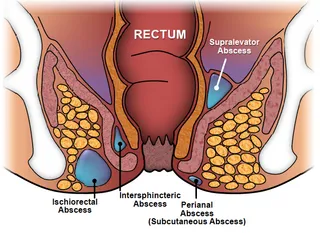
An undrained intersphincteric abscess. The infected gland sits between the two sphincter muscles. Pus that collects there — the intersphincteric space — can spread sideways behind the rectum in a horseshoe, and if that pocket is not opened, the fistula persists however the skin end was treated.
Secondary tracts. A branch off the main tract, healed over at the skin but still lined inside, quietly reopens months or years later. The full list of reasons — including tract lining, premature skin closure and untreated underlying disease — is in what causes recurrent fistula.
Why “little discharge” can hide a large abscess
Patients and, sometimes, doctors read the amount of discharge as a measure of how bad the fistula is. It is not. Discharge reflects how freely a collection drains to the surface. A deep abscess whose only exit is a long, narrow tract ending in one small opening will produce pain — pressure builds in a closed space — but very little pus at the skin. The smaller and tighter the opening, the more pain and the less discharge. So “it hurts but nothing is coming out” after previous fistula surgery is a reason for imaging, not a reason to wait.
What the grade on an MRI report means
Most MRI fistulogram reports end with a St James’s University Hospital grade from 1 to 5. Grades 1 and 2 are intersphincteric — the tract stays between the two sphincter muscles (grade 2 adds an abscess or branch). Grades 3 and 4 are trans-sphincteric — the tract crosses the external sphincter into the fat outside it (grade 4 adds an abscess or secondary tract there). Grade 5 means the tract extends above the pelvic floor. The grade is a radiology shorthand for the surgeon: it flags muscle involvement and hidden collections, but the operation is planned from the actual findings on the images, line by line. How each line is read is explained on MRI fistula mapping.
The operations, and what each one does to the muscle
Fistulotomy lays the tract open along its whole length so it heals flat from the base. It suits a simple, superficial tract that involves little sphincter. Its weakness is that it divides everything between the tract and the skin — so for a tract crossing the external sphincter, a full lay-open means cutting the muscle that controls stool.
Fistulectomy and core-out remove the tract rather than open it. The inner part — internal opening, intersphincteric space, any abscess — is laid open and drained; the part crossing the external sphincter is cored out, the tract tissue taken out as a cylinder from within the muscle so the fibres around it stay intact; and the tract is removed out to the skin, where the opening is excised. Removing rather than opening matters in a recurrent fistula, because a long-standing tract has lined itself with skin-like tissue that will not stick together and heal.
Laser (FiLaC) passes a radial laser fibre along the tract and seals the lining from inside without cutting muscle. It suits a single mature tract with no abscess and no branches; it cannot drain a collection or deal with a horseshoe.
Seton is a soft thread left in the tract so infection drains and inflamed tissue settles. It is the first stage when there is active sepsis or a high or multiply-operated tract, and the definitive operation follows weeks later. The recurrent-fistula pathway that puts these together is on complex & recurrent fistula treatment.
A real case: eight years later, eight days of pain
A man in his early thirties came to Sharvari Hospital, Pimple Nilakh, with eight days of pain around the anus. He had had a fistula operated at another hospital about eight years earlier and had been well since. There was no significant discharge. On examination there was one small external opening near the anus with scar around it — and nothing else: no swelling, no redness, nothing pointing to a large collection.
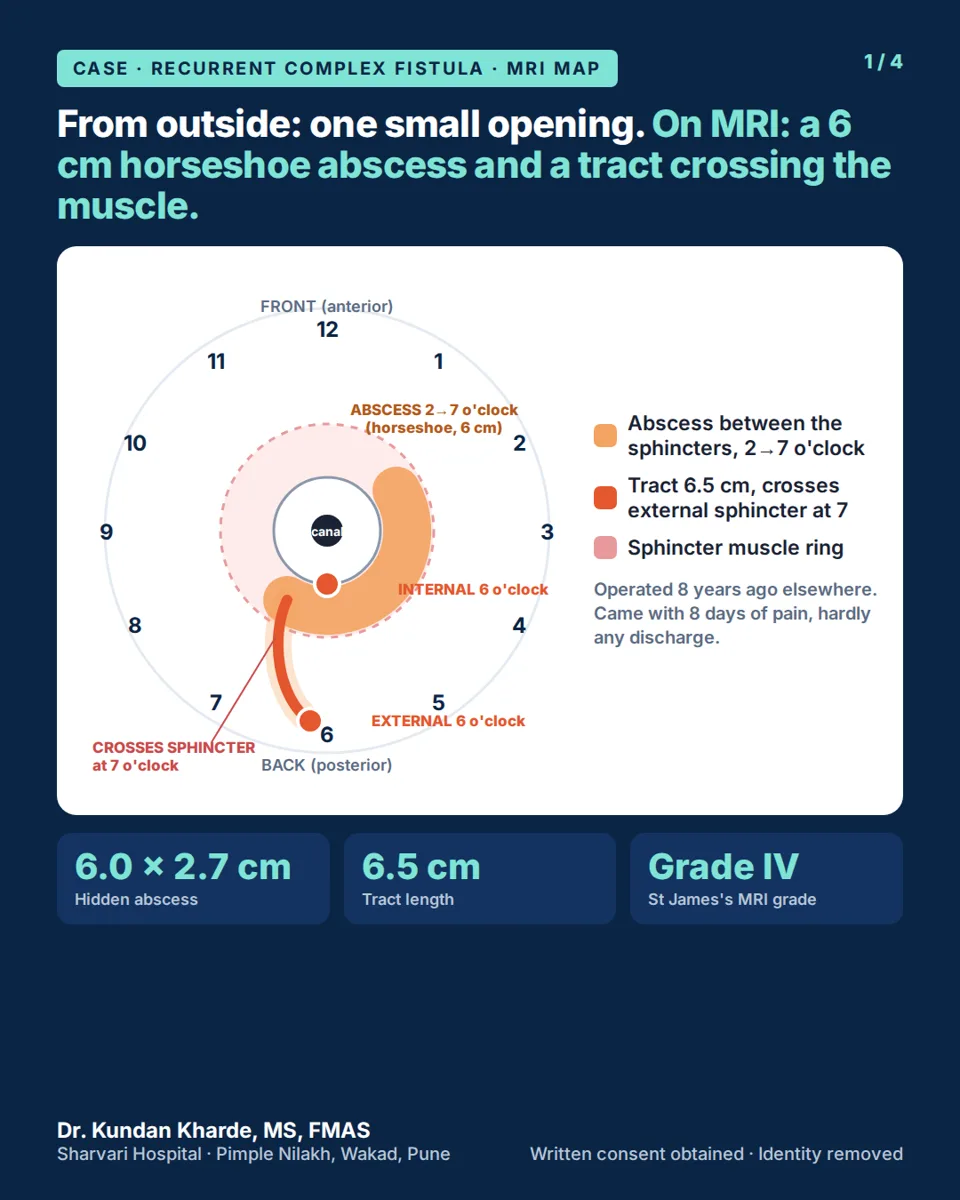
The MRI fistulogram told a different story. Behind the rectum, in the posterior perirectal and intersphincteric space, was a large multilobulated abscess of about 6 × 2.7 × 2.1 cm, spreading in a horseshoe from about 2 o’clock to 7 o’clock. There was a probable internal opening at 6 o’clock, and a 6.5 cm tract ran from the external opening in the gluteal cleft up to the collection, crossing the right external sphincter at about 7 o’clock — trans-sphincteric. No secondary tracts; no extension above the pelvic floor. St James’s grade IV.
That map ruled out two operations that would have looked reasonable from outside. A full lay-open would have cut through the external sphincter at 7 o’clock. A blind clean-up of the skin opening would have left the abscess and the internal opening behind — the exact reason the first operation had not held. Instead, the internal opening, the intersphincteric space and the abscess cavity were laid open and drained from inside; the part of the tract crossing the external sphincter was cored out rather than cut, so the muscle stayed intact; and the tract was removed out to the skin, where the old opening was excised. At the end a long-acting local anaesthetic block (bupivacaine, mixed with methylene blue dye so the surgeon can see where it has been placed) was infiltrated around the wound for pain relief. He was discharged the next day, and in his case the wound was healing at follow-up.
The full write-up, with the MRI map and labelled theatre photographs behind a tap-to-reveal, is the recurrent complex fistula case study. It is one patient’s course, published with written consent and identity removed — not a statistic and not a promise.
What to bring to a redo consultation
- Previous operation notes and discharge summary. They say what was found, what was done and what technique was used — which tells the surgeon what has already been tried and how much sphincter may already have been divided.
- Every earlier scan — MRI, ultrasound, films and reports.
- A fresh MRI fistulogram, if one has been done. If not, the consultation will usually start by requesting one; almost every fistula patient at Sharvari Hospital is imaged before surgery, and a recurrent fistula is not re-operated without a map.
- A timeline of symptoms since the last operation: when it first reopened, episodes of swelling or pus, antibiotics taken, any change in bowel control.
- Your questions about continence. Ask how much sphincter the tract crosses on the scan and what the plan does to protect it.
Frequently asked questions
Can a fistula come back years after surgery?
Yes. A fistula can recur many years after an operation — in the case described here, about eight years later. The usual reasons are an internal opening that was not dealt with, an intersphincteric collection or side branch that was left undrained, or a tract that closed at the skin but not in the depth. A recurrence is a reason to map the tract on MRI before any second operation.
My fistula came back but there is hardly any discharge — is that less serious?
Not necessarily. Discharge reflects how freely a collection drains, not how large it is. A deep abscess that reaches the skin only through a long, narrow tract can cause days of pain with very little pus at the surface; in the case in this article a 6 cm horseshoe abscess sat behind one small opening. Pain with little discharge after previous fistula surgery is a reason for imaging, not reassurance.
What does the St James’s grade on an MRI fistula report mean?
The St James’s University Hospital classification grades an anal fistula from 1 to 5 by where the tract runs relative to the sphincters and whether an abscess or secondary tract is present. Grades 1–2 are intersphincteric, grades 3–4 are trans-sphincteric (grade 4 adds an abscess or branch), and grade 5 extends above the pelvic floor. The grade is a radiology shorthand; the operation is planned from the actual findings.
What should I bring to a consultation for a fistula that has come back?
Your previous operation notes and discharge summary, any earlier MRI or ultrasound reports and films, a list of the antibiotics and procedures you have had since, and a fresh MRI fistulogram if one has already been done. The old notes tell the surgeon what was found and done last time; the new scan shows what is there now. If you do not have an MRI yet, the consultation will usually start by requesting one.
If your fistula has come back
Pain near the anus after previous fistula surgery — with or without discharge — needs a map before it needs an operation. WhatsApp your MRI report and previous notes to +91 951 951 1928 for Dr. Kundan Kharde’s opinion before you travel, book a consultation, or start with complex & recurrent fistula treatment. Sharvari Hospital is in Pimple Nilakh, 10–25 minutes from Wakad, Hinjewadi, Baner and PCMC.
This article is for patient education and does not replace an examination. Every fistula is different; the operation is decided from the scan and the findings under anaesthesia, not from an article.