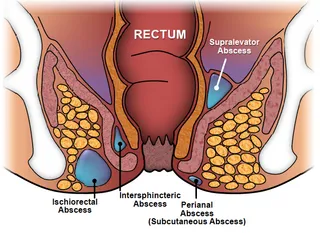
If you have drainage or repeat swelling near the anus, the next step is accurate diagnosis—not guessing from internet photos. This article walks through what usually happens in clinic, why MRI or ultrasound is ordered before surgery (almost every fistula patient at Sharvari Hospital is imaged — an MRI fistulogram or a trans-rectal ultrasound), and what examination under anaesthesia means. It pairs with what is an anal fistula and types of fistula without repeating treatment chapters—see the fistula treatment hub for procedures. Book online at Sharvari Hospital, Pune. Proctology.
Medically reviewed by Dr. Kundan Kharde, MS, FMAS — Senior Proctologist at Sharvari Hospital, Pune. View profile.
The first visit: history and symptom patterns
Your clinician will usually ask:
- When symptoms began and whether there was a prior abscess
- What the discharge looks like (colour, smell, amount)
- Fever episodes, antibiotic courses, and prior surgeries
- Bowel habits—constipation, diarrhoea, blood
- Medical conditions such as Crohn’s disease, diabetes, or immune suppression
Bring a short timeline on your phone. Photos of underwear staining are not required, but some patients find them helpful—use your own comfort level.
Clinical examination: what the doctor looks for
External openings and “tracks”
The outside opening may look like a small pit, a raised tag, or simply irritated skin. Your doctor may gently press nearby to see if fluid emerges—this can hint at active tracts.
Digital exam and anoscopy (high level)
A digital rectal exam checks tone, tenderness, and masses. Anoscopy lets the clinician inspect the anal canal for internal openings. These steps are brief and should be communicated clearly; if you have severe pain, say so before the exam so pacing can adjust.
When simple exam is enough
Almost every fistula patient at Sharvari Hospital is imaged before surgery — an MRI fistulogram or a trans-rectal ultrasound. Even a straightforward-looking low tract can hide a branch that the clinic exam cannot feel, and the scan is what decides whether a simple fistulotomy is safe or a sphincter-saving technique is needed. Which scan you get is a clinical decision — not something to self-determine.
Imaging: why it is ordered
Suspected branches or complex tracts
MRI is commonly used when doctors worry about extensions, collections, or multiple tracts—especially with recurrence after prior surgery.
Recurrence after prior surgery
Scar tissue distorts landmarks. Imaging reduces the chance of surprise anatomy in the operating room.
Radiology references and reviews describe MRI as a valuable tool for mapping perianal fistulas, with accuracy influenced by technique and radiologist experience—your hospital team chooses protocols.
MRI for anal fistula (what patients should know)
What the scan tries to show
MRI can outline the tract, internal opening, branches, and sometimes abscess pockets. Surgeons use these images while planning sphincter-safe routes.
What MRI can miss or debate
No test is perfect. Very small tracts, active spasm, or prior distortions can make images less clear. Sometimes repeat imaging after a seton or after inflammation calms helps. If reports conflict with examination, your team may reconcile findings at EUA rather than forcing a single test to decide everything.
Sequences and terms you might see
Reports may mention T2-weighted images, fat suppression, or contrast enhancement. These are technical choices radiologists use to make fluid-filled tracts stand out. You do not need to memorise them—just know they exist to improve clarity.
Practical tips: contrast, claustrophobia, implants
You will be asked about metal implants, pacemakers, and kidney function if contrast is considered. If you are claustrophobic, tell the team early—centres often have strategies (shorter sequences, counselling). Wear comfortable clothing; jewellery removal is typical.
Day-of-MRI checklist (general): arrive early; remove metal; use the restroom beforehand; follow fasting rules only if your centre instructed you (not all pelvic MRIs need fasting); bring prior reports; tell staff if you cannot lie flat or have pain lying still—sometimes positioning aids help.
Results are not DIY
A report may list intimidating phrases. Your surgeon and radiologist interpret them together. Ask for a plain-language summary if anxiety spikes.
Ultrasound and other adjuncts
Endoanal ultrasound basics
Endoanal ultrasound uses a small probe to image sphincters and nearby tracts. It can be very useful in experienced hands for selected fistulas. It is not always interchangeable with MRI—sometimes both contribute.
3D reconstruction and intraoperative adjuncts
Some centres use 3D endoanal ultrasound or adjuncts during surgery to reduce missed branches. Availability varies. Ask whether your hospital routinely combines imaging with EUA for recurrent cases—continuity of care matters more than brand names.
Other tests in selected scenarios
If Crohn’s is suspected, additional bowel evaluation may be needed beyond the anus. If tuberculosis is suspected, tissue removed at surgery can be sent for histopathology and GeneXpert/PCR testing — explained in fistula with Crohn’s or tuberculosis. If infection is severe, blood tests may accompany planning.
Examination under anaesthesia (EUA)
Why EUA is both diagnosis and planning
Under anaesthesia, muscle spasm and pain are reduced. The surgeon can carefully explore, rule out abscess, and sometimes proceed with definitive treatment in the same setting if appropriate and consented.
EUA when office exam is too painful
Some patients cannot tolerate an adequate awake exam because of spasm or fear. EUA is not “failure”—it is sometimes the safest way to see clearly without causing trauma.
What to expect on the day
You will have fasting instructions if general anaesthesia is planned. A responsible adult may be needed for discharge. Ask when you can drive and return to desk work—rough timelines depend on what is done during EUA.
After diagnosis: how Sharvari Hospital ties imaging to technique
We aim to match mapping to method—laser, LIFT, VAAFT, seton, flap, or fistulotomy when safely indicated.
A plain “pipeline” many patients follow
Step 1 — Clinic story and exam: clarify symptoms and examine.
Step 2 — Image the tract: an MRI fistulogram or trans-rectal ultrasound for almost every patient, before any surgical decision. Why surgeons insist on an MRI before redo fistula surgery is explained on our complex fistula page.
Step 3 — EUA if needed: confirm anatomy, drain abscess if present, plan definitive repair.
Step 4 — Consented treatment: technique chosen from mapping, not from advertisements.
Steps merge or repeat in real life; the point is that diagnosis is a process, not a single snapshot.
When nothing shows on MRI but symptoms persist
Sometimes imaging is inconclusive yet clinical suspicion remains. Your surgeon may proceed to EUA, repeat MRI after interval care, or observe briefly with safety-net instructions. Trust the follow-up plan and return if fever or escalating pain occurs. The procedure list and Pune context live in the main fistula guide so this diagnostic article stays focused.
For recovery planning after you know your procedure, use day-by-day recovery and desk-job recovery.
Differential diagnosis: not everything near the anus is a fistula
Pilonidal disease, hidradenitis, skin boils, and fissure tags can mimic external openings. That is another reason mapping matters—treatment diverges completely. For natal cleft problems, read pilonidal sinus vs fistula.
Cost and timing: what affects MRI bills (high level)
Charges depend on centre tariff, contrast use, 3T vs 1.5T, and whether the study is bundled into a surgical package. This article does not quote rupee figures—ask the hospital desk for a written estimate after your surgeon requests the study. Our cost guide discusses cost themes without replacing a formal quote.
Second opinions and outside scans
If you bring an MRI from another city, bring DICOM data if possible—not only printed films. Surgeons and radiologists may still request a repeat scan if quality is inadequate or anatomy changed since the prior study.
Anxiety, dignity, and communication
Many patients delay testing because of embarrassment or fear. Teams at Sharvari Hospital are accustomed to these concerns. You can request a chaperone, ask for step-by-step narration during exams, and pause if pain spikes. Accurate diagnosis is a partnership—your comfort affects how complete an awake exam can be, which in turn influences whether EUA or MRI is emphasised.
Children and special populations
Paediatric evaluation follows different norms; do not apply adult internet advice to teenagers without specialist input. Pregnant patients should mention pregnancy before MRI scheduling—protocols may change. Patients on anticoagulants should disclose this before any invasive exam or planned EUA.
Preparing for your appointment in Pune
- List prior operations and hospital names.
- Bring CDs/USB of outside MRI if applicable.
- Note insurance card and ID for cashless workflows (insurance article).
- Book via book online or call +91 951 951 1928.
Common questions (FAQ)
How is anal fistula diagnosed?
Through history, examination, and sometimes imaging or EUA to map the tract.
Is MRI necessary for fistula?
Not always; it is used more often for complex, high, or recurrent fistulas.
Can ultrasound detect anal fistula?
Endoanal (trans-rectal) ultrasound is the alternative to MRI for some tracts, depending on anatomy and operator experience — Almost every fistula patient at Sharvari Hospital is imaged before surgery — an MRI fistulogram or a trans-rectal ultrasound.
What doctor diagnoses fistula?
A proctologist or colorectal surgeon; radiologists interpret MRI.
How to prepare for fistula MRI?
Follow centre instructions; mention implants, pregnancy possibility, and claustrophobia; ask about contrast if offered.
Educational references: Cleveland Clinic — anal fistulas; ASCRS patient information; StatPearls — anal fistula.