You notice some bleeding after a bowel movement. There’s pain — sometimes sharp, sometimes a dull ache. Maybe there’s a small lump near the anus, or a discharge that wasn’t there before. You search online and suddenly you’re reading about piles, fissures, and fistulas — three different conditions, three sets of symptoms, and no clear sense of which one applies to you.
The third of those three is the one that most often gets treated as something else for months; if that is where you have landed, start with our fistula treatment in Pune page. This is one of the most common points of confusion I see in my practice. Patients walk in having used these terms interchangeably for months, sometimes years, treating themselves for a condition they don’t actually have. And that delay matters — because piles, fissure, and fistula are three distinct conditions with different causes, different symptoms, and very different treatment approaches. Getting the right diagnosis early is the single most important step toward the right treatment and a full recovery.
Let me explain each one clearly so you know exactly what sets them apart.

Dr. Kundan Kharde explains the difference between piles, fissure and fistula — three conditions that all cause anal pain or bleeding but need very different treatment. Learn how each one feels, what causes it, and which symptoms point to which condition, so you can seek the right care early.

Prefer the one-minute version? This short recap sums up the key differences — piles are swollen veins, a fissure is a tear in the lining, and a fistula is an infected tunnel — and when each needs a proctologist's examination rather than home remedies.
What Are Piles (Hemorrhoids)?
Piles — medically known as hemorrhoids — are swollen and engorged blood vessels (vascular cushions) inside or around the anal canal. Think of them somewhat like varicose veins, but in the anorectal area. Everyone has these vascular cushions naturally; they only become “piles” when they swell, bleed, or prolapse (come out during bowel movements).
Piles are graded from Grade 1 (mild internal swelling with occasional bleeding) to Grade 4 (permanently prolapsed and cannot be pushed back in). They are the most common anorectal condition — affecting a large portion of the adult population at some point in their lives.
Common Symptoms of Piles
- Painless bleeding during or after bowel movements — typically bright red blood on the toilet paper or in the bowl
- A feeling of incomplete evacuation after passing stool
- Itching or irritation around the anus
- A soft lump near the anus that may come out during straining and go back on its own (or needs to be pushed back)
- In advanced cases (Grade 3–4), a permanently prolapsed mass that cannot be reduced
Key point: Early-stage piles are often painless. The bleeding itself is the most common first symptom, which is exactly why many patients ignore it — there’s no pain to force them to act.
What Causes Piles?
- Chronic constipation and straining during bowel movements
- Low-fibre diet and inadequate water intake
- Prolonged sitting — especially on the toilet (scrolling through your phone counts)
- Pregnancy and the pressure of childbirth
- Obesity and sedentary lifestyle
- Genetic predisposition (weak vascular walls)
- Heavy lifting or chronic coughing that increases abdominal pressure
What Is an Anal Fissure?
An anal fissure is a small tear or crack in the lining (mucosa) of the anal canal. Imagine a paper cut — but in one of the most sensitive areas of the body. That’s essentially what a fissure is: a linear ulcer that causes sharp, intense pain, especially during and after a bowel movement.
Fissures can be acute (lasting less than six weeks, usually healing with conservative treatment) or chronic (lasting longer, often developing thickened edges, a sentinel skin tag, and a hypertrophied anal papilla — signs that the body has been trying and failing to heal the tear).
Common Symptoms of Fissure
- Sharp, cutting or tearing pain during bowel movements — often described as “passing broken glass”
- Pain that continues for minutes to hours after the bowel movement is over
- Bright red bleeding — usually a small amount, often seen on the toilet paper
- A visible small tear or crack near the anal opening
- A sentinel skin tag (a small flap of skin near the fissure) in chronic cases
- Spasm of the anal sphincter that worsens the pain and prevents healing
Key point: The defining feature of a fissure is pain — intense, sharp pain with every bowel movement. This is what distinguishes it most clearly from early-stage piles, which are typically painless.
What Causes Fissure?
- Passing hard, dry stools due to constipation
- Straining excessively during bowel movements
- Chronic diarrhoea (repeated passage of loose stools irritates the lining)
- Childbirth (trauma to the anal area)
- Reduced blood flow to the anal area (more common in older adults)
- Inflammatory conditions such as Crohn’s disease (in rare cases)
What Is an Anal Fistula?
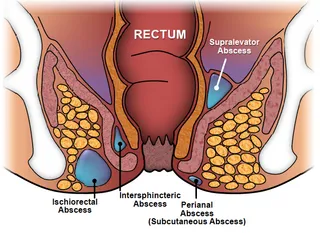
An anal fistula is an abnormal tunnel-like tract that forms between the inside of the anal canal and the skin near the anus. It almost always develops as a consequence of an anorectal abscess — a collection of pus near the anus that either drains spontaneously or requires surgical drainage. Once the abscess drains, the track it leaves behind can persist and become a fistula.
A fistula is structurally different from both piles and fissures. It is not a swollen vein or a tear — it is an actual channel through the tissue, with an internal opening inside the anal canal and an external opening on the skin outside. This channel can become infected repeatedly, causing recurring pain, swelling, and discharge.
Common Symptoms of Fistula
- Persistent or intermittent discharge of pus or blood-stained fluid from a small opening near the anus
- Recurring pain and swelling near the anus — often cyclical (builds up, drains, settles, then builds again)
- A visible small external opening on the skin near the anus, sometimes with a raised bump
- Skin irritation and itching around the external opening due to constant moisture from discharge
- History of a previous anorectal abscess that was drained or burst on its own
- Occasional fever during flare-ups if the tract becomes re-infected
Key point: A fistula is characterised by discharge — recurrent pus or fluid leaking from an opening near the anus. This is its hallmark symptom and distinguishes it clearly from both piles and fissures.
What Causes Fistula?
- Previous anorectal abscess (the most common cause — roughly 40–50% of abscesses can lead to fistula formation)
- Infection of the anal glands
- Crohn’s disease and other inflammatory bowel conditions
- Tuberculosis (more relevant in the Indian context than often recognised)
- Previous anorectal surgery or trauma (in rare cases)
- Diabetes or immunocompromised states that impair healing
Piles vs Fissure vs Fistula — A Quick Comparison
To make the differences easier to remember, here’s how the three conditions compare across the most important features:
Nature of the condition: Piles are swollen blood vessels. A fissure is a tear in the anal lining. A fistula is an abnormal tunnel between the anal canal and the skin.
Primary symptom: Piles present mainly with painless bleeding. Fissures present with sharp pain during bowel movements. Fistulas present with persistent discharge from a skin opening near the anus.
Pain: Piles are usually painless in early stages (pain occurs only if they thrombose or become severely prolapsed). Fissures cause intense, sharp pain — the most painful of the three. Fistulas cause dull, throbbing pain that comes and goes with infection cycles.
Bleeding: Piles cause painless, often significant bleeding. Fissures cause bleeding with pain — usually a smaller amount. Fistulas may have blood-stained discharge, but heavy bleeding is uncommon.
Visible signs: Piles may show as a soft lump or prolapsed mass. Fissures appear as a linear tear with possible skin tag. Fistulas show a small external opening on the skin, sometimes with pus.
Can they coexist? Yes — and this is important. A patient can have piles and a fissure at the same time, or a fistula alongside piles. This is exactly why a thorough proctological examination — not self-diagnosis — is critical.
How Are They Diagnosed?
All three conditions require a proper clinical evaluation by a proctologist. Self-diagnosis based on symptoms alone is unreliable because there is considerable overlap — bleeding, pain, and lumps can occur in various combinations across all three.
At Sharvari Hospital, the diagnostic approach includes a detailed history of your symptoms, a gentle physical examination of the perianal area, and a video proctoscopy — a painless examination that allows the doctor and the patient to see the inside of the anal canal on a screen. This is particularly valuable for identifying internal piles, chronic fissures, and the internal opening of a fistula. In complex fistula cases, an MRI of the pelvis may also be recommended to map the tract accurately before surgery.
Treatment Options — How Each Condition Is Managed Differently
Treating Piles
Grade 1 and early Grade 2 piles often respond well to conservative treatment — dietary changes (high fibre, adequate water), stool softeners, topical creams, and sitz baths. For Grade 2–3 piles that don’t improve with conservative measures, laser hemorrhoidoplasty is an excellent minimally invasive option. It uses controlled laser energy to shrink the piles tissue with minimal pain, no external wounds, and a same-day discharge. Grade 4 or complex piles may require stapler hemorrhoidopexy or a surgical haemorrhoidectomy.
Treating Fissure
Acute fissures often heal within 4–6 weeks with conservative management — stool softeners, high-fibre diet, warm sitz baths, and topical medications (including GTN ointment or diltiazem cream to relax the sphincter and improve blood flow). Chronic fissures that fail to heal with conservative treatment may require a lateral internal sphincterotomy (LIS) — a minor surgical procedure that relaxes the tight sphincter muscle, allowing the fissure to heal. Laser-assisted fissure treatment is also available for select cases, offering a gentle and precise approach.
Treating Fistula
Fistulas almost always require surgical intervention — they rarely heal on their own because the tract is lined with epithelial (skin-like) cells that prevent natural closure. Treatment options include fistulotomy (laying open the tract), LIFT procedure (Ligation of Intersphincteric Fistula Tract), laser-assisted fistula closure (FiLaC), and the use of a seton (a suture placed through the tract to promote gradual drainage and healing). The choice depends on how complex the fistula is and how much sphincter muscle is involved. Preserving continence is always a priority.
Recovery and Lifestyle After Treatment
Regardless of which condition is treated, recovery at Sharvari Hospital focuses on getting patients back to their daily routine as quickly and comfortably as possible. Most piles and fissure procedures allow same-day or next-day discharge. Fistula surgeries may require slightly longer healing depending on complexity.
For all three conditions, long-term prevention revolves around maintaining soft, regular bowel movements through a high-fibre diet rich in vegetables, fruits, and whole grains, drinking 2.5–3 litres of water daily, avoiding prolonged straining or sitting on the toilet, staying physically active, and keeping follow-up appointments with your surgeon to catch any early signs of recurrence.
When Should You See a Doctor?
Don’t wait if you experience any of the following: bleeding during or after bowel movements (even if painless), persistent pain in the anal area lasting more than a few days, discharge of pus or fluid from a spot near the anus, a lump or swelling that doesn’t resolve on its own, recurring symptoms despite home remedies or pharmacy medications, or any sudden increase in the severity of symptoms.
Many patients delay seeking help out of embarrassment. But these conditions are remarkably common, and the earlier they’re properly diagnosed, the simpler and less invasive the treatment tends to be.
Why Choose Sharvari Hospital for Anorectal Conditions?
Dr. Kundan Kharde — MBBS, MS (General Surgery), FMAS — brings over 19 years of medical experience to every consultation. At Sharvari Hospital in Wakad / Pimple Nilakh, Pune, patients benefit from:
- Accurate diagnosis with video proctoscopy, and imaging before fistula surgery (almost every fistula patient at Sharvari Hospital is imaged before surgery — an MRI fistulogram or a trans-rectal ultrasound)
- Condition-specific treatment plans — no guesswork, no one-size-fits-all approach
- Advanced laser and minimally invasive surgical techniques for piles, fissure, and fistula
- Day-care procedures with same-day discharge for most cases
- Compassionate, unhurried consultations where your questions are answered fully
- 240+ Google reviews reflecting the experience of hundreds of patients
Whether you’re dealing with piles, fissure, fistula, or aren’t sure which one — the right first step is always a proper evaluation.
📞 Call or WhatsApp: +91 951 951 1928 📧 Email: [email protected] 📍 Address: Sharvari Hospital, Wakad / Pimple Nilakh, Pune — 411027
“Precise Surgery, Swift Recovery”
Frequently Asked Questions
What is the main difference between piles, fissure, and fistula?
Piles are swollen blood vessels inside or around the anal canal, causing painless bleeding and sometimes a prolapsing lump. A fissure is a small tear in the anal lining that causes sharp, cutting pain during bowel movements. A fistula is an abnormal tunnel between the anal canal and the skin surface, causing persistent discharge of pus or fluid. Though all three affect the anorectal area, they are fundamentally different conditions requiring different treatments.
Can piles turn into a fissure or fistula?
Piles do not directly transform into a fissure or fistula — they are separate conditions. However, chronic constipation and straining, which are the most common cause of piles, can also cause a fissure. Similarly, an infected hemorrhoid or anorectal abscess can eventually lead to fistula formation. It is also possible to have more than one condition simultaneously, which is why an expert proctological examination is so important.
Which condition is the most serious — piles, fissure, or fistula?
In terms of treatment complexity, fistula is generally the most challenging because it often requires surgical intervention and can recur if not treated correctly. Piles and fissures, when caught early, can frequently be managed with conservative measures or minimally invasive procedures. However, any anorectal condition can become serious if neglected — advanced piles can cause significant blood loss and anaemia, chronic fissures can drastically affect quality of life, and untreated fistulas can lead to recurrent infections and complex tracts.
Is it possible to have piles and fissure at the same time?
Yes, absolutely. Piles and fissures share many of the same risk factors — chronic constipation, straining, low-fibre diet — so it’s quite common for them to coexist. In fact, a hard stool that worsens piles can simultaneously cause a tear in the anal lining (fissure). This overlap in symptoms is one of the key reasons self-diagnosis is unreliable and a clinical examination with proctoscopy is recommended.
Do all fistulas require surgery?
In the vast majority of cases, yes. Anal fistulas rarely close on their own because the tract becomes lined with tissue that prevents spontaneous healing. The goal of surgery is to eliminate the tract while preserving the sphincter muscles that control continence. At Sharvari Hospital, Dr. Kundan Kharde uses advanced techniques including laser-assisted fistula closure (FiLaC) and the LIFT procedure, which are designed to be effective while minimising the impact on sphincter function.
How can I prevent piles, fissure, and fistula?
The foundation of prevention for all three conditions is maintaining soft, regular bowel movements. This means eating a diet rich in fibre (vegetables, fruits, whole grains, legumes), drinking adequate water (2.5–3 litres daily), avoiding prolonged straining on the toilet, staying physically active, and addressing constipation or diarrhoea promptly rather than ignoring it. If you’ve had an anorectal abscess, follow up with your surgeon to monitor for fistula development. And if you notice any symptoms — bleeding, pain, or discharge — seek evaluation early rather than waiting.