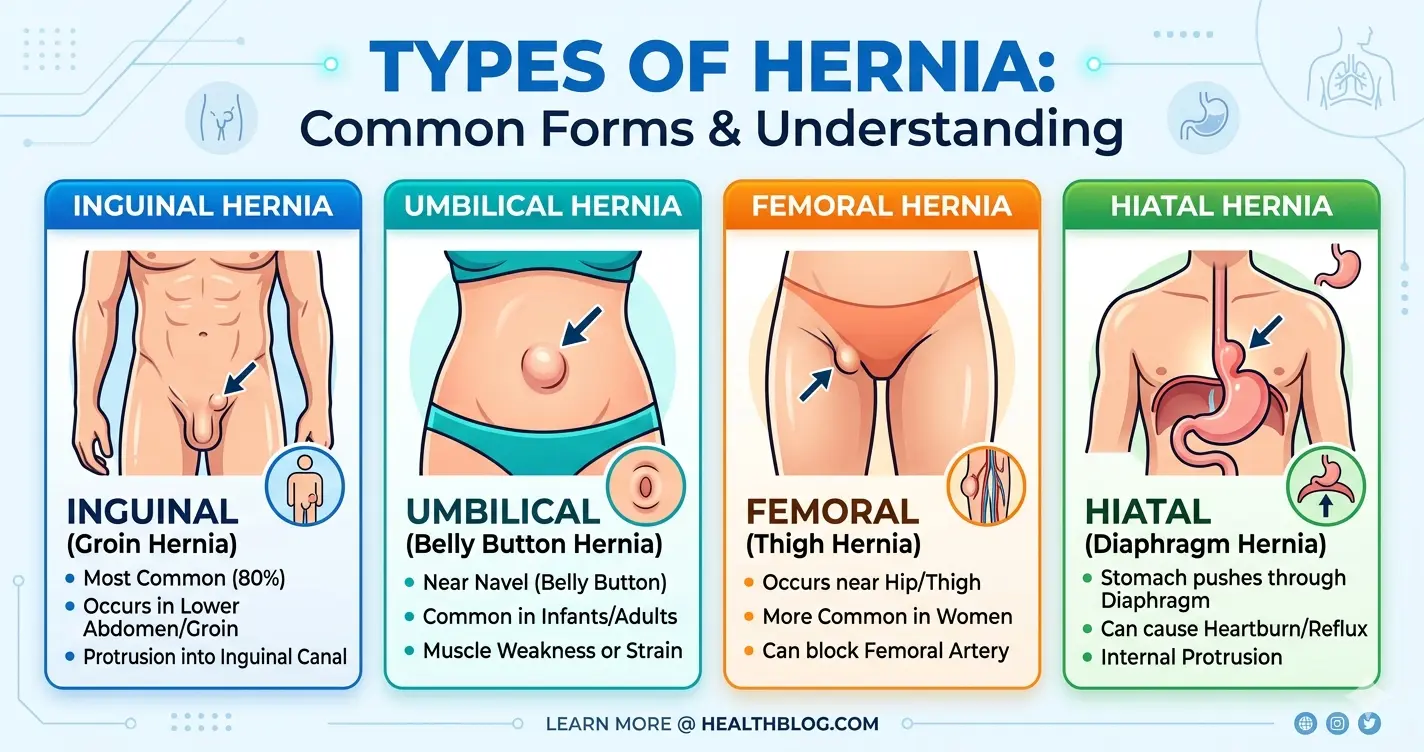
Most hernias are simple. A small groin bulge, a clean laparoscopic repair, home the next day, back at your desk in Hinjewadi within a week.
But some hernias are not simple — and the patients who have them usually know it. They have a bulge that came back six months after the first operation. They have a scar from an old caesarean or gallbladder surgery with a swelling the size of a grapefruit sitting under it. They have been told by one hospital that the case is “too big for laparoscopy” and by another that it can be done in a day. They are carrying a folder of scans and two previous discharge summaries, and nobody has explained why the first repair failed.
This guide is for those patients. It explains what actually makes a hernia complex, why repairs come back, which advanced techniques exist beyond a standard mesh patch, and how to judge whether the surgeon in front of you does this work often enough to do it well.
Looking for treatment details rather than the explanation? Go straight to our dedicated pages on complex ventral hernia repair in Pune, recurrent hernia repair and incisional hernia surgery — or the local pages for Wakad, Hinjewadi, Baner and Aundh.
What Makes a Hernia “Complex”?
A hernia is classified as complex when the defect is wider than about 4 cm, when it has recurred after one or more previous repairs, when the abdominal contents have lost domain, or when infection, a stoma or previously placed mesh complicates the field. These hernias need a planned abdominal wall reconstruction, not a routine patch.
In practical terms, we treat a hernia as complex when any of the following apply:
- Defect width over 4 cm — and particularly over 10 cm, where the European Hernia Society grades it as large.
- Recurrent hernia — one or more failed previous repairs, with or without mesh still in place.
- Loss of domain — so much bowel has lived outside the abdominal cavity for so long that the abdomen has physically shrunk and cannot simply accept its contents back.
- Multiple defects (“Swiss cheese” abdomen) — common along long midline scars.
- Previous mesh infection, sinus or fistula at the hernia site.
- A stoma (colostomy or ileostomy) beside the hernia.
- High-risk physiology — poorly controlled diabetes, BMI over 35, active smoking, chronic cough, cirrhosis or long-term steroid use.
A 2 cm umbilical hernia in a healthy 30-year-old and a 15 cm recurrent incisional hernia in a 62-year-old diabetic are the same word on paper and completely different operations in reality. The mistake patients make is assuming one price and one hospital stay applies to both.
Why Do Hernias Come Back After Surgery?
Recurrence is almost never bad luck. The usual causes are inadequate mesh overlap, mesh that was too small or fixed poorly, a repair closed under tension, wound infection at the first operation, and uncontrolled patient factors like diabetes, smoking, obesity, chronic cough or constipation. Each of these is a planning failure that can be corrected at the second attempt.
Here is what we typically find when we re-explore a failed repair:
| Reason for recurrence | What went wrong | How it is avoided second time |
|---|---|---|
| Insufficient mesh overlap | Mesh barely covered the defect; edges lifted | Minimum 5 cm overlap in every direction, wider for large defects |
| Tissue-only (suture) repair | No mesh used at all in an adult ventral hernia | Mesh reinforcement in essentially all adult repairs |
| Repair under tension | Edges pulled together forcibly; sutures cut through | Component separation to create tension-free closure |
| Poor mesh fixation | Mesh migrated or folded | Appropriate sutures/tacks or self-gripping mesh, correct plane |
| Wound infection | Mesh contaminated, healing failed | Optimisation before surgery, correct antibiotics, sometimes staged repair |
| Ongoing strain | Untreated cough, constipation, prostate obstruction, heavy lifting resumed too early | Treat the cause before operating; structured return-to-activity plan |
| Metabolic factors | HbA1c over 8, active smoking, obesity | Pre-habilitation: glycaemic control, 4-6 weeks smoking cessation, weight optimisation |
That last row matters more than most patients expect. Operating on a recurrent hernia in a smoker with an HbA1c of 9.5 is planning the third recurrence. A surgeon who insists on six weeks of preparation before a complex repair is not delaying you — they are protecting the result.
The same principle holds across surgery: a condition that has recurred needs a different plan, not a repeat of the same operation. We have written companion guides on recurrent and complex anal fistula and recurrent pilonidal sinus after failed surgery that apply the same reasoning to those conditions.
What Are the Advanced Techniques for Complex Hernia Repair?
Beyond standard mesh repair, the modern toolkit includes eTEP, IPOM and IPOM-Plus, Rives-Stoppa retromuscular repair, and posterior component separation with transversus abdominis release (TAR). The right one depends on defect size, previous surgery and where the mesh can safely sit. A surgeon offering only one technique will fit your hernia to their operation instead of the reverse.
For groin hernias — inguinal and femoral
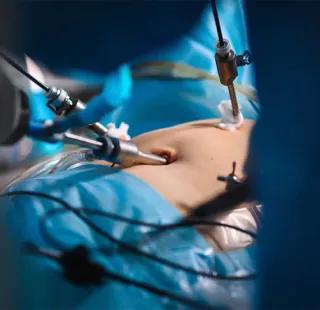
- TEP (Totally Extraperitoneal) — keyhole repair in the space outside the abdominal lining. No entry into the abdominal cavity, minimal pain, fastest return to work. Our default for most primary and many recurrent inguinal hernias.
- TAPP (Transabdominal Preperitoneal) — through the abdominal cavity, then the peritoneum is closed over the mesh. Useful for large, recurrent or incarcerated groin hernias and when both sides need repair.
- Open Lichtenstein tension-free repair — still an excellent, durable operation, especially in very large scrotal hernias or where anaesthetic risk favours a local/spinal approach.
For ventral, umbilical and incisional hernias
- eTEP (extended-view Totally Extraperitoneal) — a newer laparoscopic technique that places mesh in the retromuscular plane without any mesh touching bowel. Excellent for midline and recurrent defects.
- IPOM / IPOM-Plus — composite mesh placed inside the abdomen, with the defect closed first in IPOM-Plus. Fast and effective for small to moderate defects.
- Rives-Stoppa retromuscular repair — the reference standard for midline ventral hernias: a wide mesh sits behind the rectus muscles, held in place by the body’s own pressure.
- Posterior component separation with TAR — for large or recurrent defects. Releasing the transversus abdominis muscle allows the midline to close without tension and creates room for a very wide mesh. This is the operation that rescues most “unrepairable” abdomens.
When “just do it with laser” is the wrong answer
Laser has an important place in proctology, and we use it daily for piles and fistula. It has no role in hernia repair. If any centre offers you “laser hernia surgery”, ask precisely which technique they mean — you will usually find it is a standard laparoscopic repair being marketed with a more appealing word.
How Is a Complex or Recurrent Hernia Assessed Before Surgery?
A complex or recurrent hernia should never be operated on the strength of a clinical examination alone. A CECT scan of the abdomen and pelvis, plus the previous operation notes, is the minimum planning requirement. The scan gives defect size, number of defects, mesh position, muscle quality and the volume ratio that determines whether component separation is needed.
Bring these to your consultation:
- Previous discharge summaries and operation notes — the single most useful document. It tells us which mesh, which plane and which technique failed.
- Any previous CT or ultrasound, including the films, not just the report.
- A current medication list, especially blood thinners, steroids and diabetes medication.
- Recent HbA1c if you are diabetic.
- An honest account of your work — a software engineer in Hinjewadi and a warehouse supervisor in Chakan have very different abdominal wall loads, and the repair plan should reflect that.
If a surgeon offers to fix a recurrent ventral hernia without a CT scan, that is your signal to get a second opinion.
How Long Does Recovery Take?
A straightforward laparoscopic repair means 24 to 48 hours in hospital and desk work in about a week. A large complex or recurrent repair with component separation means 3 to 5 days in hospital, 3 to 4 weeks before desk work, and 8 to 12 weeks before heavy lifting. Honest expectations prevent the early strain that causes the next recurrence.
| Stage | Simple laparoscopic repair | Complex / recurrent repair |
|---|---|---|
| Hospital stay | 1 – 2 days | 3 – 5 days |
| Drain | Usually none | Often 3 – 7 days |
| Walking | Same evening | Day 1 |
| Driving | 5 – 7 days | 2 – 3 weeks |
| Desk work | ~1 week | 3 – 4 weeks |
| Gym / heavy lifting | 4 – 6 weeks | 8 – 12 weeks |
| Abdominal binder | Not usually needed | 6 – 8 weeks |
Some swelling and firmness over the repair for several weeks is normal — it is fluid (seroma), not a returning hernia. Persistent expanding swelling, fever, redness or discharge needs to be seen the same day.
How Do You Choose the Best Hernia Surgeon in Pune?
Ask the surgeon three specific questions: how many hernia repairs they perform annually, what their personal recurrence rate is, and which techniques they offer beyond standard mesh repair. A surgeon who can compare TEP, TAPP, eTEP, IPOM and TAR — and who wants a CT before touching a recurrent hernia — is planning. One who offers a single operation for every hernia is improvising.
Also worth checking:
- Do they operate on recurrent hernias at all? Many general surgeons refer them onward, and that is an honest and correct decision.
- Is there an anaesthetist and ICU backup? Large abdominal wall reconstructions need it.
- Will you meet the operating surgeon, or an assistant? In multi-surgeon corporate setups, ask who will actually hold the instruments.
- Is the cost estimate itemised in writing — mesh included, drains included, follow-up included?
For patients across Wakad, Hinjewadi, Baner, Aundh, Tathawade and Punawale, the practical advantage of a specialist unit close to home is not the operation itself — it is the follow-up. Complex repairs need reviews at one week, one month and three months. A hospital 15 minutes from your home in PCMC gets those visits done; one across the city quietly does not.
When Should You See a Doctor Urgently?
Book a consultation soon if you have:
- A bulge that has returned after a previous hernia operation
- A swelling along an old surgical scar that is enlarging
- A hernia that has become harder to push back in than it used to be
- Dragging pain that worsens through the working day
Go to an emergency department immediately if you have:
- A hernia that has become firm, tender and cannot be pushed back (irreducible)
- Severe pain with vomiting, abdominal distension or absolute constipation
- Redness or discolouration of the skin over the bulge
- Fever with a painful hernia
These are signs of obstruction or strangulation, where blood supply to trapped bowel is cut off. This is a surgical emergency measured in hours, not days.
Why Patients Choose Sharvari Hospital for Complex Hernia Repair
Complex hernia work at Sharvari Hospital is led by Dr. Kundan Kharde (MBBS, MS – General Surgery, FMAS), with over 19 years of surgical experience in advanced laparoscopic surgery.
- Planning before operating. Recurrent and large ventral hernias get a CT scan, a review of previous operation notes and, where needed, 4–6 weeks of pre-habilitation (glycaemic control, smoking cessation, weight optimisation) before a date is fixed.
- Technique matched to the hernia — TEP, TAPP, eTEP, IPOM-Plus, Rives-Stoppa or component separation with TAR, chosen on anatomy rather than habit.
- Honest referral. If a case genuinely needs a resource we do not have, we say so and refer, rather than attempt it.
- Itemised written estimates, insurance and TPA support, and no per-side pricing surprises.
- 240+ Google reviews, with patients travelling from Wakad, Pimple Nilakh, Hinjewadi, Baner, Aundh, Tathawade, Ravet and across PCMC.
Read more on our dedicated pages: complex ventral hernia repair · recurrent hernia repair · incisional hernia surgery · hernia surgery in Wakad, Hinjewadi, Baner and Aundh.
Book a consultation — bring your previous reports:
- 📞 Call: +91 951 951 1928
- 💬 WhatsApp: +91 951 951 1928
- 📍 Sharvari Hospital, Wakad / Pimple Nilakh, Pune — 411027
- ✉️ [email protected]
Precise Surgery, Swift Recovery.
Written and medically reviewed by Dr. Kundan Kharde, MBBS, MS (General Surgery), FMAS — Founder & Lead Surgeon, Sharvari Hospital, Wakad, Pune. This article is general information and does not replace an in-person surgical assessment.