A hernia that has been soft, reducible and comfortable for fifteen years can strangulate in a single evening. When it does, the difference between bowel that recovers and bowel that has to be removed is measured in hours — and it is decided by how quickly the patient reaches a hospital that can operate. This article explains what strangulation is, who is most at risk, the five signs that mean go to emergency now, what the operation involves and why no mesh is placed, and walks through a real, de-identified case treated at Sharvari Hospital, Pune.
Medically reviewed by Dr. Kundan Kharde, MS, FMAS — Founder & Director, Laparoscopic & General Surgeon, Sharvari Hospital, Pune. 19+ years, 6,000+ surgeries. View profile.
What strangulation is
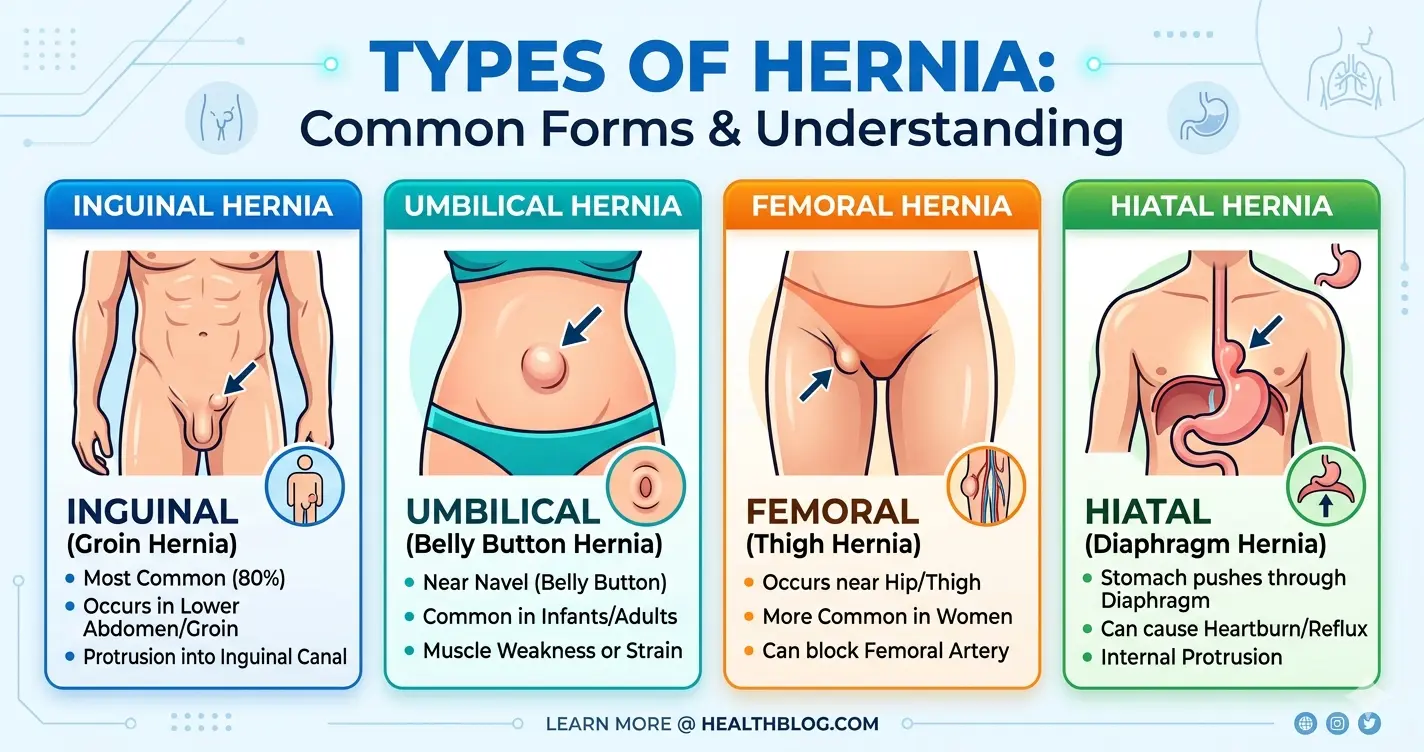
A hernia is a gap in the abdominal wall through which the contents of the abdomen — usually a loop of bowel or a piece of the fatty apron called the omentum — push outward under the skin. For years this can be harmless. The contents slide out when you stand, cough or strain, and slide back when you lie down; the hernia is “reducible”.
Two things can change that. A hernia becomes incarcerated when the contents get stuck in the gap and cannot be pushed back. It becomes strangulated when the gap is tight enough to squeeze the blood vessels running to the trapped loop. Blood can no longer get in or out. Deprived of its blood supply, the trapped bowel swells, darkens and, over a matter of hours, loses viability. Meanwhile the bowel upstream, blocked at the trapped point, distends — which is what produces the cramping pain, the vomiting and the inability to pass wind or stool.
The timing is plain physiology rather than alarm. Bowel that has lost its blood supply for a short time can recover completely once the pressure is released. Bowel that has been without blood supply for longer cannot, and that segment has to be removed and the two healthy ends joined. Which of those two operations a patient ends up having is decided largely by the clock.
Who is at risk
Any hernia can strangulate, but some are more likely to than others:
- Small-necked hernias. The narrower the opening relative to what passes through it, the easier it is for contents to become trapped. This is why a small hernia is not automatically a safe hernia.
- Femoral hernias — the bulge just below the groin crease, more common in women — have a high strangulation rate and are generally repaired soon after diagnosis rather than observed.
- Umbilical and paraumbilical hernias in adults have a firm, fibrous ring at the navel that does not stretch.
- Long-standing hernias. Over years the neck of the hernia scars and tightens, and the contents that have been sliding through it become more likely to stick.
- Older patients, who are more likely to have long-standing hernias and less reserve to tolerate a delayed operation.
The main hernia guide covers the types in detail; the point here is that “I have had it for years and it never bothers me” describes many of the hernias that strangulate.
The five warning signs
If you have a hernia of any kind and any of these appears, it needs an emergency department — one with a surgical team and an operating theatre available around the clock — now, not at the next appointment:
- Sudden, severe pain at the hernia or across the abdomen. A hernia that has never hurt, or has only ached, and suddenly becomes very painful has changed.
- A swelling that will not go back in. A bulge that used to disappear when you lay down, and now stays out and feels hard, is incarcerated. Do not keep pushing it.
- Nausea or vomiting. With a hernia that will not reduce, vomiting means the bowel is likely blocked at the trapped point.
- Redness, warmth or marked tenderness over the swelling. Skin changes over the bulge suggest the trapped contents are inflamed or losing their blood supply.
- Not passing wind or stool, with a swollen abdomen. This is the picture of bowel obstruction.
Do not eat or drink on the way, because an operation is likely and an empty stomach makes the anaesthetic safer. The everyday symptoms of a hernia that is not an emergency — a dragging ache, a bulge on standing — are covered in hernia symptoms: when is surgery necessary?.
What happens in emergency surgery
Before the operation. Blood tests, an X-ray or scan as needed, intravenous fluids and antibiotics, a tube into the stomach to relieve the vomiting, and an assessment by the anaesthetist all happen at once while the theatre is prepared. A gentle attempt to reduce the hernia may be made if there are no signs of strangulation; if there are, no attempt is made, because pushing compromised bowel back into the abdomen is unsafe.
Laparotomy rather than laparoscopy. Planned hernia repair at Sharvari Hospital is laparoscopic. A strangulated hernia with obstruction is different: the bowel is distended, the trapped loop must be released under direct vision and inspected along its full length, and if a segment has lost its blood supply it must be removed and the bowel rejoined. An open operation is the more dependable way to do all of that, and the surgeon chooses it on the findings.
The decisive moment. Once the loop is released from the hernia neck, the surgeon wraps it in warm, moist packs and watches. If its colour returns — dusky purple fading to pink, the wall regaining its sheen, pulsation returning in the small vessels — it is returned to the abdomen. If it does not, that segment is resected.
Why no mesh. In a planned repair, a lightweight mesh reinforces the gap and substantially lowers the chance of recurrence. In an emergency the field is contaminated: strangulated bowel leaks fluid and bacteria even when it recovers. A mesh is a foreign body, and in a contaminated field it is at real risk of infection — which usually means another operation to remove it. So the hernia is closed with sutures only. If the repair stretches or the hernia recurs later, a planned mesh reinforcement can be done as a clean laparoscopic procedure. A suture-only closure is not a lesser repair in this setting; it is the correct one.
A real case: fifteen years, one night
A woman in her late sixties had had an umbilical hernia for about fifteen years. It had never troubled her much and she had never had it repaired. One evening it came out and, for the first time, did not go back in; it became hard and tender, and over the following hours she developed cramping abdominal pain and vomiting. Her family brought her to the Sharvari Hospital emergency department that night.
On examination the swelling was tense, tender and irreducible, and the abdomen was distended. The picture was a strangulated umbilical hernia with early bowel obstruction. Because the hospital has an in-house operating theatre and anaesthesia team available 24×7, she was taken for an emergency laparotomy the same night rather than being stabilised and transferred or held for a morning list.
A loop of small bowel was found trapped at the hernia neck, dark and swollen. The neck was widened, the loop released and wrapped in warm packs — and in her case, because it had been reached in time, its colour and blood supply recovered on the table. No bowel had to be removed. The hernia was closed with sutures only; no mesh was placed in the contaminated field. She was drinking the next morning, walking on the first day, and went home after a three-day stay. That is her course, not a promise: recovery after an emergency laparotomy depends on the patient and, above all, on whether a resection was needed.
The operating-theatre photograph and a short muted video (both blurred until you choose to view them) are on the de-identified case study: strangulated umbilical hernia, emergency surgery the same night, bowel saved.
Why planned repair is easier
Repaired on your own terms, the same hernia is a very different operation. A planned laparoscopic repair is usually a short day-care or overnight procedure: three small keyhole incisions, a mesh placed behind the muscle wall under clean conditions, discharge the same or next day for most patients, and a return to desk work within a few days. The realistic week-by-week course is set out in hernia surgery recovery tips.
Compare that with an open emergency laparotomy at night, a suture-only repair, a hospital stay of several days and the very real possibility of a bowel resection. Every one of those differences is the cost of the delay, not of the hernia. Types, technique, recovery and cost of planned repair are all in hernia treatment in Pune: a surgeon’s guide and on the hernia surgery page.
Not every hernia needs surgery this month. Some small, symptom-free hernias can reasonably be observed under a surgeon’s guidance. The point is that the decision should be made by examination — not by waiting to see whether the hernia becomes a problem.
If you have a hernia now
- Sudden severe pain, a swelling that will not go back in, vomiting, redness over the bulge, or no wind or stool with a swollen abdomen: go to an emergency department now. Sharvari Hospital’s emergency department, operating theatre and anaesthesia team are available 24×7 on +91 951 951 1928.
- A hernia that is not an emergency: book an examination. Bring any previous scans or notes. You will leave knowing whether it should be repaired, how, and what it will involve — and the decision will be yours to make in daylight rather than at 2 a.m.