“Doctor, I’ve been going from clinic to clinic for two years. Every place gave me a different answer. I just want someone who’ll tell me the truth — what do I actually have, and what’s the safest way to fix it?”
Much of that practice is proctology — including fistula treatment in Pune, where the operation is chosen from the mapped tract rather than a fixed package. Most patients who walk into my clinic at Sharvari Hospital, Wakad, are not looking for marketing language. They want a calm, qualified surgeon who explains the problem, lays out the options honestly, and respects their time and dignity. That’s the kind of proctology practice we have tried to build over the last decade.
This post is not a brochure. It is a clear, factual answer to a question many patients in Pune type into Google: Who is Dr. Kundan Kharde, and why should I choose him as my proctologist? If you’re considering treatment for piles, fissure, fistula, pilonidal sinus, hernia, gallstones, varicose veins or other day-care surgical conditions — read on. By the end, you’ll have a structured way to evaluate whether Dr Kundan Kharde proctologist consultations and surgical care are the right fit for you.
A quick introduction — who is Dr. Kundan Kharde?
Dr. Kundan Kharde, MBBS, MS (General Surgery), FMAS, is the lead surgeon at Sharvari Hospital, located on Kaspate Wasti Road, between Wakad and Pimple Nilakh in Pune — 411027. He has 19+ years of total medical experience, and focuses on laser proctology, laparoscopic general surgery, and minimally invasive procedures for working professionals and families across the PCMC and West Pune belt.
In a typical clinic week, the practice sees patients from Wakad, Pimple Nilakh, Pimple Saudagar, Hinjewadi, Baner, Balewadi, Aundh, Ravet, Tathawade, Chinchwad and Punawale — many of them IT professionals, teachers, business owners, retirees and homemakers dealing with quietly suffered conditions like piles or fistula that they put off discussing for years.
Sharvari Hospital itself has 240+ Google reviews, reflecting consistent patient experience around clarity, cleanliness, and respectful care. But ratings only tell part of the story — what actually matters is the surgical approach, and that’s what the rest of this article is about.
Qualifications and surgical training
A patient choosing a proctologist deserves to know exactly what training is behind the operating table. Here is the factual qualification stack of Dr. Kharde:
- MBBS — basic medical training (foundation of clinical examination and patient care)
- MS — General Surgery — three-year surgical residency covering open and emergency procedures across the abdomen, anorectal region, breast, thyroid, hernia and trauma
- FMAS — Fellowship in Minimal Access Surgery — focused training in keyhole/laparoscopic and laser surgical techniques
- 19+ years of total experience — clinical and surgical, including independent operating responsibility and follow-up
The reason MS + FMAS is the right combination for a proctologist is simple: MS gives the foundation to handle anatomy and complications safely, and FMAS adds the modern minimally invasive toolkit — laser, laparoscopy, day-care techniques — that today’s patients ask for by name.
Areas of clinical focus
Dr. Kharde’s practice is intentionally focused, not scattered. Rather than offering every speciality, the clinic concentrates on a defined group of conditions where laser and laparoscopic techniques genuinely improve patient outcomes.
1. Laser proctology (the busiest part of the practice)
- Piles / haemorrhoids — Grade 1 through Grade 4, including laser haemorrhoidoplasty (LHP)
- Anal fissure — chronic and acute, including laser sphincterotomy where indicated
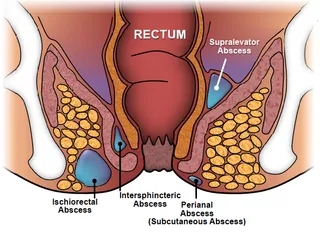
- Anal fistula — simple and complex, including FiLaC (Fistula-tract Laser Closure), VAAFT, LIFT and selected open techniques
- Pilonidal sinus — laser-assisted closure (pit-picking + laser ablation) for the tailbone sinus that returns again and again
2. Laparoscopic general surgery
- Hernia — inguinal, umbilical, incisional, ventral (TAPP/TEP keyhole repair)
- Gallbladder stones — laparoscopic cholecystectomy
- Appendix — laparoscopic appendicectomy
3. Varicose veins and vascular procedures
- EVLT / endovenous laser ablation for varicose veins of the leg
- Sclerotherapy and lifestyle planning for early venous disease
4. Male health and other day-care surgeries
- Laser and stapler circumcision for adults and adolescents (phimosis, balanitis, religious indications)
- Gynecomastia surgery, hydrocele, lipoma, sebaceous cyst removal
- Thyroid disorders — surgical opinion and removal where indicated
- Breast lumps — evaluation and benign-lesion excision
This focused mix is deliberate. It allows the team to maintain high surgical volumes in each area, which research and clinical experience consistently link to safer outcomes and faster recovery.
The surgical philosophy — three things patients notice quickly
Patients often ask what makes one proctologist different from another when the qualifications look similar on paper. The honest answer is how the surgeon thinks. Three principles guide every consultation:
1. Diagnosis first, surgery only when needed
A large portion of patients who arrive convinced they need surgery actually do not. Grade 1 and Grade 2 piles, early fissures, and many simple anorectal conditions respond beautifully to a structured medical plan — diet, fiber, sitz baths, topical agents, and follow-up. The clinic’s first instinct is to fix the problem without operating wherever clinically reasonable. Surgery is recommended only when:
- The condition is at a stage where medicines genuinely will not heal it, or
- The patient has already tried conservative care and it has failed, or
- A red-flag finding (severe bleeding, abscess, sphincter risk) makes surgery the safer choice
2. Match the technique to the patient, not the other way around
Laser is not always the answer. Open surgery is not always outdated. FiLaC suits some fistulas; LIFT suits others; kshar sutra has its niche, and open fistulotomy is sometimes the cleanest, safest choice for very low simple tracts. The same logic applies to piles (LHP vs MIPH/stapler vs Milligan-Morgan) and to hernia (TAPP vs TEP vs open mesh).
The surgeon’s job is to walk the patient through what each option actually means for their specific anatomy, lifestyle and budget — then let the patient choose with clear eyes. That is the heart of shared decision-making, and it is what most patients describe as “finally being given a straight answer”.
3. Day-care wherever safe
For working professionals — especially the IT belt around Hinjewadi and Wakad — being away from work for days is itself a kind of harm. Wherever the condition allows, the clinic plans:
- Day-care admission (in by morning, home the same evening)
- Spinal or short anaesthesia instead of long general anaesthesia where suitable
- Minimally invasive technique so that wound size, pain, and time off work are all reduced
- A structured 3-, 7- and 30-day follow-up rather than a vague “come if there’s a problem”
What a consultation with Dr. Kharde actually looks like
A first visit usually follows a predictable, unhurried rhythm. Knowing what to expect often lowers a patient’s anxiety more than anything else:
- History (10–15 minutes) — Symptoms, duration, bowel habits, previous treatments, family history, work pattern, medical history (diabetes, thyroid, heart, BP), medications and allergies.
- Targeted examination — Done with dignity, drapes, and a chaperone. For anorectal complaints, this usually includes inspection, a digital rectal exam, and video proctoscopy to actually see the inside of the anal canal on a screen.
- Findings shown to you on screen — Many patients are surprised when the doctor turns the monitor so they can see exactly what is being described. It removes mystery and rebuilds trust.
- Diagnosis and grading — In plain words: “This is what you have, this is the stage, here is what it is not.”
- Treatment options laid out — Conservative plan vs surgical plan, with realistic recovery and approximate cost ranges.
- Tests if needed — MRI fistulogram for complex fistula, ultrasound for hernia/gallstones, blood work for fitness, ECG, sometimes a colonoscopy if symptoms suggest it.
- Your questions, answered — No question is “stupid”. The clinic actively encourages a written list.
Patients consistently flag two things in their reviews: “He explained everything in simple language” and “He didn’t push me towards surgery.” Those are not accidents — they are the deliberate output of the consultation structure above.
Technologies and infrastructure available at Sharvari Hospital
A surgeon is only as good as the operating environment that supports them. Sharvari Hospital is set up specifically for modern day-care surgical care, with the following on site:
- Modular operating theatre with HEPA-filtered air, suitable for laparoscopic and laser procedures
- Surgical diode laser for piles, fistula, pilonidal sinus, EVLT (varicose veins) and circumcision
- Laparoscopic stack for hernia, gallbladder and appendix surgery
- Video proctoscopy for chair-side anorectal diagnosis
- Recovery and day-care suite for same-day discharge cases
- Cashless insurance support with most major TPAs (where the policy covers the indication)
- Pharmacy, dressing room and follow-up clinic under one roof — so patients are not bounced between buildings
Why Choose Sharvari Hospital — and Dr. Kundan Kharde
If you are still on the fence after reading the section above, here is the practical case for booking a consultation:
- Focused proctology + laparoscopic practice — not a generalist who occasionally does these surgeries
- 19+ years of experience — high-volume hands matter, especially for fistula and complex piles
- Laser, laparoscopic and conservative options all under one roof — you don’t get pushed into a single technique because that’s all the clinic offers
- Patient-first communication — clear language, written instructions, monitored follow-up
- Single-surgeon continuity — the doctor who consults you is the doctor who operates and the doctor who reviews you in follow-up
- Transparent pricing — written estimate before admission; no surprise add-ons
- Convenient PCMC location — Wakad / Pimple Nilakh, easily reachable from Hinjewadi IT Park, Baner, Aundh, Pimple Saudagar, Ravet and Chinchwad
Book your consultation
Sharvari Hospital Kaspate Wasti, Wakad / Pimple Nilakh, Pune — 411027 Call / WhatsApp: +91 951 951 1928 Email: [email protected] Google reviews: 240+ Google reviews
Precise Surgery. Swift Recovery.
Frequently Asked Questions
What are Dr. Kundan Kharde’s qualifications?
Dr. Kharde holds an MBBS, an MS in General Surgery, and an FMAS (Fellowship in Minimal Access Surgery). He has more than 19 years of total medical experience, with a clinical focus on laser proctology and laparoscopic general surgery at Sharvari Hospital, Pune.
What conditions does Dr. Kharde treat most often?
The busiest part of the practice is proctology — piles, fissure, fistula and pilonidal sinus — followed by laparoscopic hernia, gallbladder and appendix surgery, varicose veins (EVLT), circumcision, and selected breast, thyroid, lipoma and gynecomastia cases.
Is Dr. Kharde a laser specialist or an open-surgery specialist?
Both. The clinic uses whichever technique is clinically right for the patient — laser, laparoscopic, or open. For most piles, fistula, pilonidal sinus and varicose vein cases, laser allows for less pain and faster recovery. For some complex situations, open or laparoscopic surgery is the safer choice. Patients are walked through the options before deciding.
Where is the clinic located, and how do I reach Wakad / Pimple Nilakh?
Sharvari Hospital is on Kaspate Wasti Road, between Wakad and Pimple Nilakh, Pune — 411027. It is roughly 10–20 minutes by car from Hinjewadi IT parks, Baner, Aundh, Pimple Saudagar, Ravet and Chinchwad. Call +91 951 951 1928 for directions or a WhatsApp pin.
How can I book an appointment with Dr. Kundan Kharde?
You can book in three ways: (1) call or WhatsApp +91 951 951 1928, (2) email [email protected], or (3) book through the website at sharvarihospital.com. Bring previous prescriptions, scans/reports, and a list of current medicines to your first visit.
Does Sharvari Hospital accept insurance for proctology and laparoscopic surgery?
Yes. The hospital supports cashless insurance with most major TPAs and health insurance companies, provided your policy covers the specific indication and waiting periods are completed. The front office team helps you initiate pre-authorisation. EMI options are also available in selected cases.
What if I’m not sure I really need surgery — is the consultation still worth it?
Absolutely. A meaningful share of patients leave the first consultation with a conservative (non-surgical) treatment plan — medicines, diet, sitz baths, lifestyle modifications and follow-up. The clinic’s policy is to operate only when surgery is clearly the right answer. The consultation itself gives you clarity, and clarity is what most patients are really searching for.
A note from Dr. Kharde: “My only job in your first visit is to tell you, in plain words, what’s actually wrong and what your real options are — not just the option I happen to perform. If surgery isn’t needed, I’ll tell you. If it is, I’ll explain exactly what we’ll do, what it will feel like, and how soon you’ll be back to normal. That clarity is what I’d want for my own family — so that’s the standard.”