Most patients come to us with one question: “Which one do I have — piles, fissure, or fistula?” If the answer turns out to include the third, our fistula treatment in Pune page covers the techniques and what decides between them.
But a significant number of patients — more than you might expect — arrive with a harder problem: they have two or even all three of these conditions at the same time. And when that happens, treatment becomes a much more nuanced conversation than a simple procedure booking.
This guide is for patients who have been told they have more than one anorectal condition, or who suspect that something is not being fully addressed despite ongoing treatment. If you are still trying to figure out which condition you have, start with our guide to the differences between piles, fissure, and fistula first.
Why Do Piles, Fissure, and Fistula Occur Together So Often?
All three conditions share the same anatomical address — the anal canal and its surrounding tissue — and the same root risk factors. When you strain chronically, eat a low-fibre diet, or have repeated episodes of constipation or diarrhoea, you are stressing the same small area repeatedly. It is not surprising that more than one structure breaks down.
Here is how they can co-exist and even trigger each other:
- Piles → Fissure: Enlarged haemorrhoids cause discomfort and swelling. Patients often strain harder to pass stool around swollen tissue, and that extra straining tears the delicate anal lining — producing a fissure.
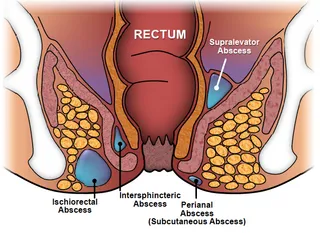
- Fissure → Abscess → Fistula: An acute fissure that does not heal can become infected. Infection spreads into the glands of the anal wall, forms an abscess, and if that abscess drains through a path it carves itself — internally or to the skin — a fistula tract is born.
- Piles + Fistula: Chronically prolapsing piles cause persistent moisture, skin irritation, and micro-trauma around the anus. This environment can make the tissue around an existing fistula opening harder to heal and easier to infect.
In our practice at Sharvari Hospital, serving patients from Wakad, Hinjawadi, Baner, Aundh and across PCMC, we regularly see patients who have had “piles surgery” somewhere else and return months later with a persistent discharging wound — because an underlying fistula was missed during the first workup.
How Do Symptoms Overlap — and How Do Doctors Tell the Conditions Apart?
When two or three conditions co-exist, symptoms can mask each other. The sharp pain of a fissure often dominates the clinical picture, causing patients to dismiss the bleeding (which may be from piles) or the occasional discharge (which may be from a fistula). A systematic examination is the only way to disentangle them.
| Symptom | Piles | Fissure | Fistula |
|---|---|---|---|
| Bright red blood (during stool) | ✅ Very common | ✅ Common | Rare |
| Cutting/tearing pain during defecation | Mild (if prolapsed) | ✅ Dominant symptom | Absent or dull |
| Persistent pain after passing stool | ✅ If thrombosed | ✅ Lasts 30–60 min | Absent |
| Mucus/pus discharge | ✅ Grade 3–4 | Absent | ✅ Classic symptom |
| Skin tag / lump at anus | ✅ Common | ✅ Sentinel tag | Possible near opening |
| Wet/damp feeling near anus | Grade 3–4 piles | Absent | ✅ Very common |
| Itching | ✅ Common | Mild | ✅ Common |
A proper clinical examination — including proctoscopy and, when fistula is suspected, an MRI fistulogram — is essential. An MRI tells us exactly how many fistula tracts exist, where they go, and how close they are to the sphincter. You cannot plan safe surgery without this information when multiple conditions are present.
When All Three Are Present, Why Can’t They All Be Fixed at Once?
Treating piles, fissure, and fistula in a single session sounds efficient, but it is usually not safe. The anal canal is a small, high-pressure environment. Multiple simultaneous wounds compete for blood supply, increase infection risk, and — most critically — risk damaging the sphincter muscle that controls continence.
Think of it this way: if a surgeon removes haemorrhoidal tissue, cuts the fissure, and opens a fistula tract in the same sitting, you now have three raw wound surfaces in a space roughly the size of a thumb. Each wound needs to heal from the inside out. When they are adjacent, they can merge, heal abnormally, or — in the worst case — create a stricture (narrowing) that makes passing stool even harder than before.
The risk most surgeons are cautious about is faecal incontinence — the inability to control when you pass wind or stool. The sphincter muscle is the barrier between you and this life-altering complication. Every incision in the anal area carries some risk to it. Multiple simultaneous incisions multiply that risk.
What most specialists do instead: a staged approach.
What Does a Staged Treatment Plan Look Like?
In a staged approach, the surgeon treats the most acute or symptomatic condition first, allows full healing (typically 6–12 weeks), then addresses the next condition. This reduces operative risk, preserves the sphincter, and gives each wound the blood supply it needs to heal cleanly.
A common sequence when all three conditions are present:
Stage 1 — Address the fissure (if it is the dominant source of pain):
- Lateral internal sphincterotomy (LIS) — a minor procedure that relaxes the internal sphincter and resolves the fissure in over 90% of cases.
- Alternatively, botulinum toxin injection for patients where sphincter-cutting is not preferred (e.g., women with previous obstetric injury).
Stage 2 — Treat the fistula:
- Simple fistulas: Lay-open fistulotomy or FiLaC (laser); very high success rates.
- Complex/high fistulas: VAAFT (Video-Assisted Anal Fistula Treatment), LIFT (Ligation of Inter-Sphincteric Fistula Tract), or seton placement.
- Full MRI fistulogram review before deciding — the tract anatomy dictates the technique.
Stage 3 — Address the piles (if still symptomatic after stages 1 and 2):
- Grade 1–2: Sclerotherapy or banding.
- Grade 3: DGHAL (Doppler-guided haemorrhoid artery ligation), laser haemorrhoidoplasty, or rubber band ligation.
- Grade 4 / large prolapsing: Stapler haemorrhoidopexy or open haemorrhoidectomy.
Patients from Hinjawadi IT parks and Baner who cannot afford extended time off work often ask about day-care laser options. For Grade 1–3 piles and simple fistulas, minimally invasive laser procedures genuinely allow return to desk work within 2–4 days. Grade 4 piles or complex fistulas will need more recovery time regardless of technique — and anyone telling you otherwise is overpromising.
Red Flags: When Should You Seek Urgent Help?
See a doctor without delay — do not manage with home remedies alone — if you have:
- Continuous bleeding that soaks toilet paper or drips into the pan — anaemia is a real risk with prolonged piles bleeding.
- Severe throbbing pain that builds over hours — this can indicate a perianal abscess forming, which needs drainage urgently.
- Fever with anal pain or discharge — infection spreading.
- Complete inability to pass stool — rare but serious if a large prolapse is strangulated.
- Fistula discharge that changes from clear to greenish or blood-mixed — suggests a secondary tract or new abscess.
For patients in Wakad, Pimple Nilakh, Tathawade or Punawale, Sharvari Hospital is typically under 10 minutes away — early consultation prevents the one-condition situation from becoming a three-condition situation.
Why This Matters: The Cost of Leaving One Condition Untreated
The most common pattern we see in referrals is this: a patient had piles treated elsewhere, the bleeding stopped, and everyone declared success. But the fissure that was present alongside the piles went undiagnosed — and then infected — and six months later the patient has a fistula that could have been prevented entirely.
Treating each condition accurately and in the correct sequence is not just about symptoms. It is about preventing the cascade from one condition to the next.
A thorough first evaluation — video proctoscopy, plus an MRI fistulogram or trans-rectal ultrasound for almost every fistula patient — costs a small fraction of the surgery required to manage an advanced fistula. If you have been treated for one condition and still feel something is “not right,” you deserve a second opinion.
Why Sharvari Hospital for Complex Anorectal Conditions
At Sharvari Hospital, Pimple Nilakh (near Wakad), Dr. Kundan Kharde — MBBS, MS (General Surgery), FMAS — has 19+ years of surgical experience in proctology and minimal access surgery. Our approach:
- Complete diagnostic workup first — video proctoscopy as standard, and imaging before every fistula operation: almost every fistula patient at Sharvari Hospital is imaged before surgery, an MRI fistulogram or a trans-rectal ultrasound. We do not operate on incomplete information.
- Staged planning — we sit with you, explain the sequence, and let you plan your leaves and recovery windows intelligently.
- Minimally invasive where appropriate — FiLaC, VAAFT, laser haemorrhoidoplasty, DGHAL — we use the technique that is genuinely right for your anatomy, not the one that is easiest to market.
- Honest about limitations — if a condition is Grade 4 piles or a complex horseshoe fistula, we say so clearly rather than overpromising a “laser cure.”
Book a consultation:
- 📞 Phone / WhatsApp: +91 951 951 1928
- 📧 Email: [email protected]
- 📍 Sharvari Hospital, Pimple Nilakh, Pune — 411027 (5 min from Wakad bridge, 10 min from Hinjawadi Phase 1)
Related Reading
- Piles vs Fissure vs Fistula: Key Differences Explained
- Types of Anal Fistula: Simple vs Complex
- What Causes Recurrent Fistula — and How to Prevent It
- Recurrent Complex Fistula: When You Need a Second Opinion in Pune
- Piles Treatment at Sharvari Hospital →
- Complex Fistula Treatment →
Reviewed and approved by Dr. Kundan Kharde, MBBS, MS – General Surgery, FMAS. Last reviewed: September 2026.
This article is for patient education only and does not replace an in-person medical consultation. If you have symptoms of piles, fissure, or fistula — or all three — please see a qualified proctologist for an accurate diagnosis.