Case studies · Rectal prolapse · Misdiagnosed as piles · De-identified
Case study: "piles" that turned out to be rectal prolapse — and why the treatment is completely different
A 24-year-old man had about a year of constipation and a swelling that came out of the anus on passing stool. Several doctors had treated it as piles, without relief. On history and clinical examination at Sharvari Hospital the swelling was a single ring-shaped mass with circular folds — the whole wall of the rectum, not separate lumps. That is a full-thickness rectal prolapse, and it was repaired with Delorme’s procedure: through the anus, no abdominal incision, no mesh.
Presentation
A 24-year-old man came to Sharvari Hospital, Pimple Nilakh, with about a year of constipation and a swelling that came out of the anus whenever he strained to pass stool. He had consulted several doctors over that year and had been treated for piles — medicines, ointments and advice — without relief. The swelling kept coming out, and the constipation had not settled.
The history already had two features that do not fit ordinary piles well: the main complaint was the swelling and the constipation, not bleeding, and he was 24. On clinical examination, with the patient asked to strain, what came out was not one or more separate lumps. It was a single ring-shaped mass with folds running in circles around a central opening — the same all the way round. That pattern is the whole rectal wall coming down: a full-thickness rectal prolapse. The diagnosis was made in that one visit, from the history and the examination, and it changed the treatment completely.
Piles or prolapse? How the examination tells them apart
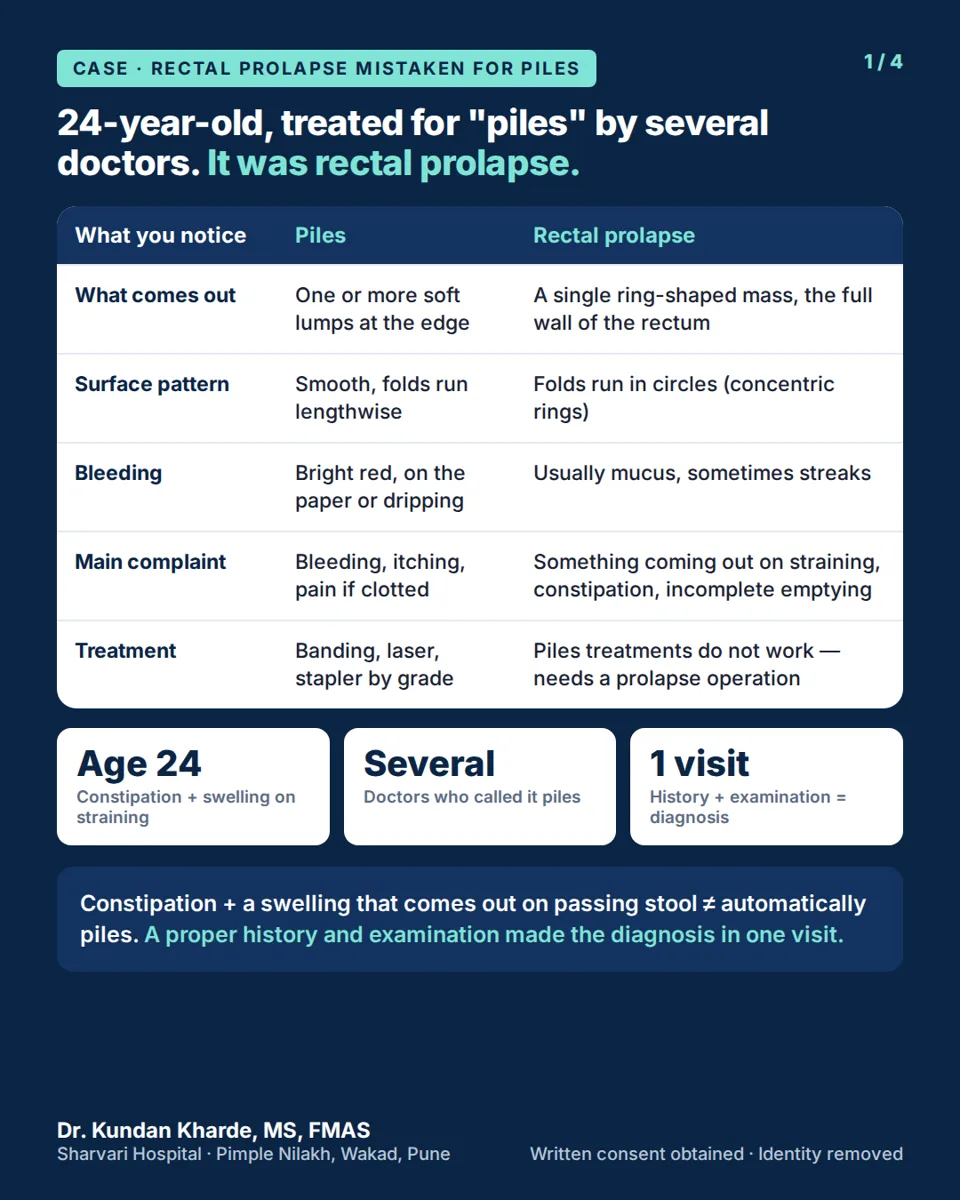
Both conditions produce the same sentence in the consulting room: “something comes out when I pass stool.” What separates them is what that something looks like, and that can only be seen by asking the patient to strain and looking. Piles are cushions of tissue from inside the anal canal; they come out as one or more soft lumps at the edge, with grooves and folds running lengthwise between them. A full-thickness rectal prolapse is the rectum itself telescoping out; it comes out as one ring-shaped mass, the same all the way round, with folds running in concentric circles.
The other clues line up behind that. Piles bleed bright red on the paper or into the pan. Prolapse more often produces mucus and staining, with streaks of blood only if the surface has been out and rubbed. The main complaint with piles is bleeding, itching or pain if a pile clots; with prolapse it is the mass itself, constipation and a feeling of never quite emptying. And the treatments do not overlap at all: banding, laser and stapler procedures treat piles by grade, while a prolapse needs an operation on the rectal wall.
| What you notice | Piles | Rectal prolapse |
|---|---|---|
| What comes out | One or more soft lumps at the edge | A single ring-shaped mass, the full wall of the rectum |
| Surface pattern | Smooth, folds run lengthwise | Folds run in circles (concentric rings) |
| Bleeding | Bright red, on the paper or dripping | Usually mucus, sometimes streaks |
| Main complaint | Bleeding, itching, pain if clotted | Something coming out on straining, constipation, incomplete emptying |
| Treatment | Banding, laser, stapler by grade | Piles treatments do not work — needs a prolapse operation |
How piles are graded and treated is on the piles treatment in Pune page; the same comparison for large prolapsed piles is on Grade 3 & 4 piles treatment.
Why prolapse gets labelled as piles
The complaint is the same. “Something comes out when I go to the toilet” is the opening line for piles far more often than for prolapse, and piles are common, so piles is the first thought. Nothing in the patient’s own words distinguishes the two.
The examination is often done without asking the patient to strain. At rest, both a prolapse and a set of piles sit inside. A look at the anus, or a finger examination, in a patient who is lying relaxed can be entirely normal in both conditions. The ring-shaped mass only appears when the patient bears down, and if that step is skipped there is nothing to see and the label stays.
Young age makes prolapse unexpected. Rectal prolapse is usually thought of as a condition of older women. A 24-year-old man with a swelling on straining does not fit that picture, so the more common diagnosis is assumed. Long-standing constipation and straining, which he had, are exactly what predispose a young adult to prolapse.
What piles treatment would have done here
The piles procedures — rubber band ligation, laser haemorrhoidoplasty, injection sclerotherapy, stapler haemorrhoidopexy — all act on the haemorrhoidal cushions inside the anal canal. A full-thickness prolapse is not made of those cushions; it is the entire rectal wall, muscle included, sliding down. Banding, laser or injection applied to it would have treated tissue that was not the problem and left the rectum coming out exactly as before.
The cost of that is not only the procedure itself. It is the delay: another few months of constipation and straining, during which a prolapse tends to lengthen, and a surface that is repeatedly out and rubbed becomes more prone to mucus, staining and small bleeds. A procedure on the wrong tissue can also leave scarring in the anal canal that the later prolapse repair has to work around. None of this happened in this case, because the examination came first; it is set out so that the reason for examining before treating is clear.
In the operating theatre: Delorme’s procedure
The operation was Delorme’s procedure, done entirely through the anus. The three photographs below are explicit surgical images and are blurred until you choose to view them.

The prolapse delivered under anaesthesia. With the patient anaesthetised the prolapse was brought fully out, and its nature was plain: one ring of rectal wall with concentric circular folds around a central opening, not separate haemorrhoidal lumps. This is the finding that the examination had predicted and that the piles diagnosis could not explain.

Lining stripped, muscle exposed. The inner lining (mucosa) of the prolapsed segment was stripped off as a sleeve, starting just above the anal canal and working up the length of the prolapse. What remains is the bare muscle wall of the rectum, which is what the next step tightens.

Muscle plicated, lining re-joined. The exposed muscle wall was gathered with a series of plication stitches so that the rectum shortened and firmed into a thick collar, and the two edges of lining were then re-joined with absorbable stitches. Everything went back inside; there was no abdominal incision and no mesh.
Why Delorme’s for this patient
He was young and otherwise well, and the prolapse was of moderate length — long enough to need repair, short enough for a perineal operation to deal with the whole of it. Delorme’s procedure works through the anus, so there is no abdominal incision, no entry into the abdominal cavity and no mesh, and recovery is correspondingly short. For a first operation in a young patient, avoiding an abdominal procedure and any implant was the reason it was chosen.
The alternative is abdominal rectopexy, usually laparoscopic, in which the rectum is mobilised and fixed to the sacrum from inside the abdomen; it is chosen for longer full-thickness prolapses and where the lower chance of recurrence after an abdominal repair outweighs the larger operation — a decision made from the examination and discussed with each patient.
Recovery
He was discharged on day 2 after surgery. He went home on stool softeners and a high-fibre diet with plenty of fluids, with one instruction repeated above all others: no straining at stool. Straining is what brought the prolapse down in the first place, and the plicated rectal wall needs to heal without being pushed against.
He was back to his routine in about a week. On follow-up so far there has been no recurrence. That is this patient’s course; recovery after Delorme’s procedure differs from person to person and no timeline is promised.
What this case shows
A year of constipation and a swelling on passing stool had been treated as piles by several doctors. One history and one examination — with the patient asked to strain — showed a single ring-shaped mass with circular folds, which is the rectum itself and not piles. The diagnosis changed the treatment from procedures on the haemorrhoidal cushions to an operation on the rectal wall: Delorme’s procedure, done through the anus without an abdominal incision or mesh. He went home on day 2 and was back to routine in about a week, with no recurrence on follow-up so far. This is one patient’s case, not a statistic and not a promise.
Consent and privacy
This case is published for patient education with the patient’s written consent for the images. No name, patient identifier, date or other detail that could identify him is shown, and the doctors who saw him earlier are not identified. The intra-operative photographs have been cropped so that no identifying feature is visible, and they are shown only after you choose to view them. Every case study on this site follows the same rule: the anatomy and the decision are shared, the person is not.
Told it is piles but something ring-shaped comes out when you strain? Get examined.
If a swelling comes out on passing stool, you have constipation, and piles treatment has not helped, the next step is an examination in which you are asked to strain — not another piles procedure. Call +91 951 951 1928 or WhatsApp to book with Dr. Kundan Kharde at Sharvari Hospital, Pimple Nilakh.
If it is piles, the grades, procedures and costs are on piles treatment in Pune. Dr. Kharde’s own page on piles: piles treatment — drkundankharde.com.
Your surgeon: Dr. Kundan Kharde, MS, FMAS — Founder & Director, Lead Proctology Surgeon, Sharvari Hospital. 19+ years, 6,000+ surgeries.
Frequently asked questions
How do I know if it is piles or rectal prolapse?
You usually cannot tell from the symptoms alone, because both present as “something comes out when I pass stool”. The examination tells them apart: the doctor asks you to strain, and looks at what appears. Piles come out as one or more separate soft lumps with folds running lengthwise; a full-thickness rectal prolapse comes out as a single ring-shaped mass with folds running in circles, the same all the way round, because it is the whole wall of the rectum. Constipation, mucus and a feeling of incomplete emptying point more towards prolapse; bright red bleeding on the paper points more towards piles. If the swelling has never been looked at while you strain, ask for that at your next consultation.
Can rectal prolapse happen at 24?
Yes. Rectal prolapse is more common in older women, but it also occurs in young adults of either sex, particularly with long-standing constipation and straining. The patient in this case was a 24-year-old man. Because prolapse is unexpected at that age, a young person with a swelling on passing stool is often assumed to have piles, and that assumption can go unchecked for months. Age does not decide the diagnosis; the examination does.
What is Delorme's procedure?
Delorme's procedure is an operation for rectal prolapse done entirely through the anus. The prolapse is brought out under anaesthesia, the inner lining (mucosa) of the prolapsed segment is stripped off as a sleeve, the exposed muscle wall is gathered with a series of plication stitches so that the rectum shortens and firms up, and the lining is then re-joined with absorbable stitches. There is no abdominal incision and no mesh. It is generally chosen for shorter prolapses and for patients in whom an abdominal operation is better avoided.
Is rectal prolapse surgery done through the abdomen?
Sometimes, but not always. There are two families of operations. Perineal operations — Delorme's and Altemeier's — are done entirely through the anus, with no cut on the abdomen. Abdominal operations — rectopexy, usually laparoscopic — fix the rectum to the sacrum from inside the abdomen and are generally chosen for longer, full-thickness prolapses because the prolapse is less likely to come back after them. Which is chosen depends on the length of the prolapse, the patient's age and fitness, bowel function and what is found on examination. In this case a perineal operation (Delorme's) was chosen, so there was no abdominal incision.
Can rectal prolapse come back after surgery?
It can. The chance of recurrence depends on the type of prolapse, its length and the operation chosen; perineal operations such as Delorme's are simpler to recover from but carry a higher chance of recurrence than abdominal rectopexy, which is part of the decision made with each patient. The patient in this case has no recurrence on follow-up so far — that is his course, not a promise. Keeping to follow-up, treating constipation and avoiding straining matter for every patient after prolapse surgery.
SR. NO. 19(P), behind Gulmohor Park, Vishal Nagar, Pimple Nilakh, Pune 411027 · Open 24 hours · +91 951 951 1928