A small lump in the groin while lifting a suitcase. A slight bulge near the belly button that comes and goes. A dragging, heavy feeling at the end of a long day. Most of my patients in Pune don’t walk into the clinic the moment they notice these symptoms — they wait. They search online, ask friends, try a hernia belt, and hope it will simply settle down.
I understand the hesitation. The word “surgery” feels final. So one of the most common questions I’m asked is straightforward: “Doctor, do I really need an operation?”
The honest answer is — not always. But sometimes, yes, and sometimes urgently. As a general surgeon (MBBS, MS, FMAS) with 19+ years of experience treating hernias at Sharvari Hospital, Wakad, I’ve seen what happens when patients act early — and what happens when they don’t. This guide will walk you through hernia symptoms in plain language, explain when surgery is genuinely necessary, and tell you exactly which warning signs mean “go to the emergency room now”.
By the end, you’ll have a clear, doctor-backed framework to make the right decision for your body.
What Exactly Is a Hernia?
A hernia happens when an internal organ or fatty tissue pushes through a weak spot in the surrounding muscle or connective tissue wall. Think of your abdominal wall like the inner tube of a tyre — when there’s a weakness, what’s inside bulges outward.
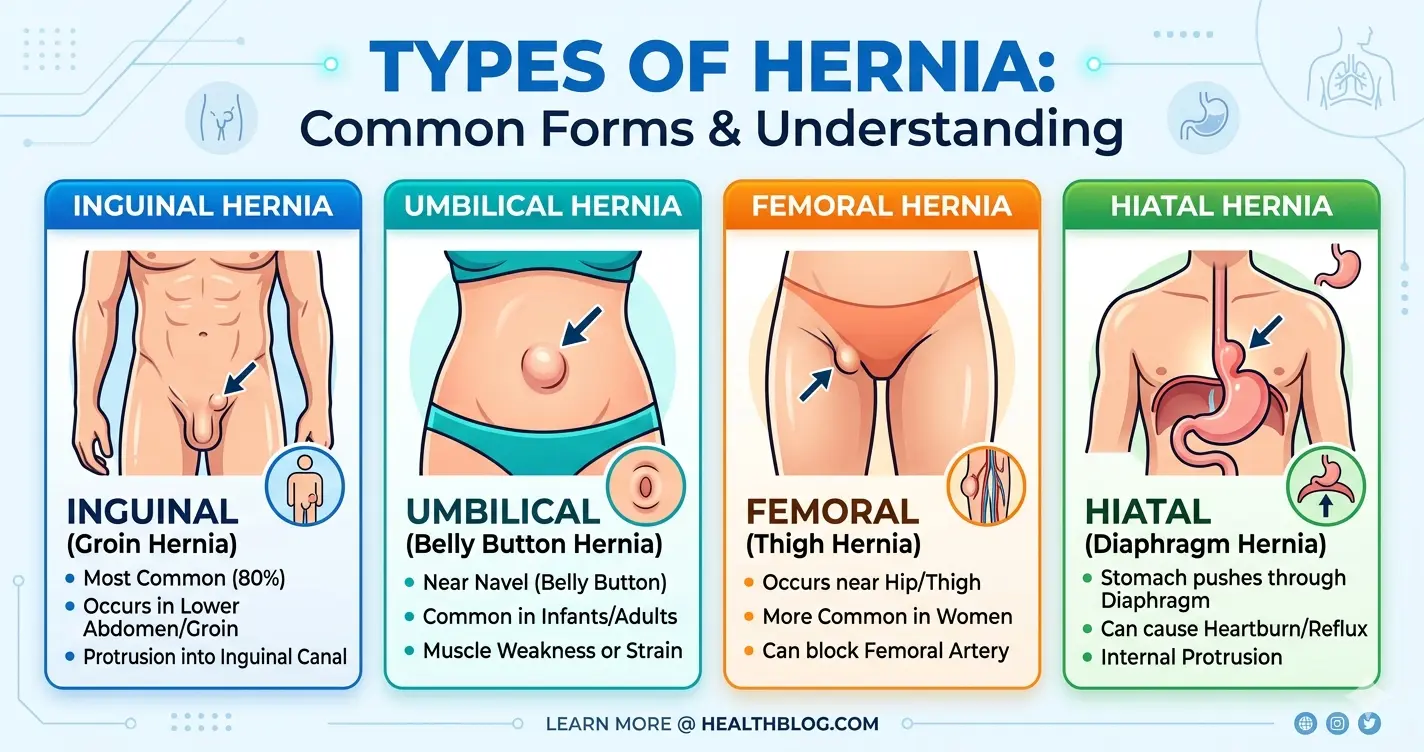
The most common types we treat in Pune include:
- Inguinal hernia — in the groin (most common, especially in men)
- Umbilical hernia — at or near the belly button
- Incisional hernia — at the site of a previous surgical scar
- Femoral hernia — just below the groin, more common in women
- Hiatal hernia — when part of the stomach pushes up through the diaphragm
- Epigastric hernia — in the upper abdomen, between the navel and chest
Each type behaves a little differently, but the symptoms — and the decision around when surgery is necessary — follow similar rules.
Hernia Symptoms You Should Recognise
Many hernias are silent at first. Some patients only feel them when they cough, sneeze, lift weights, or strain on the toilet. The classic symptoms include:
- A visible bulge or swelling in the groin, abdomen, near the navel, or near an old scar
- A bulge that becomes more obvious when standing or straining and disappears on lying down
- A dull, dragging, or heavy sensation in the affected area, especially at the end of the day
- Discomfort or aching pain with lifting, exercise, or long hours of standing
- A burning or pinching feeling at the bulge
- For inguinal hernias in men: discomfort or swelling extending into the scrotum
- For hiatal hernias: heartburn, acid reflux, chest discomfort after meals, difficulty swallowing
- A feeling of fullness, pressure, or weakness at the site
If you’re noticing any of these, you don’t need to panic — but you do need a proper surgical evaluation. Hernias don’t shrink, heal, or go away on their own. They only stay the same or get worse with time.
What Causes a Hernia in the First Place?
Hernias develop when two things meet: a weak point in the muscle wall and a force that pushes tissue through it. Common contributors include:
- A congenital weakness present from birth (the most common cause of inguinal hernias in men)
- Heavy lifting with poor technique
- Chronic cough (smokers, asthmatics, COPD)
- Chronic constipation and straining on the toilet
- Pregnancy and childbirth
- Obesity and rapid weight changes
- Previous abdominal surgery (a leading cause of incisional hernias)
- Ageing, which naturally weakens connective tissue
- Persistent strain from urinary issues such as an enlarged prostate
In my Wakad clinic, I see a clear cluster of patients who develop hernias from a combination of long sitting hours, sudden gym lifting, and chronic constipation — particularly IT professionals in their 30s and 40s.
How Hernias Are Diagnosed
A hernia diagnosis is largely clinical — meaning a trained surgeon can usually identify it through a careful physical examination, asking you to stand, cough, or strain so the bulge becomes visible. In some cases, especially when the bulge is small, intermittent, or hidden inside (like a hiatal hernia), we use:
- Ultrasound of the abdominal wall or groin — quick, painless, and very accurate for soft-tissue hernias
- CT scan — for complex, recurrent, incisional, or suspected internal hernias
- MRI — when the diagnosis is unclear, particularly for sportsman’s hernia or pelvic floor weakness
- Endoscopy — for confirming hiatal hernias and ruling out reflux complications
A proper diagnosis matters because it tells us not just if you have a hernia, but the type, size, contents, and risk profile — all of which guide whether surgery is needed.
When Is Hernia Surgery Necessary? The 5 Clear Indications
This is the heart of the question. Here’s the honest, evidence-based answer.
1. The hernia is symptomatic
If your hernia is causing pain, dragging, heaviness, burning, or interfering with daily activities — work, walking, exercise, sleep, or sex — surgery is generally indicated. Symptoms rarely improve on their own; they tend to slowly intensify.
2. The hernia is enlarging
A hernia that’s clearly bigger than it was six months ago is a strong indication for repair. Larger hernias are technically harder to repair, more painful to recover from, and carry higher complication risk if left for years.
3. The hernia is a femoral, incisional, or large umbilical hernia
These types have a higher risk of complications and are usually advised for elective repair even if symptoms are mild. Femoral hernias in particular have a high strangulation rate and should not be watched.
4. The hernia content cannot be pushed back (irreducible)
If the bulge no longer goes back inside — even when you lie down — the hernia is “incarcerated”. This needs surgical repair on a planned, urgent basis to prevent the next, more dangerous stage.
5. The hernia is causing complications
Bowel obstruction symptoms (vomiting, bloating, no passage of stool or gas), severe pain, redness over the bulge, fever, or skin discolouration mean strangulation is possible. This is a true surgical emergency.
When Is “Watchful Waiting” Reasonable?
Not every hernia needs immediate surgery. Watchful waiting — where we monitor instead of operating — can be a reasonable choice for:
- A small, painless inguinal hernia in an older patient with significant other health issues
- A very small umbilical hernia in an infant (most close on their own by age 4–5)
- Patients who are temporarily unfit for surgery (active infection, uncontrolled diabetes, recent heart event)
That said, even for these patients, recent international studies show that most will eventually need surgery within 5 to 10 years. So watchful waiting is a delay, not a cure. It must be done with regular check-ups so we can intervene before complications develop.
Red-Flag Warning Signs — Go to the Hospital Immediately
Stop reading and call the hospital if you (or someone you love with a known hernia) experience:
- A bulge that suddenly becomes firm, dark, red, or extremely tender
- Severe, sudden abdominal pain that doesn’t ease with rest
- Vomiting, especially with abdominal swelling
- No passage of stool or gas for several hours along with bloating
- Fever with hernia pain
- A previously reducible hernia that suddenly cannot be pushed back
These can mean strangulated hernia — the blood supply to the trapped tissue is cut off. Without surgery within hours, the affected bowel can die, leading to a life-threatening emergency. This is one of the very few situations in general surgery where every hour counts.
Sharvari Hospital is equipped for emergency hernia care. Call +91 951 951 1928 without delay if any of these red flags appear.
Treatment Options at Sharvari Hospital
Once we decide surgery is needed, the next question is which surgery. The good news is that hernia repair has come a long way from the painful, large-incision operations of the past. At Sharvari Hospital, Wakad, we focus on minimally invasive, advanced techniques chosen based on your hernia type, size, age, and lifestyle.
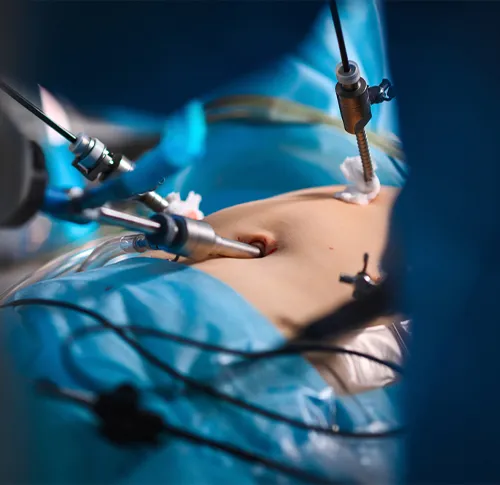
- Laparoscopic hernia repair (TEP / TAPP) — keyhole surgery using 2–3 small (5–10 mm) cuts. Mesh is placed from inside to reinforce the weak area. Less pain, smaller scars, faster return to work, lower recurrence rate. Day-care possible in many cases.
- Open mesh hernia repair (Lichtenstein) — a single small cut over the hernia, with a tension-free mesh placed to seal the defect. Reliable, well-studied, and ideal for some patient profiles.
- Robotic-assisted hernia repair — for selected complex or recurrent hernias, where greater precision is needed.
- Component separation and complex ventral hernia repair — for large incisional or recurrent hernias that require advanced reconstruction.
Whichever approach we choose, the goal is the same: a strong, durable repair, the least possible pain, and the fastest safe return to your normal life.
Recovery and Lifestyle After Hernia Surgery
Most of my laparoscopic hernia patients walk a few hours after surgery and go home the same day or the next morning. Here’s a realistic picture of recovery:
- Days 1–3: Mild soreness around the cuts. Walk regularly. Soft, fibre-rich diet to avoid constipation.
- Days 4–7: Return to office desk work for most patients. Avoid heavy lifting.
- Weeks 2–4: Resume light activity, walking, and most household tasks. Driving usually fine after 1–2 weeks.
- Weeks 4–6: Gradual return to gym and heavier work. No sudden heavy lifting before 4 weeks.
- Long term: With a properly placed mesh, recurrence is very low (under 2–5% in most series).
To support healing, focus on hydration, fibre (to avoid straining), gentle walking, and quitting smoking — smoking is one of the strongest risk factors for hernia recurrence.
When to See a Doctor
Don’t wait for an emergency. Book a surgical consultation if you have:
- Any new bulge in the groin, abdomen, or near a previous surgery scar
- Recurring discomfort, pulling, or heaviness in these areas
- Symptoms that worsen with cough, lifting, or straining
- A previously diagnosed hernia that’s growing, becoming painful, or harder to push back
- New onset reflux or chest discomfort that may suggest a hiatal hernia
The earlier we evaluate, the smaller and simpler the operation tends to be — and the smoother your recovery.
Why Choose Sharvari Hospital for Hernia Care in Pune
Sharvari Hospital, Wakad/Pimple Nilakh, is led by Dr. Kundan Kharde (MBBS, MS, FMAS) — a fellowship-trained minimal access and general surgeon with 19+ years of clinical experience. Patients across Wakad, Hinjewadi, Aundh, Baner, Pimple Saudagar, and Pimpri-Chinchwad choose us because of:
- Advanced laparoscopic and robotic-ready hernia repair facility
- Personalised surgical planning — not a one-size-fits-all template
- Day-care surgery for most uncomplicated hernias
- Transparent, all-inclusive pricing with cashless insurance support
- Low recurrence rates through proper mesh selection and technique
- 240+ Google reviews from real patients
- Tagline we live by — Precise Surgery, Swift Recovery
Book Your Hernia Consultation
📞 Phone / WhatsApp: +91 951 951 1928 ✉️ Email: [email protected] 📍 Address: Sharvari Hospital, Wakad / Pimple Nilakh, Pune — 411027 🌐 Website: sharvarihospital.com
You don’t have to live with the worry of “what if it gets worse?” — a 20-minute consultation can give you clarity, a clear treatment plan, and peace of mind.
Frequently Asked Questions (FAQ)
Can a hernia heal without surgery?
No. Once the muscle wall has a true defect, it cannot heal back on its own in adults. Belts, exercise, and weight loss may reduce symptoms temporarily, but the only definitive treatment is surgical repair. The one exception is small umbilical hernias in infants, which often close naturally by age 4–5.
How do I know if my hernia is an emergency?
Sudden severe pain, vomiting, a bulge that becomes hard, dark, or extremely tender, fever, or inability to push the hernia back in are red-flag signs of a strangulated hernia. This is a surgical emergency — go to a hospital immediately.
Is laparoscopic hernia surgery better than open surgery?
For most patients, yes — it offers smaller cuts, less post-operative pain, faster recovery, lower wound infection rates, and the ability to repair both sides through the same small incisions. However, the best technique depends on your specific case. We recommend the option that gives you the strongest long-term result.
How soon can I return to work after hernia surgery?
Desk-job patients typically return to work within 4–7 days after laparoscopic repair. Jobs involving heavy lifting usually require 4–6 weeks before full duty. Dr. Kharde will give you a personalised timeline at your follow-up.
Will the hernia come back after surgery?
With modern mesh-based repair done by an experienced surgeon, recurrence rates are very low — typically 2–5%. Maintaining a healthy weight, treating chronic cough or constipation, and avoiding sudden heavy lifting in the first 6 weeks all help prevent recurrence.
How much does hernia surgery cost in Pune?
The cost depends on the type of hernia, surgical approach (open vs laparoscopic vs robotic), mesh used, and your hospital stay. At Sharvari Hospital we offer transparent pricing and cashless insurance support — please call +91 951 951 1928 for a clear estimate based on your case.
Medically reviewed by Dr. Kundan Kharde, MBBS, MS (General Surgery), FMAS — Lead Surgeon, Sharvari Hospital, Pune.