If you notice pain, swelling, or drainage near your bottom, it is easy to mix up pilonidal sinus and anal fistula. Both can cause repeat infections and frustration. But they start in different places and usually need different plans. This guide explains the differences in plain language—similar to how major hospitals explain symptoms to patients—so you know what to tell your doctor and what to expect next. For anal fistula care in Pune, see our fistula treatment hub. You can also book an appointment online or learn more about proctology services. Meet the reviewing specialist: Dr. Kundan Kharde.
Medically reviewed by Dr. Kundan Kharde, MS, FMAS — Senior Proctologist at Sharvari Hospital, Pune. View profile.
Two different problems, similar frustration
Pilonidal disease most often affects the natal cleft—the vertical groove between the buttocks, usually higher up near the tailbone area. Anal fistula is a tunnel that connects an inside opening near the anal canal to an outside opening on the skin around the anus. Because both can drain pus or fluid, people sometimes assume they are the same illness.
Why patients confuse them
Discharge, odour, pain with sitting, and repeat “boils” can look alike on casual inspection. Without a careful exam, it is also easy to assume every problem “down there” is a piles or fistula issue. Location and examination findings are the main clues—not internet photos.
Why the right diagnosis matters
Treatment that fits pilonidal disease (for example, midline wound care or specific excision approaches) is not the same as treatment for a cryptoglandular fistula (where surgeons map a tract related to anal glands). Using the wrong mental model can delay the right procedure or wound instructions. When in doubt, a surgeon or proctologist can examine you and explain what they see.
Where each condition occurs (the biggest clue)
Natal cleft / upper buttock midline
Pilonidal problems usually sit in the midline of the upper buttock cleft. Patients often report a tender lump, repeated abscesses, or small pits in that line. Hair friction, deep cleft anatomy, and local skin inflammation play a role in how pilonidal disease behaves—major patient education sites describe it as a problem of the skin and natal cleft, not a tunnel from the anal canal in the classic fistula sense.
Perianal area near the anus
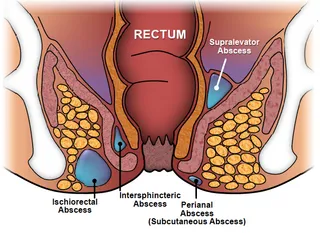
An anal fistula typically has an external opening on the perianal skin within a few centimetres of the anal opening, often with a history of a prior perianal abscess that was drained. The internal opening is usually related to an anal gland crypt. Educational materials from centres like Mayo Clinic and NHS emphasise this perianal anatomy when they describe fistula symptoms.
Typical symptoms compared
Pain with sitting vs pain with bowel movement patterns
Pilonidal pain often worsens with prolonged sitting or pressure on the cleft; a flare can feel like a deep boil. Fistula pain may track with abscess episodes, bowel habits, or irritation at the external opening; some people feel relatively little pain between flares but notice ongoing discharge. Neither symptom pattern is 100 percent specific, which is why exam matters.
Drainage and flare-up triggers
Both conditions can produce pus or bloody fluid. With a fistula, drainage may be more chronic or intermittent from a small opening near the anus. With pilonidal disease, drainage may follow repeated midline abscesses. Fever and spreading redness are warning signs for either condition and should prompt urgent care.
Causes in plain language
Hair follicles, friction, and pits (pilonidal)
Pilonidal disease is often explained as ingrown hairs, blocked pores, or small pits in the natal cleft that trap debris and bacteria. Young adults are commonly affected. Lifetime risk figures in medical literature vary, so it is fair to say it is fairly common in certain age groups rather than quoting a single precise statistic.
Glands, abscess, and fistula tracts (anal)
Most anal fistulas in people without inflammatory bowel disease form after infection in the anal glands, which may start as a perianal abscess. If the infection creates a tunnel to the skin, a fistula remains after the acute swelling settles. This pathway is different from midline natal cleft skin disease.
How doctors tell them apart
Examination findings
Your doctor will look at exactly where the opening sits, whether there are multiple pits in the cleft, and whether the problem lines up with the anal verge. They may gently probe to understand tract direction (this is not something to try at home). The history—prior abscess drainage, chronic drainage site, pain location—also helps.
When imaging helps
Ultrasound or MRI is sometimes used when the anatomy is unclear, there are branches, or surgery planning needs detail. For anal fistulas, imaging is routine: almost every fistula patient at Sharvari Hospital is imaged before surgery — an MRI fistulogram or a trans-rectal ultrasound — because the exam alone does not give a safe map.
Treatment paths (high level)
Options for pilonidal disease
Mild cases may be managed with hygiene, hair control (as advised), and treatment of acute infection. Abscesses may need incision and drainage. Definitive options can range from excision procedures to minimally invasive techniques depending on your pattern of disease and surgeon judgement. The key point: the plan targets the natal cleft problem. Learn more about laser pilonidal sinus treatment at Sharvari Hospital.
If a pilonidal sinus has already been operated once and has come back — or the wound never fully healed — the assessment changes completely, and minimally invasive options are often no longer the right answer. That situation is covered in detail in recurrent pilonidal sinus after failed surgery.
Options for anal fistula
Anal fistula care depends on how much muscle the tract involves. Options can include fistulotomy for suitable low tracts, setons, flaps, LIFT, video-assisted approaches, or laser techniques in selected cases—always matched to mapping and continence risk. Read the full picture on our fistula treatment Pune page.
Myths that lead to wrong self-diagnosis
Some people assume every painful lump near the buttocks is a “fistula” because they read the word online. Others call every chronic draining spot a “piles problem.” In real clinics, location and exam decide the label. Another myth is that odour alone proves one diagnosis—both infected pilonidal flares and infected perianal fistulas can smell unpleasant. A third myth is that antibiotics will permanently fix either condition without addressing the underlying anatomy; antibiotics may help infection episodes, but established tracts often still need a procedural plan once your surgeon has mapped them safely.
When to seek urgent care (either condition)
Go urgently if you have fever, spreading redness, severe pain, dizziness, or difficulty passing urine. These can be signs of a deeper infection or abscess that needs prompt drainage and medical support. Do not delay emergency care because you are unsure whether the problem is pilonidal or fistula—the first step is still safe assessment.
If you live in Pune: coordinated care
When to ask for proctology review
See a specialist if you have repeat abscesses, chronic drainage, or unclear diagnosis. Early mapping reduces surprises in surgery. Our proctology team handles anorectal conditions in a structured way.
Links to booking and our fistula guide
Use book online to schedule a visit. For fistula-specific education and services, start at fistula treatment Pune. You can also read about Dr. Kundan Kharde and the Sharvari Hospital approach.
Common questions (FAQ)
Is pilonidal sinus a fistula?
Pilonidal sinus is not the same as an anal fistula. Pilonidal disease is centred in the natal cleft and follows different rules. An anal fistula is a tract that connects the anal canal region to the perianal skin in typical cases.
Can pilonidal cyst be near the anus?
It is usually in the upper gluteal cleft midline, not at the anal verge. Unusual locations can occur, but your surgeon distinguishes problems by exam and history—not by guesswork.
Does pilonidal sinus smell like fistula?
Infected drainage from either problem can have an odour. Smell alone cannot diagnose the condition; location, exam, and sometimes imaging are needed.
Which doctor treats pilonidal sinus?
General surgeons and colorectal surgeons commonly treat pilonidal disease. Some patients are also seen in proctology or wound-care pathways depending on the centre.
Is pilonidal surgery same as fistula surgery?
No. The incisions, wound care, and goals differ. Mixing the two diagnoses can lead to the wrong expectations for healing time and activity limits.
Sources
- Mayo Clinic — Pilonidal cyst: https://www.mayoclinic.org/diseases-conditions/pilonidal-cyst/symptoms-causes/syc-20376329
- Mayo Clinic — Anal fistula overview: https://www.mayoclinic.org/diseases-conditions/anal-fistula/symptoms-causes/syc-20351345
- NHS — Pilonidal sinus: https://www.nhs.uk/conditions/pilonidal-sinus/
- Cleveland Clinic — Pilonidal cyst: https://my.clevelandclinic.org/health/diseases/pilonidal-disease
- American Society of Colon and Rectal Surgeons — Anal abscess and fistula (patient): https://fascrs.org/Web/Web/Patients/Diseases-and-Conditions/A-Z/Abscess-and-Fistula-Expanded-Information.aspx