Choosing between minimally invasive and traditional surgery can feel confusing.
Both methods are valid. The right choice depends on your diagnosis, risk profile, and surgical goals.
What minimally invasive surgery means
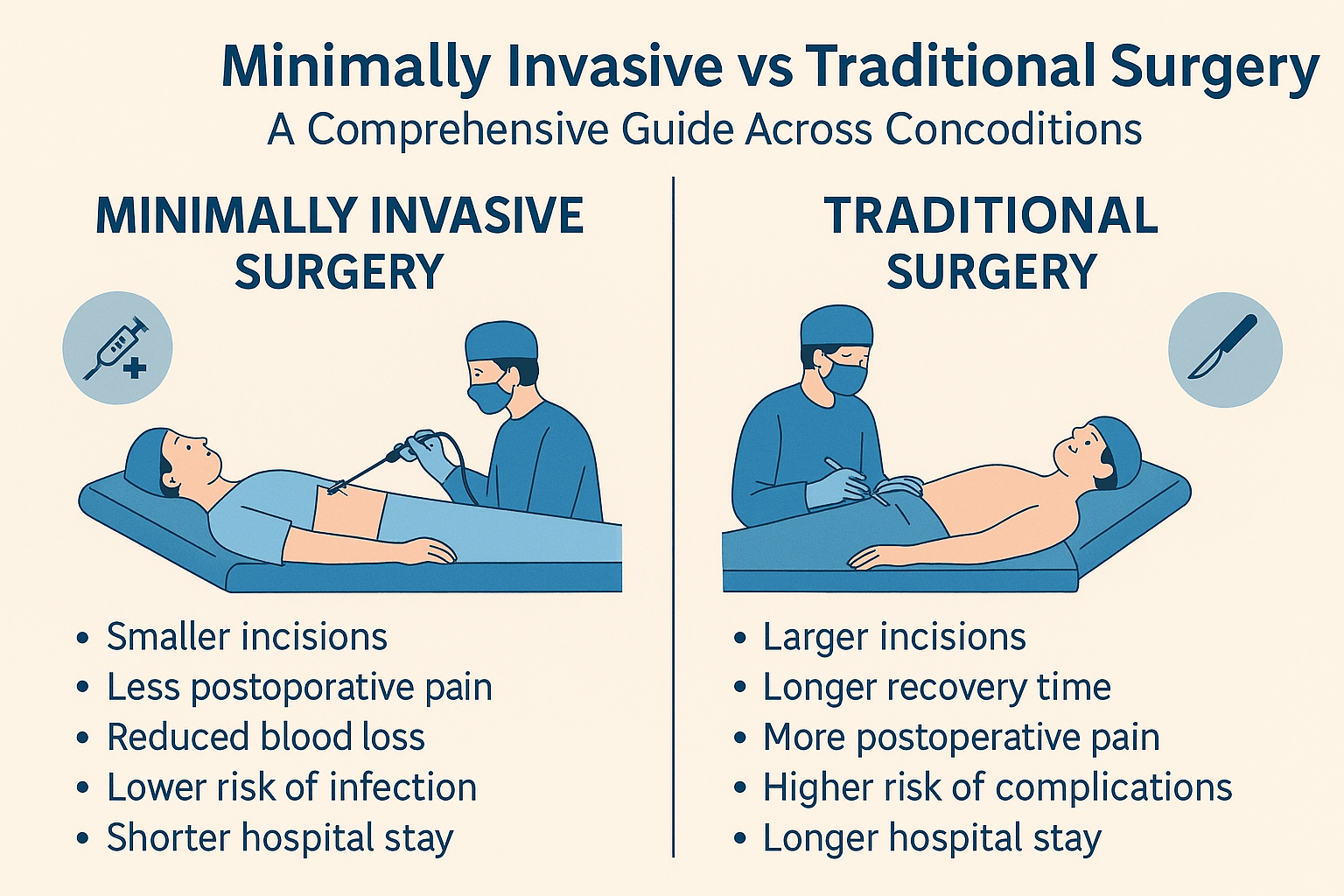
Minimally invasive surgery uses small cuts, camera guidance, and precision instruments. It may be laparoscopic, endoscopic, or laser-based, depending on the condition.
Common advantages include:
- Less blood loss
- Smaller scars
- Lower pain after surgery
- Shorter hospital stay
- Earlier return to daily activity
What traditional open surgery means
Traditional surgery uses a larger incision so the surgeon can directly access the operative area.
This approach is still essential in many situations, especially when:
- Disease is extensive or anatomy is complex
- There is severe infection, bleeding, or emergency trauma
- Large masses must be removed safely
- Minimally invasive access is not technically safe
Condition-wise comparison
Below is a practical overview of minimally invasive vs traditional surgery in common specialties.
Proctology: piles, fissure, fistula
Minimally invasive options often provide faster comfort and earlier mobility in selected patients.
Open procedures may still be needed for recurrent or complex disease where wider exposure is safer.
Hernia surgery
Laparoscopic repair usually supports faster recovery and earlier return to work.
Open repair remains important in very large, complicated, or strangulated hernias.
Gallbladder surgery
Laparoscopic cholecystectomy is the standard for most symptomatic gallbladder stone cases.
Open conversion may be required if there is dense inflammation or distorted anatomy.
Orthopedic procedures
Arthroscopy helps in many ligament and joint problems with smaller incisions.
Open surgery is still needed for fractures, major reconstructions, and some joint replacements.
Gynecology procedures
Laparoscopic and vaginal approaches can reduce pain and hospital stay in selected women.
Open abdominal surgery is preferred when complexity or cancer-related factors demand broader access.
How doctors choose the best approach
Your surgeon evaluates more than one factor before recommending a plan:
- Exact diagnosis and stage
- MRI/CT/ultrasound findings
- Prior surgeries and scar tissue
- Age, diabetes, heart and lung status
- Recovery needs at home and work
The goal is not to choose the “latest” method. The goal is to choose the safest method for your body.
Questions to ask during consultation
Use this checklist before deciding:
- Am I a candidate for minimally invasive surgery?
- If not, why is open surgery safer for me?
- What is the expected pain and recovery timeline?
- What are the risks of each option in my case?
- How soon can I return to work and routine activity?
Final takeaway
The discussion is not minimally invasive vs traditional surgery as a competition. It is about personalized care.
At Sharvari Hospital, treatment planning is based on safety, long-term outcomes, and realistic recovery expectations. When patients understand why a technique is chosen, confidence and recovery both improve.