

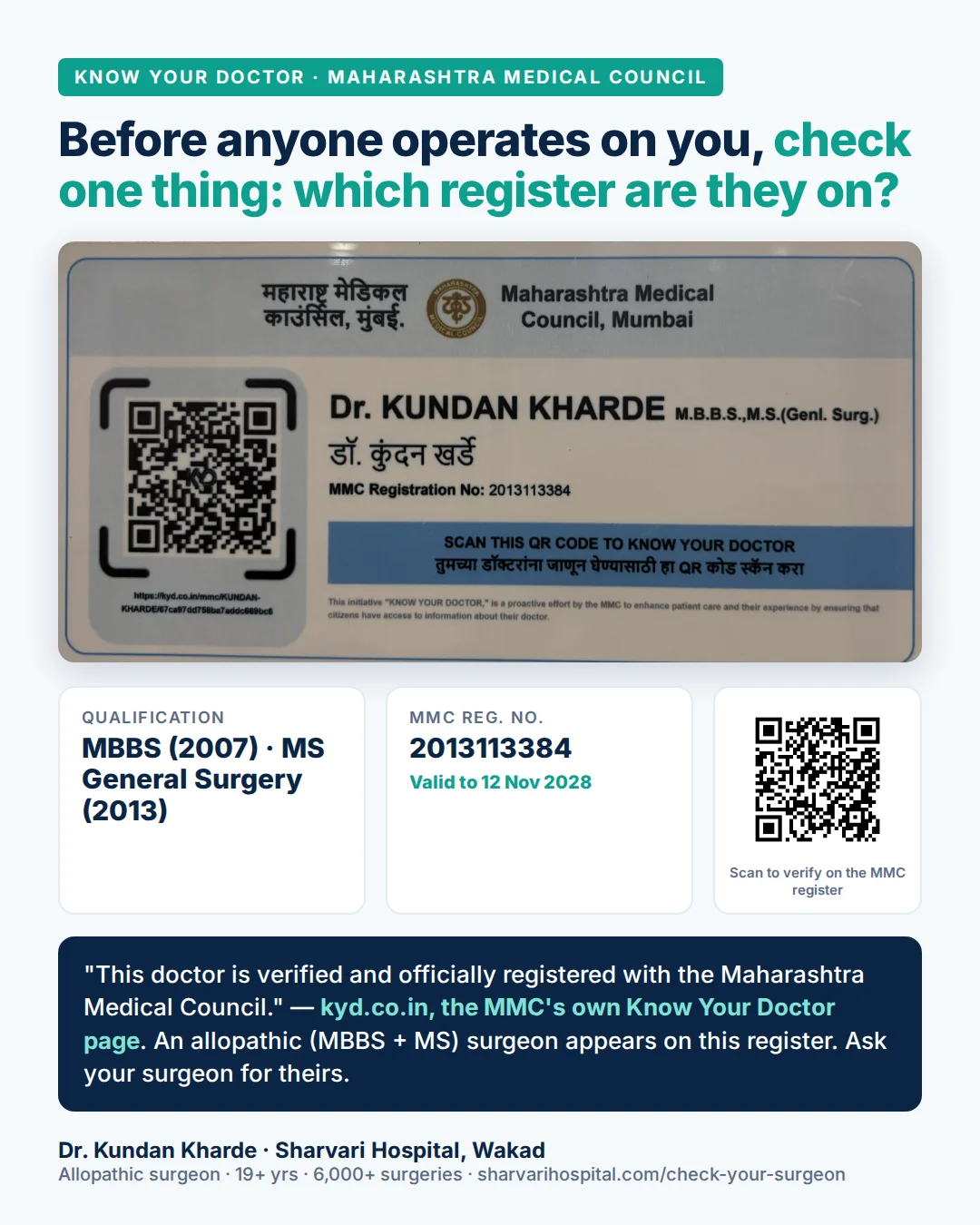
Piles, fistula, fissure and hernia surgery are among the most common operations in Pune, and most people choose their surgeon on a recommendation, a search result or an advertisement. None of those tells you what the person operating on you is qualified to do. The public register does — and checking it takes about a minute. This guide gives you the three questions to ask, explains which register is which, walks through the searches step by step, and uses Dr. Kundan Kharde’s own entry as a worked example.
Medically reviewed by Dr. Kundan Kharde, MBBS, MS (General Surgery), FMAS — Founder & Director, Sharvari Hospital, Pune. 19+ years, 6,000+ surgeries. Maharashtra Medical Council Reg. No. 2013113384. View profile · Check your surgeon.
The three questions
Ask these in the consultation, before any date is booked. A qualified surgeon answers all three without hesitation.
- What is your qualification, in full — MBBS? MS (General Surgery)? Ask for the full degree names and the college that awarded them, not just the initials on the board outside.
- Which council are you registered with, and what is your registration number? Every practising doctor in India has one. It is public, and it is the key to the register search below.
- Will you personally perform the operation? The person you consult and the person who operates should be the same, and should say so plainly.
Write the answers down. The rest of this guide is about checking them.
Which register?
In India, doctors practising modern (allopathic) medicine — MBBS, MS, MD — are registered with a State Medical Council such as the Maharashtra Medical Council (MMC) or the National Medical Commission. Practitioners of Ayurveda, Unani and Siddha (BAMS, MS-Ayurveda/Shalya Tantra) are registered with the Maharashtra Council of Indian Medicine, and homeopathy (BHMS) with the Maharashtra Council of Homoeopathy. These are separate systems of medicine with separate councils and separate registers. ‘MS’ can be a degree in either system, so the register — not the initials — tells you which system your surgeon trained in.
That last point is the reason the register matters more than the name board. The initials tell you a degree was awarded; the register tells you by which system, and confirms that the person in front of you is the person on the record.
What MBBS and MS training involves
For context, here is what the two modern-medicine qualifications in question actually represent.
- MBBS (Bachelor of Medicine, Bachelor of Surgery) is a five-and-a-half-year programme: four and a half years of study across anatomy, physiology, pharmacology, pathology, medicine, surgery, obstetrics and the other clinical subjects, followed by a compulsory one-year rotating internship in a teaching hospital. Completing it, and passing the university examinations, is the qualification for entry on a State Medical Council’s register.
- MS (General Surgery) is a three-year postgraduate residency taken after MBBS. The resident works in a surgical department under supervision, operates with graded independence, sits university examinations, and submits a thesis. It is the degree that qualifies a doctor as a general surgeon in modern medicine.
Together, that is at least eight and a half years of formal training before a surgeon practises independently. Fellowships such as FMAS (Fellowship in Minimal Access Surgery) come on top of the MS and cover laparoscopic and other minimally invasive techniques.
Step by step: searching the registers
You need the doctor’s name as it appears on their certificates and, ideally, the registration number they gave you.
1. Maharashtra Medical Council (modern medicine — MBBS, MS, MD)
- Open maharashtramedicalcouncil.org.in/doctors (the older
www.maharashtramedicalcouncil.inaddress redirects here). The menu item is Doctor Search. - Search by name or by registration number.
- On the result, read three fields: the name, the qualification listed, and the registration number and date. They should match what the doctor told you.
The MMC also issues Know Your Doctor (KYD) pages — a per-doctor verification page with a QR code that registered practitioners can display in their clinic. Scanning it opens the council’s record directly.
2. National Medical Commission — Indian Medical Register (all states)
- Open the Indian Medical Register.
- Search by name, and narrow by state council or registration number if the name is common.
- Check the qualification and the state council shown.
The NMC register consolidates the State Medical Council registers, so a doctor on the MMC register should also appear here.
3. Maharashtra Council of Indian Medicine (Ayurveda, Unani, Siddha — BAMS, MS-Ayurveda)
- Open mcimindia.co.in/FindDoctor.
- Search by name or registration number.
- Check the qualification and registration details shown.
Whichever register the doctor is on, the check is the same three things: name, qualification, council. If they match what you were told, question two is answered.
A worked example: Dr. Kundan Kharde
Here is what the check looks like for the surgeon who operates at Sharvari Hospital.
| Question | Answer |
|---|---|
| Name on register | Dr. Kundan Ashok Kharde |
| Qualification | MBBS (2007, I.M. Sechenov Moscow Medical Academy); MS General Surgery (2013, Dr. D. Y. Patil Medical College, Pimpri, Pune); FMAS |
| Council | Maharashtra Medical Council — allopathic / modern-medicine register under the Maharashtra Medical Council Act |
| Registration number | 2013113384 |
| Registered | 12/11/2013 · valid to 12/11/2028 |
| Who operates | He examines and operates personally. |
His MMC Know Your Doctor page — kyd.co.in/mmc/KUNDAN-KHARDE/67ca97dd758ba7addc669bc6 — states: “This doctor is verified and officially registered with the Maharashtra Medical Council (MMC).”
You can repeat the search yourself on the MMC register using the name or the number above. The card, the QR code and the facts are also on our Check your surgeon page and on Dr. Kharde’s profile.
What to do with the answers
If all three questions are answered and the register agrees, you know who is operating and what they are qualified to do. From there the conversation can move to what actually matters clinically: the diagnosis, the options, the expected recovery and the cost. If a question is deflected, or the register does not match, ask again — politely, and before any date is fixed. It is your body and your right to know.
For the surgical conditions we treat most often, see the pillar pages for piles, fistula, fissure and hernia, or book a consultation at Sharvari Hospital, Pimple Nilakh, Pune.
Sources
- Maharashtra Medical Council — Doctor Search: https://maharashtramedicalcouncil.org.in/doctors
- National Medical Commission — Indian Medical Register: https://www.nmc.org.in/information-desk/indian-medical-register/
- Maharashtra Council of Indian Medicine — Find Doctor: https://mcimindia.co.in/FindDoctor
- MMC Know Your Doctor — Dr. Kundan Kharde: https://kyd.co.in/mmc/KUNDAN-KHARDE/67ca97dd758ba7addc669bc6