Case studies · Piles · De-identified
Case study: Grade 4 prolapsed piles, 10 years of symptoms, treated with stapler haemorrhoidopexy (MIPH)
A man in his fifties lived with piles that came out and bled for about ten years before coming in. By then they were Grade 4 — permanently outside and impossible to push back. This case shows what that looks like, why a stapler was chosen over laser or open surgery for this particular anatomy, and what the anal verge looked like on the table immediately afterwards.
This page contains explicit surgical photographs of the anal region. The pre- and post-operative images are blurred until you choose to view them.
Presentation
A man in his fifties came to Sharvari Hospital, Pimple Nilakh, with two complaints he had carried for roughly ten years: a swelling that came out of the anal region, and bleeding per rectum that came and went. In the early years the swelling went back in on its own after passing stool. Later he had to push it back with a finger. For the last stretch it stayed out all the time, with mucus, soiling and a constant feeling of something sitting at the anus.
Ten years is not unusual. People wait because piles are embarrassing to talk about, because the bleeding stops for months at a time, because a cream or a course of tablets from a pharmacy gives short relief, and because they fear a painful operation. Each of those pauses lets the prolapse advance one grade. By the time the swelling no longer goes back, medicines have nothing left to offer.
Examination and grading

On examination the haemorrhoidal cushions were prolapsed all the way around the anal canal — a circumferential prolapse — and they could not be pushed back inside. That is the definition of Grade 4 in the Goligher classification: permanently prolapsed, irreducible. Grade 3 piles come out on straining and go back with a finger; Grade 4 piles stay out.
The photograph shows what a Grade 4 circumferential prolapse looks like before surgery: the red, congested haemorrhoidal tissue sitting outside the anal verge, with the individual cushions and the grooves between them still visible. Those grooves matter — they separate prolapsed piles from a full-thickness rectal prolapse, which protrudes as concentric rings and needs an entirely different operation.
Examination and proctoscopy are used to confirm that the bleeding is coming from internal haemorrhoids and to rule out a fissure, a fistula or any other cause before anything is planned. With that confirmed and routine pre-anaesthetic assessment complete, surgery was scheduled.
Why stapler haemorrhoidopexy (MIPH) for this case
Three operations are realistic for Grade 4 piles: stapler haemorrhoidopexy (MIPH), laser with mucopexy, and open or energy-device haemorrhoidectomy. The choice is made from the anatomy on the table, not from a menu.
What the stapler does. A circular stapler removes a ring of redundant lower-rectal mucosa about 3–4 cm above the anal verge — above the pain-sensitive skin of the anal canal — and staples the edges back together. That lifts the prolapsed cushions back to their normal position inside the canal and, at the same time, interrupts the feeding vessels so the piles shrink. Nothing is cut at the anal verge, so there is no external wound.
Why it suited this patient. The prolapse was circumferential — the whole ring had come down together, which is exactly the pattern a circular stapler addresses. The anatomy that suits a stapler, and the reason it was chosen here, is a prolapse made up mainly of internal haemorrhoidal cushion that reduces under anaesthesia, without a large fixed external component and without thrombosis.
The trade-off, stated plainly. Stapler haemorrhoidopexy causes less post-operative pain than open haemorrhoidectomy, but it carries a higher rate of prolapse recurrence than haemorrhoidectomy, so it is chosen only when the anatomy suits it. Where the external component is large, or the disease is thrombosed or recurrent, a haemorrhoidectomy is the more durable operation and is what we advise, even though it hurts more in the first week.
Why not laser. Laser haemorrhoidoplasty shrinks haemorrhoidal tissue from inside but does not lift a large prolapse. It suits selected Grade 2–3 piles. A circumferential Grade 4 prolapse is beyond what laser alone can hold, and offering it would have set this patient up for the "I had a procedure but it came back" story we hear from second-opinion patients every week.
In the operating theatre
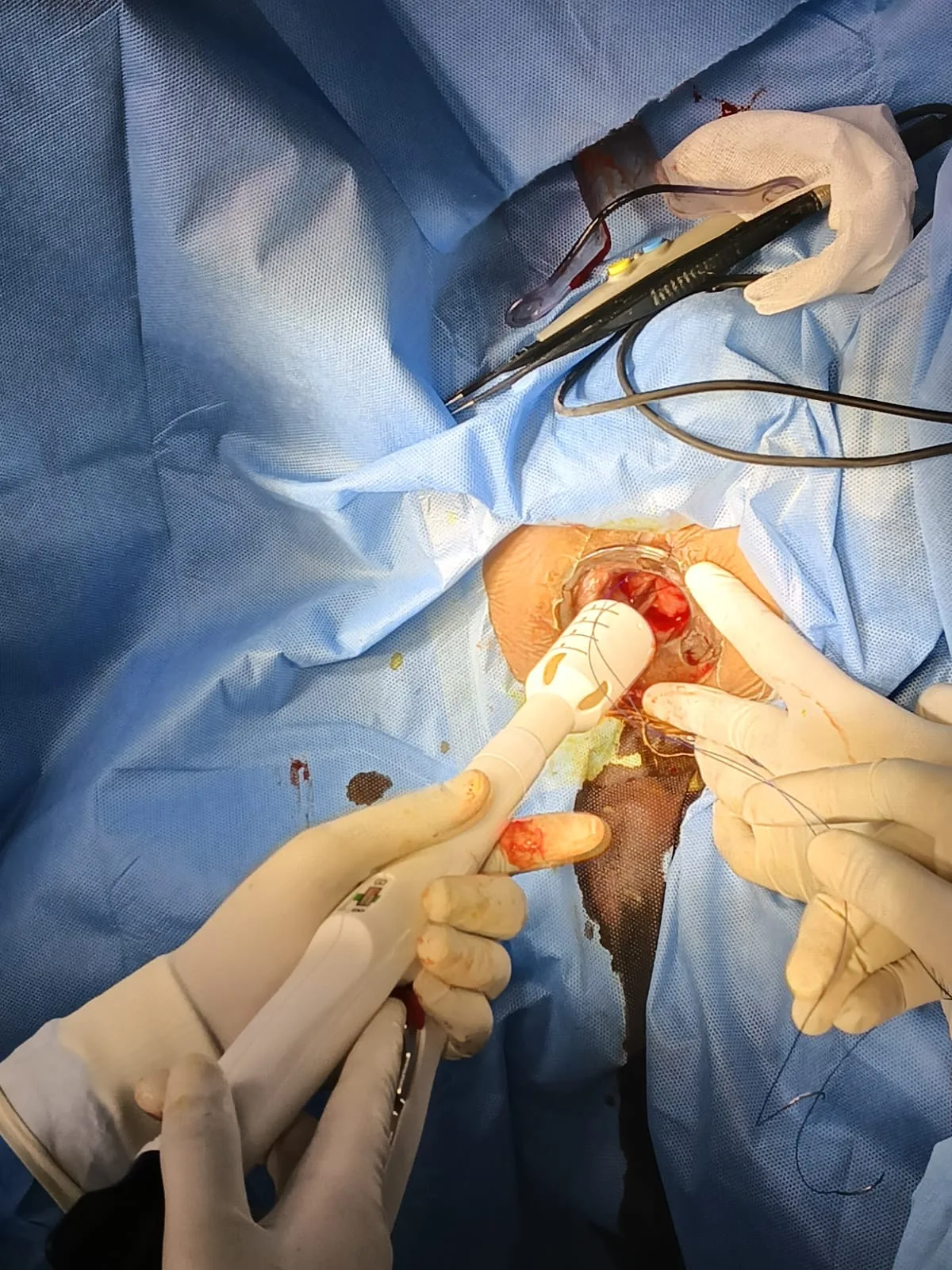
Under anaesthesia, a circular anal dilator is placed and the prolapse reduced. A purse-string suture is taken in the rectal mucosa above the piles, all the way round. The head of the circular stapler is passed above the purse-string, the suture is tied down to draw the redundant mucosa into the stapler housing, and the instrument is closed and fired.
The photograph shows that moment in this case: the stapler seated in the anal canal, being fired. In one action it cuts out the ring of excess mucosa and lays a double row of titanium staples across the join. The staple line is then inspected and any bleeding point secured with a suture before the instrument is withdrawn.
Immediately after surgery

This photograph was taken on the table, minutes after the stapler was removed. Compare it with the pre-operative image: the ring of prolapsed tissue that sat outside the anus has been drawn back inside, and the anal verge is restored to its normal position. There is no cut on the skin of the anal verge and no external wound to dress — the staple line lies inside, above the sensitive part of the canal.
That absence of an external wound is the reason stapler patients generally have less pain in the first days than patients after open haemorrhoidectomy, where the wounds sit at the anal verge and are touched by every bowel movement — with the caveat, repeated from above, that the stapler carries a higher prolapse-recurrence rate than haemorrhoidectomy.
Recovery
The patient was discharged the next day with a stool-softening regimen, oral pain relief, sitz-bath instructions and a review appointment.
The general guidance after stapler haemorrhoidopexy is the same for every patient: keep the stool soft so the first few bowel movements do not strain the staple line, expect some urgency or a feeling of fullness for a while as the rectum settles, avoid heavy lifting in the early weeks, and return to desk work when comfortable — usually sooner than after open surgery, later than after a laser procedure. Timelines vary from person to person and no figure is promised. Any fresh heavy bleeding, fever, inability to pass urine or severe pain is a reason to call the hospital, which is open 24×7.
The general week-by-week pattern is described in recovery after piles surgery — day-by-day timeline.
What this case shows
Ten years of "it goes back in" quietly became a Grade 4 prolapse that no medicine could touch. A circumferential, mainly internal prolapse that reduced under anaesthesia is the anatomy a stapler is designed for, and choosing it here — while accepting its higher prolapse-recurrence rate compared with haemorrhoidectomy — gave a lifted anal verge with no external wound and discharge the next day. The same swelling with a large external component or thrombosis would have been treated with haemorrhoidectomy instead, which is why the decision is always made at examination, not from a photograph.
Consent and privacy
This case is published for patient education with the patient’s written consent. No name, patient identifier, date of admission, report or hospital number is shown; age is given only as a decade. The clinical photographs are cropped to the operative field so that no identifying feature is visible, and the pre- and post-operative images are blurred until a visitor chooses to view them. Social-media previews of this page use only a blurred image. Every case study on this site follows the same rule: the anatomy and the decision are shared, the person is not.
Do your piles stay outside? Get them graded
Piles that no longer go back in will not respond to creams or tablets. An examination tells you the grade, which operation the anatomy suits, and a written estimate — in one visit. Call +91 951 951 1928 or WhatsApp us.
Options for prolapsed piles are compared on Grade 3 & 4 prolapsed piles treatment. All grades, symptoms and costs start at piles treatment in Pune.
Your surgeon: Dr. Kundan Kharde, MS, FMAS — Founder & Director, Lead Proctology Surgeon, Sharvari Hospital. 19+ years, 6,000+ surgeries.
SR. NO. 19(P), behind Gulmohor Park, Vishal Nagar, Pimple Nilakh, Pune 411027 · Open 24 hours · +91 951 951 1928